Knowledge What is the primary function of mechanical grinding equipment in PHBV production? Optimize Feedstock for Maximum Yield
Author avatar

Tech Team · Kintek Solution

Updated 3 weeks ago

What is the primary function of mechanical grinding equipment in PHBV production? Optimize Feedstock for Maximum Yield


The primary function of mechanical grinding is to act as a physical catalyst for biological conversion. During the PHBV pretreatment stage, this equipment breaks down agricultural waste, such as rice husks and straw, to significantly reduce particle size and increase specific surface area. This physical alteration is critical for releasing entrapped nutrients and ensuring the biomass is structurally accessible for the microorganisms required to synthesize the polymer.

Mechanical grinding transforms recalcitrant agricultural waste into a high-surface-area feedstock. By physically disrupting the material's structure, it removes barriers to nutrient extraction and enables the efficient microbial conversion of waste into essential carbon sources.

Optimizing Physical Structure for Reaction

Reduction of Particle Size

The immediate goal of mechanical grinding is the physical fragmentation of bulk agricultural waste. Raw materials like straw and husks are too large and structurally complex for efficient direct processing. Grinding equipment utilizes impact and shear forces to reduce these materials to a fine powder or small particulate form.

Maximizing Specific Surface Area

As particle size decreases, the specific surface area of the material increases exponentially. This is the most critical physical change, as chemical and biological reactions occur at the surface level. A larger surface area ensures that a greater percentage of the biomass is exposed to subsequent treatment processes rather than being locked away inside the fiber.

Facilitating Biological Availability

Releasing Entrapped Nutrients

Agricultural waste contains valuable nutrients that are often shielded by tough outer layers or complex cellular structures. Mechanical grinding physically breaks these structures open. This rupture allows for the release of nutrients that are necessary for the downstream biological or chemical extraction phases.

Enhancing Microbial Accessibility

For PHBV production, microorganisms must convert the waste into carbon sources. These microorganisms act more efficiently when the "food source" is easily accessible. By altering the physical form of the waste, grinding ensures that microbes can easily penetrate and digest the material, accelerating the synthesis of the polymer.

Understanding the Trade-offs

Energy Consumption vs. Efficiency

While mechanical grinding is effective, it relies on high-energy mechanical forces to disrupt solid structures. The energy required to grind material down to very fine mesh sizes can be substantial. Operators must weigh the benefit of increased surface area against the operational cost of the electricity required to drive the equipment.

Particle Size Distribution

Mechanical methods can sometimes yield an uneven distribution of particle sizes. While some material may be ground to the ideal fineness, other fractions may remain too coarse, leading to inconsistent hydrolysis or fermentation rates later in the process.

Making the Right Choice for Your Goal

To optimize your PHBV production line, consider how the extent of pretreatment aligns with your specific operational targets:

  • If your primary focus is maximum yield: Prioritize finer grinding to maximize specific surface area, ensuring the highest possible release of nutrients and carbon sources for microbial conversion.
  • If your primary focus is operational efficiency: Monitor the energy consumption of the grinding stage; stop size reduction once the material is sufficiently accessible to microbes, as further grinding offers diminishing returns.

The goal is not just to crush the material, but to engineer a feedstock that allows your biological agents to thrive.

Summary Table:

Feature Impact on PHBV Production Benefit to Process
Particle Size Reduction Breaks down bulk straw and husks into fine powder Increases material uniformity
Specific Surface Area Maximizes contact points for biological reactions Accelerates microbial digestion
Structural Disruption Releases entrapped nutrients and carbon sources Enhances nutrient bioavailability
Physical Pretreatment Acts as a catalyst for downstream conversion Improves overall polymer yield

Elevate Your Biomass Processing with KINTEK Precision

Ready to optimize your PHBV production? KINTEK specializes in advanced crushing and milling systems and sieving equipment designed to transform recalcitrant agricultural waste into high-performance feedstock. Whether you are refining carbon sources or conducting advanced polymer research, our comprehensive range of high-temperature furnaces, hydraulic presses, and battery research tools provides the reliability your laboratory demands.

Maximize your yield and operational efficiency today. Contact our specialists now to find the perfect equipment solution for your research and production needs!

References

  1. Rahul Dev Bairwan, H. P. S. Abdul Khalil. Recent Advances in Poly(3-Hydroxybutyrate-co-3-Hydroxyvalerate) Biocomposites in Sustainable Packaging Applications. DOI: 10.5185/amlett.2024.011739

This article is also based on technical information from Kintek Solution Knowledge Base .

Related Products

People Also Ask

Related Products

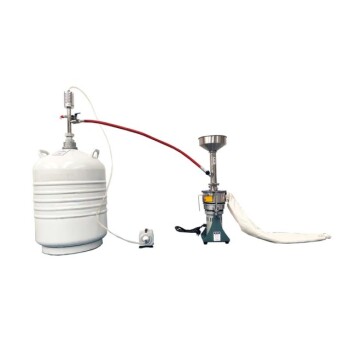
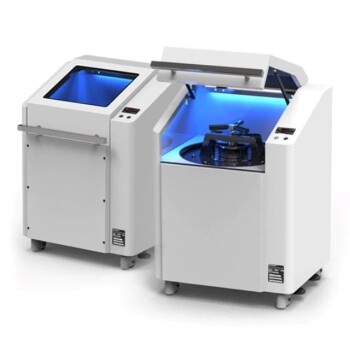
lab cryogenic grinding use liquid-nitrogen for pulverizing plastic raw materials and heat sensitive materials

lab cryogenic grinding use liquid-nitrogen for pulverizing plastic raw materials and heat sensitive materials

Discover the KT-CG01 Liquid Nitrogen Cryogenic Pulverizer, Ideal for Plastic and Heat-Sensitive Material Pulverization, Preserving Material Integrity and Delivering Ultra-Fine Results.

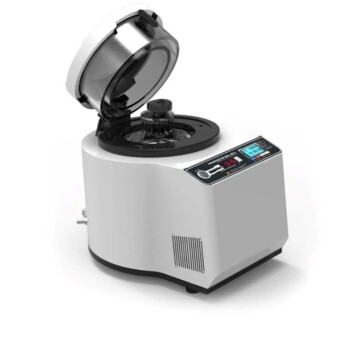
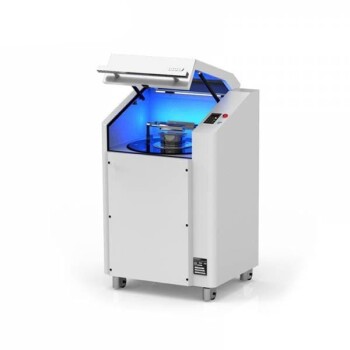
Low-Temperature Water-Cooled Touchscreen Vibratory Ultrafine Pulverizer

Low-Temperature Water-Cooled Touchscreen Vibratory Ultrafine Pulverizer

Low-temperature water-cooled vibratory pulverizer for ultrafine grinding. Preserves material integrity. Ideal for labs and production. Learn more.

Lab Internal Rubber Mixer Rubber Kneader Machine for Mixing and Kneading

Lab Internal Rubber Mixer Rubber Kneader Machine for Mixing and Kneading

Lab internal rubber mixer is suitable for mixing, kneading and dispersing various chemical raw materials such as plastics, rubber, synthetic rubber, hot melt adhesive and various low-viscosity materials.

Rubber Vulcanizer Vulcanizing Machine Plate Vulcanizing Press for Lab

Rubber Vulcanizer Vulcanizing Machine Plate Vulcanizing Press for Lab

The Plate vulcanizing press is a kind of equipment used in the production of rubber products, mainly used for the vulcanization of rubber products. Vulcanization is a key step in rubber processing.

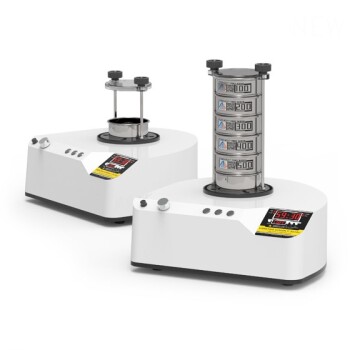
Laboratory Vibratory Sieve Shaker Machine for Dry and Wet Three-Dimensional Sieving

Laboratory Vibratory Sieve Shaker Machine for Dry and Wet Three-Dimensional Sieving

KT-VD200 can be used for sieving tasks of dry and wet samples in the laboratory. The screening quality is 20g-3kg. The product is designed with a unique mechanical structure and an electromagnetic vibrating body with a vibration frequency of 3000 times per minute.

Single Punch Electric Tablet Press Machine TDP Tablet Punching Machine

Single Punch Electric Tablet Press Machine TDP Tablet Punching Machine

The electric tablet punching machine is a laboratory equipment designed for pressing various granular and powdery raw materials into discs and other geometric shapes. It is commonly used in pharmaceutical, healthcare products, food, and other industries for small batch production and processing. The machine is compact, lightweight, and easy to operate, making it suitable for use in clinics, schools, laboratories, and research units.

Laboratory Vibratory Sieve Shaker Machine Slap Vibrating Sieve

Laboratory Vibratory Sieve Shaker Machine Slap Vibrating Sieve

KT-T200TAP is a slapping and oscillating sieving instrument for laboratory desktop use, with 300 rpm horizontal circular motion and 300 vertical slapping motions to simulate manual sieving to help sample particles pass through better.

XRF & KBR steel ring lab Powder Pellet Pressing Mold for FTIR

XRF & KBR steel ring lab Powder Pellet Pressing Mold for FTIR

Produce perfect XRF samples with our steel ring lab powder pellet pressing mold. Fast tableting speed and customizable sizes for accurate molding every time.

Single Punch Tablet Press Machine and Mass Production Rotary Tablet Punching Machine for TDP

Single Punch Tablet Press Machine and Mass Production Rotary Tablet Punching Machine for TDP

Rotary tablet punching machine is an automatic rotating and continuous tableting machine. It is mainly used for tablet manufacturing in the pharmaceutical industry, and is also suitable for industrial sectors such as food, chemicals, batteries, electronics, ceramics, etc. to compress granular raw materials into tablets.

Laboratory Test Sieves and Vibratory Sieve Shaker Machine

Laboratory Test Sieves and Vibratory Sieve Shaker Machine

Efficiently process powders, granules, and small blocks with a high-frequency vibration sieve. Control vibration frequency, screen continuously or intermittently, and achieve accurate particle size determination, separation, and classification.

Electric Split Lab Cold Isostatic Press CIP Machine for Cold Isostatic Pressing

Electric Split Lab Cold Isostatic Press CIP Machine for Cold Isostatic Pressing

Split cold isostatic presses are capable of providing higher pressures, making them suitable for testing applications that require high pressure levels.

Lab Blown Film Extrusion Three Layer Co-Extrusion Film Blowing Machine

Lab Blown Film Extrusion Three Layer Co-Extrusion Film Blowing Machine

Lab blown film extrusion is mainly used to detect the feasibility of film blowing of polymer materials and the colloid condition in the materials, as well as the dispersion of colored dispersions, controlled mixtures, and extrudates;

Desktop Fast Laboratory Autoclave Sterilizer 20L 24L for Lab Use

Desktop Fast Laboratory Autoclave Sterilizer 20L 24L for Lab Use

The desktop fast steam sterilizer is a compact and reliable device used for rapid sterilization of medical, pharmaceutical, and research items.

Automatic Heated Hydraulic Press Machine with Heated Plates for Laboratory Hot Press 25T 30T 50T

Automatic Heated Hydraulic Press Machine with Heated Plates for Laboratory Hot Press 25T 30T 50T

Efficiently prepare your samples with our Automatic Heated Lab Press. With a pressure range up to 50T and precise control, it's perfect for various industries.

Lab Sterile Slapping Type Homogenizer for Tissue Mashing and Dispersing

Lab Sterile Slapping Type Homogenizer for Tissue Mashing and Dispersing

The slapping sterile homogenizer can effectively separate the particles contained in and on the surface of solid samples, ensuring that the mixed samples in the sterile bag are fully representative.

Benchtop Laboratory Vacuum Freeze Dryer

Benchtop Laboratory Vacuum Freeze Dryer

Benchtop laboratory freeze dryer for efficient lyophilization of biological, pharmaceutical, and food samples. Features intuitive touchscreen, high-performance refrigeration, and durable design. Preserve sample integrity—consult now!

Heated Hydraulic Press Machine with Integrated Manual Heated Plates for Lab Use

Heated Hydraulic Press Machine with Integrated Manual Heated Plates for Lab Use

Efficiently process heat-pressing samples with our Integrated Manual Heated Lab Press. With a heating range up to 500°C, it's perfect for various industries.

Small Injection Molding Machine for Lab Use

Small Injection Molding Machine for Lab Use

The small injection molding machinehas fast and stable movements; good controllability and repeatability, super energy saving; the product can be automatically dropped and formed; the machine body is low, convenient for feeding, easy to maintain, and no height restrictions on the installation site.

Single Punch Electric Tablet Press Machine Laboratory Powder Tablet Punching TDP Tablet Press

Single Punch Electric Tablet Press Machine Laboratory Powder Tablet Punching TDP Tablet Press

The single-punch electric tablet press is a laboratory-scale tablet press suitable for corporate laboratories in pharmaceutical, chemical, food, metallurgical and other industries.

High Performance Laboratory Freeze Dryer for Research and Development

High Performance Laboratory Freeze Dryer for Research and Development

Advanced laboratory freeze dryer for lyophilization, preserving sensitive samples with precision. Ideal for biopharmaceuticals, research & food industries.


Leave Your Message