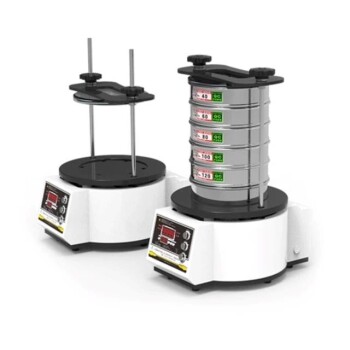
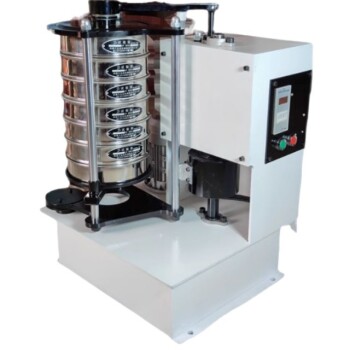
The primary function of sieving equipment in the raw material pretreatment phase of aluminum matrix composite fabrication is to strictly control the particle size distribution of the aluminum powder.
By utilizing precise screens, such as a 325-mesh setup, the equipment removes oversized particles to ensure the matrix powder is fine enough to uniformly fill the void spaces between reinforcement fibers. This step is the foundational requirement for achieving consistent mixing, effective densification, and a defect-free microstructure.
Core Takeaway Sieving is not merely about separation; it is a critical quality control measure that defines the microstructural integrity of the final composite. By eliminating coarse particles, sieving ensures the aluminum matrix packs efficiently around reinforcements, preventing voids and fractures in the finished product.
The Mechanics of Particle Size Control
Removing Oversized Particles
The immediate operational goal of sieving is the physical separation of raw material based on size. Using screens like the 325-mesh (approximately 44 micrometers), the equipment filters out particles that exceed the maximum allowable diameter.
Ensuring Strict Distribution
Beyond simple separation, this process ensures a statistically consistent particle size distribution. In high-precision applications, this may involve restricting particles to sizes less than 10 micrometers to guarantee homogeneity across the entire batch.
Eliminating Impurities
Sieving also acts as a final filtration step after processes like air classification. It captures residual large-particle impurities that could contaminate the chemical composition or mechanical consistency of the aluminum powder.
Impact on Manufacturing Efficiency
Optimizing Matrix Filling
For a composite to be strong, the aluminum powder must physically fit into the small gaps between reinforcement fibers. Sieving ensures the particles are small enough to penetrate and uniformly fill these interstitial spaces.
Facilitating Densification
Uniform particle sizes allow for tighter packing during the molding and sintering phases. When the powder fills space efficiently, the subsequent densification process is smoother, resulting in a solid material with fewer porous defects.
Improving Mixing Consistency
A sieved, uniform powder mixes more predictably with reinforcement materials. This prevents the segregation of components, ensuring that the aluminum and the fibers are distributed evenly throughout the mixture before heat and pressure are applied.
The Risks of Inadequate Screening
Fracture Initiation
If oversized particles or coarse defects are allowed to remain in the powder, they act as stress concentrators in the final material. These "coarse defects" are often the primary sites where fractures initiate under load.
Structural Weakness
Inconsistent particle sizes lead to uneven density in the final product. Areas with poor packing or large voids will significantly reduce the composite's overall strength and reliability.
Compromised Microstructure
Without strict size control, the final microstructure will lack uniformity. This heterogeneity leads to unpredictable physical properties, making the composite unsuitable for high-performance applications.
Making the Right Choice for Your Goal
To apply these principles effectively to your fabrication process, consider your specific performance requirements.
- If your primary focus is Structural Durability: Prioritize high-precision screens (e.g., 20 micrometers) to eliminate coarse defects that cause fractures.
- If your primary focus is Process Efficiency: Focus on the standard 325-mesh range to balance throughput speed with adequate fiber filling and densification.
The strict control of particle size is the invisible variable that determines whether an aluminum matrix composite will fail under stress or perform as intended.
Summary Table:
| Process Objective | Operational Action | Critical Outcome |
|---|---|---|
| Size Control | 325-mesh screening | Eliminates oversized particles >44μm |
| Microstructure | Uniform powder filling | Prevents voids and interstitial defects |
| Structural Integrity | Impurity removal | Minimizes stress concentrators and fractures |
| Densification | Statistical distribution | Ensures tight packing during sintering |
| Mixing | Homogenization | Prevents component segregation |
Elevate Your Composite Fabrication with KINTEK Precision
High-performance aluminum matrix composites demand absolute precision in material pretreatment. KINTEK specializes in advanced sieving equipment, crushing and milling systems, and hydraulic presses (pellet, hot, and isostatic) designed to meet the rigorous standards of modern laboratory research and industrial production.
Whether you are refining particle size for uniform matrix filling or requiring high-temperature furnace solutions for sintering, our comprehensive portfolio—including muffle and vacuum furnaces, ball mills, and essential ceramic consumables—is engineered to eliminate structural defects and enhance material durability.
Ready to optimize your lab’s efficiency and material quality? Contact KINTEK today to discover how our high-precision tools can transform your raw material pretreatment and fabrication workflows.
Related Products
- Three-dimensional electromagnetic sieving instrument
- Laboratory Vibratory Sieve Shaker Machine for Dry and Wet Three-Dimensional Sieving
- Laboratory Test Sieves and Sieving Machines
- Laboratory Wet Three-Dimensional Vibratory Sieve Shaker Machine
- Laboratory Test Sieves and Vibratory Sieve Shaker Machine
People Also Ask
- Why is sieving equipment essential for the classification of processed bio-activated carbon? Optimize Performance
- What are the limitations of sieving? Understanding the Constraints of Particle Size Analysis
- What are advantages and disadvantages of sieving method? A Guide to Reliable & Cost-Effective Particle Sizing
- How is sieving important? The Critical Role of Particle Size Analysis in Quality Control
- What is sieving and how does it work? A Guide to Accurate Particle Size Analysis