Knowledge What is the primary purpose of using graphite foil to wrap Tantalum Carbide samples? Ensure Pure & Precise Sintering
Author avatar

Tech Team · Kintek Solution

Updated 1 day ago

What is the primary purpose of using graphite foil to wrap Tantalum Carbide samples? Ensure Pure & Precise Sintering


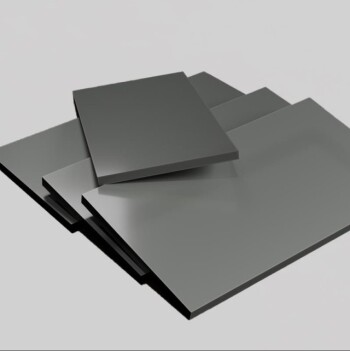
The primary purpose of using graphite foil is to create a flexible isolation barrier between the Tantalum Carbide (TaC) sample and the rigid graphite mold components. By physically separating the powder from the punches and inner walls, the foil prevents unwanted diffusion reactions that would otherwise occur due to direct contact at high sintering temperatures.

While its main function is chemical isolation, graphite foil provides a critical mechanical advantage: its flexibility compensates for microscopic mold irregularities, ensuring uniform pressure distribution and effortless sample separation.

The Critical Role of Isolation

Preventing Chemical Diffusion

At the extreme temperatures required for hot pressing (often up to 2000°C), materials become highly reactive. Graphite foil acts as a shield, blocking direct contact between the TaC powder and the graphite mold.

Without this barrier, carbon from the mold could diffuse into the sample, or the sample could react with the mold walls. This isolation preserves the chemical purity and stoichiometry of your Tantalum Carbide sample.

Protecting the Mold Assembly

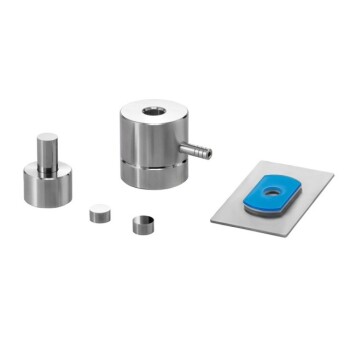
Graphite molds serve as the primary containment and pressure transmission vessels. They are expensive to machine and susceptible to damage.

By preventing the sample from fusing to the mold walls, the foil extends the lifespan of your tooling. It ensures the mold remains clean and reusable for subsequent runs.

Mechanical and Process Advantages

Compensating for Surface Irregularities

Even high-quality graphite molds possess microscopic surface imperfections. The flexible nature of graphite foil allows it to deform slightly under pressure.

This deformation fills gaps caused by surface roughness on the punches or die walls. Consequently, the uniaxial pressure from the hydraulic system is distributed more uniformly across the TaC sample, leading to consistent density.

Facilitating Clean Separation

Post-sintering extraction is a notorious pain point in ceramic processing. Without a release interface, the ceramic sample can sinter directly to the mold.

Graphite foil acts as a release agent. Because it prevents adhesion, it allows for the easy separation of the final ceramic part from the die components, significantly reducing the cleaning effort required after the cycle.

Common Pitfalls and Considerations

The Risk of Surface Texture Transfer

While flexibility is an asset, it introduces a trade-off regarding surface finish. Any wrinkles or folds in the graphite foil during the wrapping process will be stamped into the surface of the TaC sample.

If surface flatness is critical, the foil must be applied with extreme care to avoid inducing defects that will require costly post-process grinding or polishing.

Foil Integrity Under Pressure

Graphite foil is relatively fragile compared to the massive forces involved in hot pressing. If the foil tears during loading or pressing, the isolation barrier is compromised.

A tear results in localized diffusion spots where the sample fuses to the mold. This creates a "hard point" that can crack the sample during cooling or extraction.

Making the Right Choice for Your Goal

To maximize the effectiveness of graphite foil in your hot pressing assembly, consider your specific priorities:

  • If your primary focus is Chemical Purity: Ensure the foil wrapping is generous and overlaps securely to eliminate any path for carbon diffusion.
  • If your primary focus is Surface Finish: Apply the foil with high tension to eliminate wrinkles, or consider using a slightly thicker foil that is less prone to creasing.

The correct application of graphite foil is the single most effective step you can take to ensure your Tantalum Carbide samples are chemically pure and mechanically sound.

Summary Table:

Key Function Benefit for Tantalum Carbide (TaC) Why It Matters
Chemical Isolation Blocks carbon diffusion between sample and mold Preserves chemical purity and stoichiometry
Mechanical Buffer Compensates for mold surface irregularities Ensures uniform pressure distribution and density
Release Agent Prevents sample from fusing to mold walls Facilitates clean extraction and extends mold life
Surface Protection Fills microscopic gaps in die/punches Reduces surface defects and post-process grinding

Maximize Your Material Purity with KINTEK Precision

Success in high-temperature material science depends on the right containment and pressure tools. At KINTEK, we specialize in the advanced laboratory equipment you need to achieve flawless sintering results.

Whether you are processing Tantalum Carbide or developing new ceramic composites, our comprehensive range of hot pressing systems, hydraulic presses (pellet, hot, isostatic), and graphite consumables are designed for performance and durability. We also offer high-temperature furnaces (vacuum, CVD, atmosphere), crushing and milling systems, and specialized ceramics to support every stage of your research.

Ready to upgrade your lab's capabilities? Contact our technical experts today to find the perfect solution for your high-pressure research and production needs.

Related Products

People Also Ask

Related Products

Conductive Carbon Cloth Carbon Paper Carbon Felt for Electrodes and Batteries

Conductive Carbon Cloth Carbon Paper Carbon Felt for Electrodes and Batteries

Conductive carbon cloth, paper, and felt for electrochemical experiments. High-quality materials for reliable and accurate results. Order now for customization options.

Copper Foam

Copper Foam

Copper foam has good thermal conductivity and can be widely used for heat conduction and heat dissipation of motors/electrical appliances and electronic components.

Vertical High Temperature Graphite Vacuum Graphitization Furnace

Vertical High Temperature Graphite Vacuum Graphitization Furnace

Vertical high temperature graphitization furnace for carbonization and graphitization of carbon materials up to 3100℃.Suitable for shaped graphitization of carbon fiber filaments and other materials sintered in a carbon environment.Applications in metallurgy, electronics, and aerospace for producing high-quality graphite products like electrodes and crucibles.

Vacuum Hot Press Furnace Machine for Lamination and Heating

Vacuum Hot Press Furnace Machine for Lamination and Heating

Experience clean and precise lamination with Vacuum Lamination Press. Perfect for wafer bonding, thin-film transformations, and LCP lamination. Order now!

Custom PTFE Teflon Parts Manufacturer for Non-Standard Insulator Customization

Custom PTFE Teflon Parts Manufacturer for Non-Standard Insulator Customization

PTFE insulator PTFE has excellent electrical insulation properties in a wide temperature and frequency range.

Electrode Polishing Material for Electrochemical Experiments

Electrode Polishing Material for Electrochemical Experiments

Looking for a way to polish your electrodes for electrochemical experiments? Our polishing materials are here to help! Follow our easy instructions for best results.

Glassy Carbon Sheet RVC for Electrochemical Experiments

Glassy Carbon Sheet RVC for Electrochemical Experiments

Discover our Glassy Carbon Sheet - RVC. Perfect for your experiments, this high-quality material will elevate your research to the next level.

Graphite Vacuum Furnace Negative Material Graphitization Furnace

Graphite Vacuum Furnace Negative Material Graphitization Furnace

Graphitization furnace for battery production has uniform temperature and low energy consumption. Graphitization furnace for negative electrode materials: an efficient graphitization solution for battery production and advanced functions to enhance battery performance.

Metallographic Specimen Mounting Machine for Laboratory Materials and Analysis

Metallographic Specimen Mounting Machine for Laboratory Materials and Analysis

Precision metallographic mounting machines for labs—automated, versatile, and efficient. Ideal for sample prep in research and quality control. Contact KINTEK today!

Conductive Boron Nitride BN Ceramics Composite for Advanced Applications

Conductive Boron Nitride BN Ceramics Composite for Advanced Applications

Due to the characteristics of boron nitride itself, the dielectric constant and dielectric loss are very small, so it is an ideal electrical insulating material.

Custom PTFE Teflon Parts Manufacturer for Acid and Alkali Resistant Chemical Powder Material Scoops

Custom PTFE Teflon Parts Manufacturer for Acid and Alkali Resistant Chemical Powder Material Scoops

Known for its excellent thermal stability, chemical resistance and electrical insulating properties, PTFE is a versatile thermoplastic material.

Graphite Vacuum Furnace High Thermal Conductivity Film Graphitization Furnace

Graphite Vacuum Furnace High Thermal Conductivity Film Graphitization Furnace

The high thermal conductivity film graphitization furnace has uniform temperature, low energy consumption and can operate continuously.

High Pressure Laboratory Vacuum Tube Furnace Quartz Tubular Furnace

High Pressure Laboratory Vacuum Tube Furnace Quartz Tubular Furnace

KT-PTF High Pressure Tube Furnace: Compact split tube furnace with strong positive pressure resistance. Working temp up to 1100°C and pressure up to 15Mpa. Also works under controller atmosphere or high vacuum.

Button Battery Storage Box for Battery Lab

Button Battery Storage Box for Battery Lab

Button-type battery storage box, detachable, high-quality PP environmental protection material; suitable for small objects/chemicals, etc., thickened, compressive, durable, and available in a variety of styles.

UV Lamp Trolley for Laboratory and Hospital Use

UV Lamp Trolley for Laboratory and Hospital Use

The UV lamp trolley is made of cold-rolled plate sprayed with plastic, and adopts a double-lamp structure; it is movable, foldable, and equipped with universal wheels, which is very convenient to use.

Custom PTFE Teflon Parts Manufacturer for PTFE Ball Valve Seat

Custom PTFE Teflon Parts Manufacturer for PTFE Ball Valve Seat

Seats and inserts are vital components in the valve industry. As a key component, polytetrafluoroethylene is usually selected as the raw material.

E Beam Crucibles Electron Gun Beam Crucible for Evaporation

E Beam Crucibles Electron Gun Beam Crucible for Evaporation

In the context of electron gun beam evaporation, a crucible is a container or source holder used to contain and evaporate the material to be deposited onto a substrate.

Precision Machined Zirconia Ceramic Ball for Engineering Advanced Fine Ceramics

Precision Machined Zirconia Ceramic Ball for Engineering Advanced Fine Ceramics

zirconia ceramic ball have the characteristics of high strength, high hardness, PPM wear level, high fracture toughness, good wear resistance, and high specific gravity.

Laboratory Disc Rotary Mixer for Efficient Sample Mixing and Homogenization

Laboratory Disc Rotary Mixer for Efficient Sample Mixing and Homogenization

Efficient Laboratory Disc Rotary Mixer for Precise Sample Mixing, Versatile for Various Applications, DC Motor and Microcomputer Control, Adjustable Speed and Angle.

Custom PTFE Teflon Parts Manufacturer for Culture Dish and Evaporation Dish

Custom PTFE Teflon Parts Manufacturer for Culture Dish and Evaporation Dish

The PTFE culture dish evaporating dish is a versatile laboratory tool known for its chemical resistance and high-temperature stability. PTFE, a fluoropolymer, offers exceptional non-stick properties and durability, making it ideal for various applications in research and industry, including filtration, pyrolysis, and membrane technology.


Leave Your Message