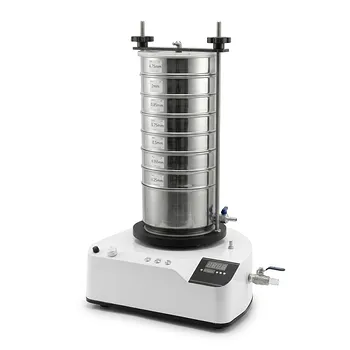
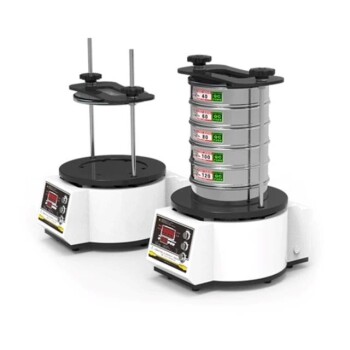
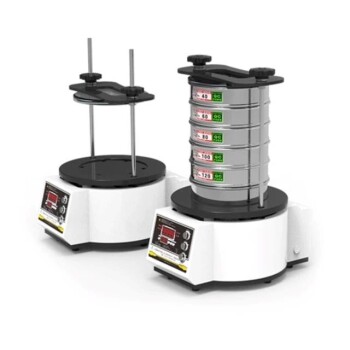
The primary purpose of precision sieving during the pretreatment of Posidonia oceanica residues is to screen chopped biomass into a specific particle size range, typically between 0.2 and 0.5 cm. By establishing this specific size, the equipment ensures the uniformity required for consistent heat and mass transfer during subsequent processing. Additionally, this step maximizes the contact surface area between the biomass and the solvent, directly increasing the efficiency of the hydrolysis process.
Precision sieving transforms raw, chopped residues into a chemically consistent feedstock. This physical uniformity is the critical prerequisite for efficient hydrothermal liquefaction, ensuring reliable heat transfer and maximum solvent interaction.
The Critical Role of Particle Uniformity
Establishing Precise Size Ranges
Raw biomass chopping often results in irregular fragments. Precision sieving filters this output to strict dimensions, specifically targeting a range of 0.2 to 0.5 cm for this type of residue.
Enabling Consistent Heat Transfer
When particles vary wildly in size, they absorb heat at different rates. Uniform particles ensure that heat transfer is consistent throughout the batch.
This consistency prevents cold spots or overheating during the hydrothermal liquefaction process, ensuring the entire feedstock reacts under the same thermal conditions.
Regulating Mass Transfer
Just as heat must penetrate the biomass evenly, mass transfer—the movement of material within the reactor—relies on physical uniformity.
Sieving eliminates outliers that could disrupt the flow or behavior of the biomass slurry, facilitating a stable and predictable reaction environment.
Enhancing Chemical Efficiency
Maximizing Contact Surface Area
The rate of a chemical reaction is often limited by how much of the solid material is exposed to the liquid solvent.
By sieving to a finer, uniform size, you significantly increase the specific surface area available for reaction.
Boosting Hydrolysis Performance
With increased surface area, the solvent can interact more effectively with the biomass structure.
This improved contact directly enhances hydrolysis efficiency, allowing for a more complete breakdown of the Posidonia oceanica residues into valuable chemical products.
Understanding the Trade-offs
The Risk of Non-Uniformity
Skipping the sieving step introduces significant variability into the reactor.
Large, unsieved particles may fail to heat through completely, leading to incomplete reactions and lower yields. Conversely, extremely fine dust (if not managed) can cause different handling issues or react too aggressively.
Equipment vs. Efficiency
While sieving adds a step to the mechanical preparation process, the trade-off is operational stability.
Without this step, the subsequent chemical processes (like liquefaction) may suffer from internal diffusion limitations, where the reaction is slowed because chemicals cannot penetrate the biomass center effectively.
Making the Right Choice for Your Goal
To optimize your biomass conversion process, consider your specific operational targets:
- If your primary focus is process stability: Prioritize sieving to the 0.2–0.5 cm range to guarantee uniform heat and mass transfer, preventing fluctuations during liquefaction.
- If your primary focus is reaction speed: Ensure your sieving protocol strictly eliminates larger particles to maximize the specific surface area available for immediate hydrolysis.
Proper mechanical pretreatment is the foundation upon which high-efficiency biomass valorization is built.
Summary Table:
| Feature | Impact on Pretreatment | Primary Benefit |
|---|---|---|
| Particle Size Range | Targeted 0.2 - 0.5 cm range | Ensures physical uniformity of feedstock |
| Heat & Mass Transfer | Consistent thermal absorption | Prevents cold spots and reaction fluctuations |
| Specific Surface Area | Maximized contact area | Significantly boosts hydrolysis efficiency |
| Internal Diffusion | Reduced path for solvent penetration | Overcomes chemical reaction limitations |
Elevate Your Biomass Research with KINTEK Precision
High-efficiency valorization of Posidonia oceanica and other residues starts with physical uniformity. At KINTEK, we specialize in the advanced laboratory equipment necessary to transform raw materials into consistent, high-yield feedstock.
Our extensive portfolio is designed for researchers who demand precision, including:
- Advanced Sieving Equipment: Achieve the exact 0.2–0.5 cm ranges required for optimal mass transfer.
- High-Temperature & High-Pressure Reactors: Perfect for consistent hydrothermal liquefaction and hydrolysis.
- Crushing & Milling Systems: Reliable mechanical pretreatment to prepare your biomass for sieving.
- Essential Consumables: From ceramics and crucibles to PTFE products for chemical stability.
Don't let internal diffusion limitations or non-uniform heating compromise your yields. Contact KINTEK today to discover how our high-performance tools and technical expertise can optimize your laboratory’s workflow and ensure the success of your biomass conversion projects.
References
- İrem Deniz. Marin biyokütlenin hidrotermal sıvılaştırılması: Entegre bir proses. DOI: 10.21541/apjes.320484
This article is also based on technical information from Kintek Solution Knowledge Base .
Related Products
- Three-dimensional electromagnetic sieving instrument
- Laboratory Vibratory Sieve Shaker Machine for Dry and Wet Three-Dimensional Sieving
- Laboratory Test Sieves and Sieving Machines
- Precision Wire Saw Laboratory Cutting Machine with 800mm x 800mm Workbench for Diamond Single Wire Circular Small Cutting
- Laboratory Test Sieves and Vibratory Sieve Shaker Machine
People Also Ask
- Why is sieving equipment essential for the classification of processed bio-activated carbon? Optimize Performance
- What are the limitations of sieving? Understanding the Constraints of Particle Size Analysis
- What are advantages and disadvantages of sieving method? A Guide to Reliable & Cost-Effective Particle Sizing
- How is sieving important? The Critical Role of Particle Size Analysis in Quality Control
- What is sieving and how does it work? A Guide to Accurate Particle Size Analysis