The primary role of a ball mill in boron carbide preparation is to serve as a dual-function mechanical processor. Through a grinding duration typically lasting between 3 and 48 hours, it ensures the thorough mixing of boron carbide with essential sintering additives—such as activated carbon, silicon carbide, and binders—while simultaneously refining the particle size through mechanical impact.
Core Takeaway The ball mill acts as the foundational step for microstructural integrity. By breaking down agglomerates and forcing intimate contact between the ceramic matrix and its additives, it creates the uniform "green" state necessary to achieve consistent density and mechanical properties during the final sintering process.
The Mechanisms of Powder Modification
Achieving Homogeneous Dispersion
The most critical challenge in ceramic processing is preventing the segregation of components. The ball mill addresses this by utilizing mechanical energy to force activated carbon, silicon carbide, or metallic additives into the boron carbide matrix.
This process ensures that micro-additives do not clump together. By maintaining a uniform distribution, the mill prevents "stratification," ensuring the chemical composition is identical throughout the entire powder batch.
Particle Refinement and Agglomerate Reduction
Raw ceramic powders often arrive with inconsistent particle sizes or clustered structures known as agglomerates.
The grinding media within the ball mill delivers high-energy impact and shear forces. This action fractures large particles and breaks apart agglomerates. The result is a refined powder with a uniform particle size distribution, which is a prerequisite for high-quality sintering.
Why This Matters for the Final Material
Facilitating Sintering Kinetics
Boron carbide is notoriously difficult to sinter due to its covalent bonding. The ball milling process increases the specific surface area of the powder.
By refining the particles and ensuring intimate contact between the boron carbide and sintering aids, the mill reduces the diffusion path for atoms. This reduction lowers the kinetic barrier, facilitating the reactions and densification required during subsequent heat treatments (such as Spark Plasma Sintering).
Ensuring Microstructural Consistency
Any inconsistency in the initial powder mix will manifest as a flaw in the final ceramic part.
By guaranteeing a uniform distribution of components, the ball mill ensures that the final ceramic possesses a consistent microstructure. This uniformity allows the material to exhibit isotropic mechanical properties, rather than having weak points caused by poorly mixed pockets of binders or additives.
Understanding the Trade-offs
While essential, the ball milling process introduces variables that must be carefully managed to avoid diminishing returns.
Processing Duration vs. Efficiency
The primary reference notes a wide processing window of 3 to 48 hours. While longer times generally improve homogeneity, they also increase energy consumption and reduce throughput. There is a point of diminishing returns where further grinding yields negligible improvement in particle refinement.
Media Contamination Risks
The mechanical impact that refines the powder also wears down the grinding media (balls) and the mill lining.
If the milling duration is excessive or the media material is incompatible, wear debris can contaminate the boron carbide powder. This introduces impurities that may degrade the high-performance properties of the final ceramic, such as hardness or thermal conductivity.
Making the Right Choice for Your Goal
- If your primary focus is Sintering Density: Prioritize longer milling times to maximize particle refinement and surface area, which drives the densification process.
- If your primary focus is Purity: Select high-hardness grinding media compatible with boron carbide and optimize for the shortest effective milling duration to minimize contamination.
- If your primary focus is Composite Uniformity: Focus on the thorough mixing of additives (like carbon or SiC) to ensure the secondary phases are evenly dispersed within the matrix.
The ball mill is not merely a grinder; it is the tool that defines the structural potential of the final ceramic component.
Summary Table:
| Function | Mechanism | Impact on Final Ceramic |
|---|---|---|
| Homogenization | Disperses sintering aids (C, SiC) | Prevents stratification and structural weak points |
| Particle Refinement | High-energy shear and impact | Increases surface area for faster sintering kinetics |
| De-agglomeration | Breaks down powder clusters | Ensures uniform density and microstructural consistency |
| Kinetic Activation | Reduces atom diffusion paths | Facilitates densification of hard covalent materials |
Elevate Your Material Research with KINTEK Precision
Achieving the perfect boron carbide microstructure starts with the right equipment. KINTEK specializes in high-performance crushing and milling systems, including advanced ball mills designed to minimize contamination while maximizing refinement.
Whether you are preparing advanced ceramics, conducting battery research, or scaling up production, our comprehensive range of laboratory equipment and consumables—from high-temperature furnaces and hydraulic presses to ceramic crucibles—ensures your lab operates at peak efficiency.
Ready to optimize your ceramic processing? Contact our experts today to find the ideal milling and sintering solutions for your specific application.
Related Products
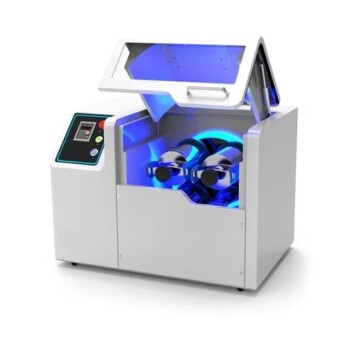
- High-Energy Omnidirectional Planetary Ball Mill Milling Machine for Laboratory
- High-Energy Omnidirectional Planetary Ball Mill Machine for Laboratory
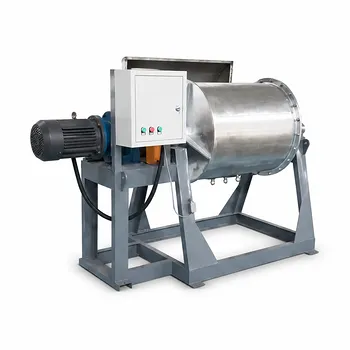
- Stainless Steel Laboratory Ball Mill for Dry Powder and Liquid with Ceramic Polyurethane Lining
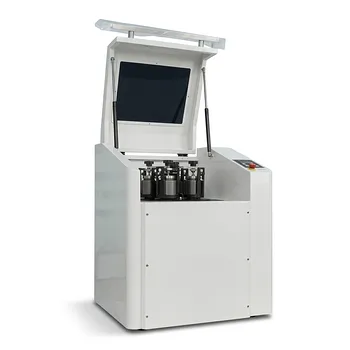
- Laboratory Planetary Ball Mill Rotating Ball Milling Machine
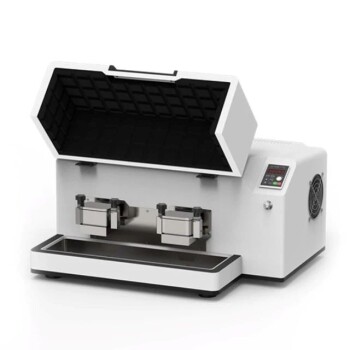
- Hybrid High Energy Vibratory Ball Mill for Lab Use
People Also Ask
- How does a planetary ball mill solve mixing challenges with PEO? Unlock solid-state synthesis for insoluble dopants
- What is the role of a planetary ball mill in preparing doped high-nickel cathode materials? Enhance Battery Stability
- Why is a planetary ball mill used for LNMO precursor powders? Optimize Particle Uniformity & Battery Performance
- What is the function of a planetary ball mill in the solid-state synthesis of LiTa2PO8? Achieve High-Purity Electrolytes
- What is the critical role of a planetary ball mill in the processing of inorganic fillers? Enhance Battery Performance