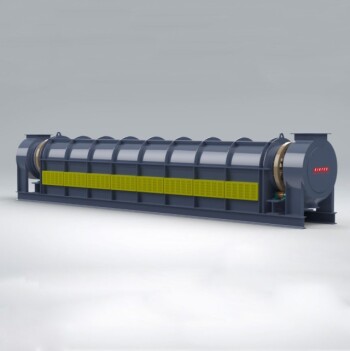
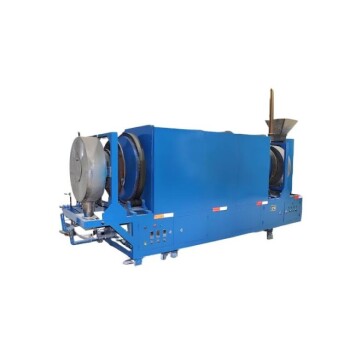
The primary role of a tube furnace in preparing coconut shell biochar is to provide a strictly controlled, high-temperature, oxygen-free environment for pyrolysis. By utilizing an inert gas atmosphere, the furnace facilitates the thermal decomposition of the biomass at temperatures reaching 800°C or higher. This process effectively removes volatile organic compounds and moisture, transforming the raw shells into a high-carbon, porous, and conductive powder.
The tube furnace acts as a precision reactor that enables the conversion of coconut shells into high-quality biochar by managing thermal kinetics and atmospheric purity. This level of control is essential for achieving the specific material properties, such as high surface area and electrical conductivity, required for advanced technical applications.
Achieving Precise Pyrolysis Conditions
The Importance of an Oxygen-Free Atmosphere
A tube furnace ensures an anaerobic or oxygen-poor environment through the introduction of inert gases like nitrogen (N2). This prevents the biomass from combusting into ash, allowing the material to undergo reductive pyrolysis instead.
Precise Temperature Control and Heating Rates
Advanced heating elements allow the user to set specific heating rates, such as 5°C to 10°C per minute. Maintaining a constant pyrolysis temperature is critical for ensuring the uniform chemical transformation of the coconut shells throughout the furnace tube.
Maintaining Atmospheric Flow Fields
The furnace provides a stable flow field for carrier gases, which can include nitrogen or water vapor for physical activation. This flow ensures that released volatiles are consistently swept away, maintaining the purity of the carbonization process.
Structural and Chemical Transformation
Devolatilization and Removal of Impurities
High temperatures within the furnace drive reactions such as dehydrogenation and decarboxylation. These reactions effectively remove volatile organic compounds (VOCs) and moisture, which is essential for creating a biochar substrate with high thermal stability.
Induction of Porosity and Graphitization
The controlled heat induces the formation of a graphite phase, which significantly increases the material's electrical conductivity. Additionally, the process develops a rich porous structure, providing a high specific surface area that makes the biochar an ideal support for active components.
Functional Group Customization
By adjusting the isothermal residence time and temperature, researchers can tailor the presence of specific functional groups on the biochar surface. This customization is vital when the biochar is intended for soil improvement or as a precursor for conductive composite materials.
Understanding the Trade-offs
Batch Size vs. Precision
While tube furnaces offer unmatched precision in temperature and atmosphere, they are typically limited to batch processing. This makes them excellent for research and high-value material production but less efficient for large-scale industrial biochar manufacturing.
Maintenance of Gas Seals
Maintaining an oxygen-free atmosphere requires high-quality seals and consistent gas flow monitoring. Any leak can lead to partial combustion, which compromises the graphitization degree and structural integrity of the final biochar product.
Energy Consumption
Operating at temperatures between 500°C and 1000°C requires significant energy input. Achieving a high-carbon, stable carbon structure often necessitates long residence times, which increases the overall cost of preparation compared to simpler kiln methods.
How to Apply This to Your Project
When utilizing a tube furnace for coconut shell biochar preparation, your specific parameters should align with your end-use requirements.
- If your primary focus is electrical conductivity: Aim for higher temperatures (800°C to 1000°C) and longer residence times to maximize the graphitization degree of the carbon network.
- If your primary focus is surface area for adsorption: Focus on physical activation by introducing water vapor or CO2 as carrier gases at temperatures around 700°C.
- If your primary focus is functional groups for soil research: Use lower pyrolysis temperatures (around 500°C) and slower heating rates to preserve specific oxygen-containing functional groups.
- If your primary focus is conductive composites: Ensure a strictly nitrogen-protected atmosphere at 800°C to produce a fine, high-purity powder that can be easily integrated into polymer matrices.
Mastering the controlled environment of a tube furnace is the definitive step in transforming raw biomass into a high-performance technical material.
Summary Table:
| Feature | Role in Biochar Preparation | Key Benefit |
|---|---|---|
| Inert Atmosphere | Prevents combustion via N2/Argon flow | High-carbon yield without ash formation |
| Precise Temp Control | Maintains stable pyrolysis (up to 1000°C+) | Uniform chemical and structural transformation |
| Controlled Gas Flow | Sweeps away VOCs and moisture | High-purity biochar with stable carbon structure |
| Thermal Kinetics | Manages heating rates (e.g., 5-10°C/min) | Tailored porosity and functional group density |
| Graphitization | Induces formation of graphite phases | Significantly enhanced electrical conductivity |
Elevate Your Material Research with KINTEK
Precision is the foundation of high-quality biochar production. KINTEK specializes in advanced laboratory equipment designed to meet the rigorous demands of material science. Our high-performance tube furnaces, muffle furnaces, and vacuum systems provide the stable, oxygen-free environments essential for superior graphitization and porosity control.
Whether you are developing conductive composites, soil amendments, or advanced adsorbents, KINTEK offers a comprehensive portfolio including:
- High-Temperature Furnaces: Tube, rotary, CVD, and atmosphere-controlled models.
- Processing Tools: Crushing, milling, and hydraulic pellet presses.
- Essential Consumables: High-purity ceramics, crucibles, and PTFE products.
Ready to achieve consistent, high-value results in your lab? Contact our specialists today to find the perfect thermal processing solution for your project!
References
- Justin George, Debes Bhattacharyya. Improvement of Electrical and Mechanical Properties of PLA/PBAT Composites Using Coconut Shell Biochar for Antistatic Applications. DOI: 10.3390/app13020902
This article is also based on technical information from Kintek Solution Knowledge Base .
Related Products
- Electric Rotary Kiln Small Rotary Furnace Biomass Pyrolysis Plant
- Carbon Graphite Boat -Laboratory Tube Furnace with Cover
- Vertical Laboratory Tube Furnace
- 1200℃ Split Tube Furnace with Quartz Tube Laboratory Tubular Furnace
- Electric Rotary Kiln Pyrolysis Furnace Plant Machine Calciner Small Rotary Kiln Rotating Furnace
People Also Ask
- What is the temperature of a rotating kiln? It Depends on Your Material and Process Goal
- What are the different types of calciners? A Guide to Selecting the Right Thermal Processing Equipment
- What are the principles of a rotary kiln? Master the Mechanics of High-Temperature Processing
- How are rotary kilns heated? Direct vs. Indirect Heating Methods Explained
- Is rotary kiln a furnace? Discover the Key Differences for Industrial Processing