Knowledge Rubber processing machine What is the principle of mixing on open two roll mill? Master Shear, Compression & Heat for Uniform Blending
Author avatar

Tech Team · Kintek Solution

Updated 2 months ago

What is the principle of mixing on open two roll mill? Master Shear, Compression & Heat for Uniform Blending


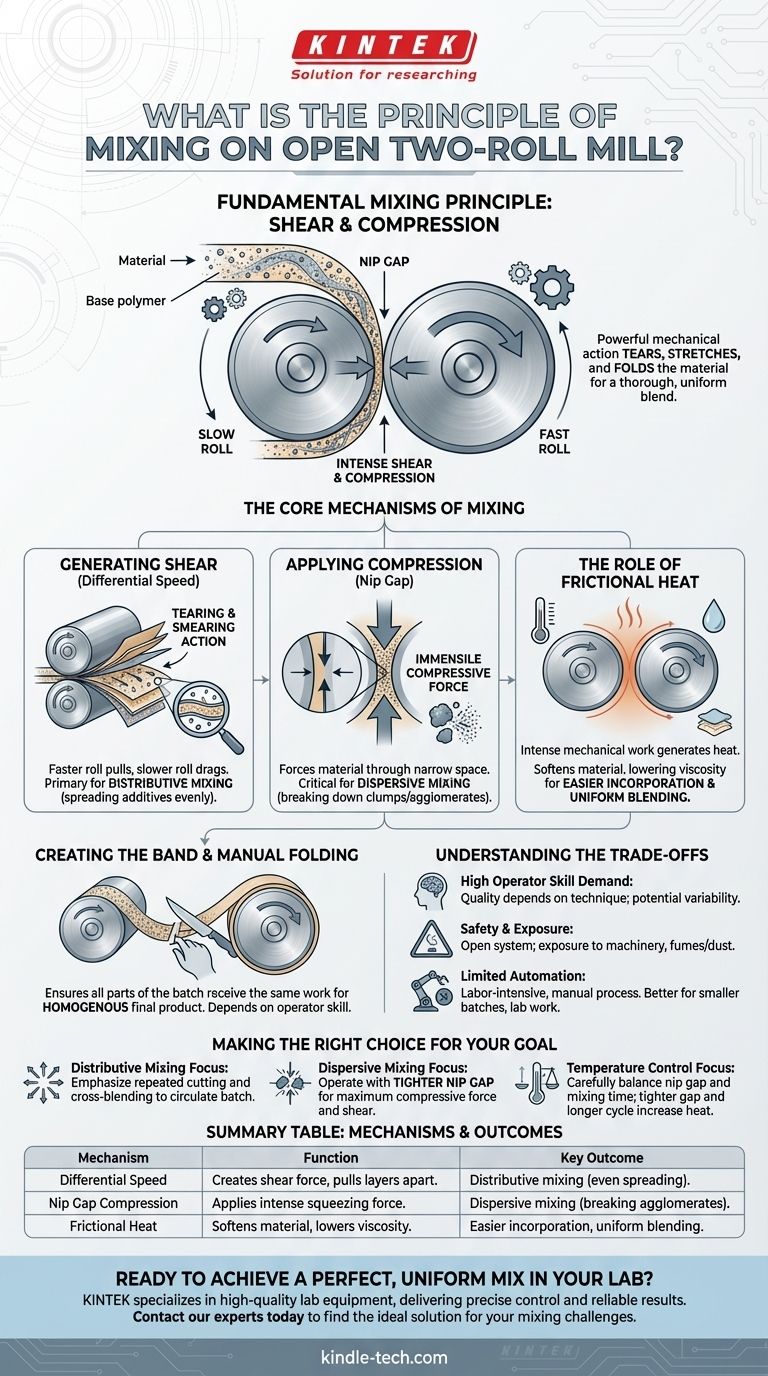
The fundamental mixing principle of a two-roll mill is the application of intense shear and compression to a material. This is achieved by passing the material through the narrow gap, or "nip," between two large steel rolls that rotate towards each other at different speeds. This powerful mechanical action tears, stretches, and folds the material, ensuring a thorough and uniform blend.

A two-roll mill achieves its mix not just by squeezing, but by creating a powerful shearing effect. The difference in roll speeds is the critical factor that pulls and tears material layers apart, while the narrow gap provides the compressive force needed to break down and disperse particles.
What is the principle of mixing on open two roll mill? Master Shear, Compression & Heat for Uniform Blending

The Core Mechanisms of Mixing

To truly understand the process, it's essential to break down the distinct forces at play. Each mechanism serves a specific purpose in transforming raw ingredients into a homogenous compound.

Generating Shear with Differential Speed

The two rolls do not rotate at the same velocity. There is always a "slow" roll and a "fast" roll.

This differential speed is the primary source of shear force. As the material enters the nip, the faster roll pulls it forward while the slower roll drags it back, creating an intense tearing and smearing action between the layers of the material.

This action is highly effective for distributive mixing, which focuses on spreading particles of additives evenly throughout the polymer matrix.

Applying Compression at the Nip

The distance between the two rolls, known as the nip gap, is adjustable by the operator.

This narrow gap forces the material through a small space, subjecting it to immense compressive force. This squeezing action is critical for dispersive mixing—the process of breaking down clumps or agglomerates of additives (like carbon black or pigments) into their finest particles.

The Role of Frictional Heat

The intense mechanical work of shearing and compressing the material generates significant frictional heat.

This is not an unwanted side effect but a crucial part of the process. The heat softens the rubber or plastic, lowering its viscosity and making it more pliable. This softened state allows additives to be incorporated much more easily and uniformly.

Creating the Band and Manual Folding

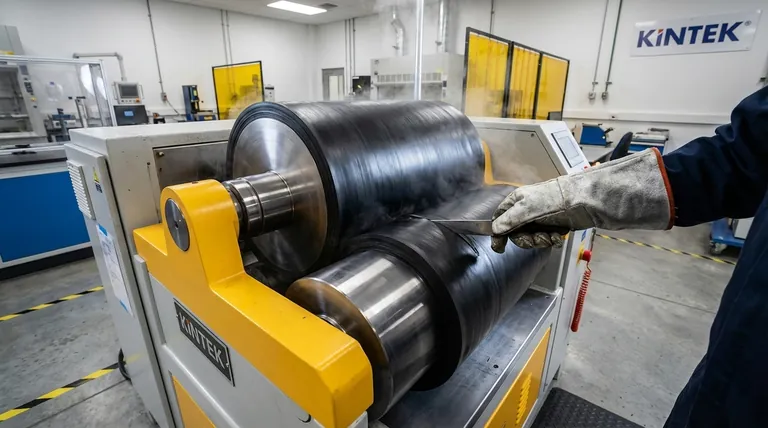
During operation, the material will form a continuous sheet, or "band," that wraps around the faster roll.

To ensure all parts of the batch receive the same amount of work, the operator must manually use a knife to cut this band and fold it back into the nip repeatedly. This step is essential for guaranteeing a homogenous final product.

Understanding the Trade-offs

While powerful, the two-roll mill is a classic piece of machinery with inherent limitations that are important to recognize.

High Demand on Operator Skill

The quality and consistency of the final mix are heavily dependent on the skill of the operator. Their technique in cutting, folding, and managing the material band directly impacts the outcome, leading to potential batch-to-batch variability.

Safety and Exposure

As an "open" system, there are significant safety considerations. Operators are in close proximity to powerful rotating machinery and can be exposed to fumes or dust generated from the material being mixed.

Limited Automation

Compared to modern internal mixers (like a Banbury mixer), the two-roll mill is a labor-intensive, manual process. It is generally better suited for smaller batches, laboratory work, or situations requiring precise visual control over the mix.

Making the Right Choice for Your Goal

Controlling the outcome on a two-roll mill means understanding how to manipulate its key variables to achieve your specific objective.

  • If your primary focus is distributive mixing (spreading additives evenly): Emphasize repeated cutting and cross-blending of the material band to ensure all parts of the batch are circulated through the nip.
  • If your primary focus is dispersive mixing (breaking down tough particle clumps): Operate with a tighter nip gap to maximize compressive force and increase the local shear rate on the material.
  • If your primary focus is controlling material temperature: Carefully balance the nip gap setting and mixing time, as a tighter gap and longer cycle will both dramatically increase heat buildup.

By mastering the interplay between roll speed, nip gap, and manual technique, you can effectively control the mixing process to achieve your desired compound properties.

Summary Table:

Mechanism Function Key Outcome
Differential Speed Creates shear force by pulling material layers apart. Distributive mixing (even spreading of particles).
Nip Gap Compression Applies intense squeezing force in the narrow roll gap. Dispersive mixing (breaking down agglomerates).
Frictional Heat Softens the material, lowering viscosity. Easier incorporation and uniform blending of additives.

Ready to achieve a perfect, uniform mix in your lab? The principles of a two-roll mill are foundational for material processing. KINTEK specializes in high-quality lab equipment, including mills and mixers, designed to deliver precise control and reliable results for your laboratory needs. Contact our experts today to find the ideal solution for your mixing challenges and enhance your R&D or quality control processes.

Visual Guide
What is the principle of mixing on open two roll mill? Master Shear, Compression & Heat for Uniform Blending Visual Guide

Related Products

People Also Ask

Related Products

Open Type Two Roll Mixing Mill Machine for Rubber Crusher

Open Type Two Roll Mixing Mill Machine for Rubber Crusher

Rubber crusher open mixing mill/Open two roller rubber mixing mill machine is suitable for mixing and dispersing rubber, plastic raw materials, pigments, masterbatches and other high molecular polymers.

High Energy Vibratory Laboratory Ball Mill Double Tank Type

High Energy Vibratory Laboratory Ball Mill Double Tank Type

High-energy vibration ball mill is a small desktop laboratory grinding instrument. It uses 1700r/min high-frequency three-dimensional vibration to make the sample achieve the result of grinding or mixing.

Laboratory Single Horizontal Jar Mill

Laboratory Single Horizontal Jar Mill

KT-JM3000 is a mixing and grinding instrument for placing a ball milling tank with a volume of 3000ml or less. It adopts frequency conversion control to realize timing, constant speed, direction change, overload protection and other functions.

Laboratory Disc Cup Vibratory Mill for Sample Grinding

Laboratory Disc Cup Vibratory Mill for Sample Grinding

The vibrating disc mill is suitable for non-destructive crushing and fine grinding of samples with large particle sizes, and can quickly prepare samples with analytical fineness and purity.

Laboratory Planetary Ball Mill Rotating Ball Milling Machine

Laboratory Planetary Ball Mill Rotating Ball Milling Machine

KT-P400E is a desktop multi-directional planetary ball mill with unique grinding and mixing capabilities. It offers continuous and intermittent operation, timing, and overload protection, making it ideal for various applications.

Laboratory Jar Mill with Agate Grinding Jar and Balls

Laboratory Jar Mill with Agate Grinding Jar and Balls

Grind your materials with ease using Agate Grinding Jars with Balls. Sizes from 50ml to 3000ml, perfect for planetary and vibration mills.

Disc Cup Vibrating Mill Multi-Platform for Lab

Disc Cup Vibrating Mill Multi-Platform for Lab

The multi-platform vibrating disc mill is suitable for non-destructive crushing and fine grinding of samples with large particle sizes. It is suitable for crushing and grinding applications of medium-hard, high-hard, brittle, fibrous, and elastic materials.

Laboratory Grinding Mill Mortar Grinder for Sample Preparation

Laboratory Grinding Mill Mortar Grinder for Sample Preparation

KT-MG200 mortar grinder can be used for mixing and homogenizing powder, suspension, paste and even viscous samples. It can help users realize the ideal operation of sample preparation with more regularization and higher repeatability.

Laboratory Planetary Ball Mill Cabinet Planetary Ball Milling Machine

Laboratory Planetary Ball Mill Cabinet Planetary Ball Milling Machine

The vertical cabinet structure combined with ergonomic design enables users to obtain the best comfortable experience in standing operation. The maximum processing capacity is 2000ml, and the speed is 1200 revolutions per minute.

Laboratory Four-Body Horizontal Jar Mill

Laboratory Four-Body Horizontal Jar Mill

The four-body horizontal tank mill ball mill can be used with four horizontal ball mill tanks with a volume of 3000ml. It is mostly used for mixing and grinding laboratory samples.

Hybrid High Energy Vibratory Ball Mill for Lab Use

Hybrid High Energy Vibratory Ball Mill for Lab Use

KT-BM400 is used for rapid grinding or mixing of dry, wet and frozen small amount of samples in the laboratory. It can be configured with two 50ml ball mill jars

Mini Planetary Ball Mill Machine for Laboratory Milling

Mini Planetary Ball Mill Machine for Laboratory Milling

Discover the KT-P400 desktop planetary ball mill, ideal for grinding and mixing small samples in the lab. Enjoy stable performance, long service life, and practicality. Functions include timing and overload protection.

Laboratory Ten-Body Horizontal Jar Mill for Lab Use

Laboratory Ten-Body Horizontal Jar Mill for Lab Use

The Ten-body horizontal jar mill is for 10 ball mill pots (3000ml or less). It has frequency conversion control, rubber roller movement, and PE protective cover.

High Energy Vibratory Ball Mill for Lab Use

High Energy Vibratory Ball Mill for Lab Use

The high-energy vibrating ball mill is a high-energy oscillating and impacting multifunctional laboratory ball mill. The table-top type is easy to operate, small in size, comfortable and safe.

Laboratory Horizontal Planetary Ball Mill Milling Machine

Laboratory Horizontal Planetary Ball Mill Milling Machine

Improve sample uniformity with our Horizontal Planetary Ball Mills. KT-P400H reduces sample deposition and KT-P400E has multi-directional capabilities. Safe, convenient and efficient with overload protection.

High Energy Planetary Ball Mill Milling Machine for Laboratory

High Energy Planetary Ball Mill Milling Machine for Laboratory

The biggest feature is that the high energy planetary ball mill can not only perform fast and effective grinding, but also has good crushing ability

High-Energy Omnidirectional Planetary Ball Mill Milling Machine for Laboratory

High-Energy Omnidirectional Planetary Ball Mill Milling Machine for Laboratory

The KT-P4000E is a new product derived from the vertical high-energy planetary ball mill with a 360° swivel function. Experience faster, uniform, and smaller sample output results with 4 ≤1000ml ball mill jars.

High Energy Planetary Ball Mill for Laboratory Horizontal Tank Type Milling Machine

High Energy Planetary Ball Mill for Laboratory Horizontal Tank Type Milling Machine

KT-P4000H uses the unique Y-axis planetary motion trajectory, and utilizes the collision, friction and gravity between the sample and the grinding ball to have a certain anti-sinking ability, which can obtain better grinding or mixing effects and further improve the sample output.

High Energy Vibratory Laboratory Ball Mill Grinding Mill Single Tank Type

High Energy Vibratory Laboratory Ball Mill Grinding Mill Single Tank Type

High-energy vibration ball mill is a small desktop laboratory grinding instrument.It can be ball-milled or mixed with different particle sizes and materials by dry and wet methods.

High Energy Planetary Ball Mill Milling Machine for Laboratory

High Energy Planetary Ball Mill Milling Machine for Laboratory

Experience fast and effective sample processing with the F-P2000 high-energy planetary ball mill. This versatile equipment offers precise control and excellent grinding capabilities. Perfect for laboratories, it features multiple grinding bowls for simultaneous testing and high output. Achieve optimal results with its ergonomic design, compact structure, and advanced features. Ideal for a wide range of materials, it ensures consistent particle size reduction and low maintenance.


Leave Your Message