The primary purpose of a cooling jacket in a Continuous Stirred Tank Reactor (CSTR) is critical thermal management. During the production of Carboxymethyl Cellulose (CMC), the specific etherification reaction between cellulose and monochloroacetic acid is exothermic, meaning it releases significant energy as heat. The cooling jacket circulates a cooling medium around the vessel to actively remove this excess heat, preventing dangerous temperature spikes.
The etherification process is inherently exothermic; without active cooling, heat accumulation leads to product degradation. A cooling jacket is the primary defense against this, ensuring isothermal conditions to maximize efficiency and limit unwanted side reactions.
The Thermodynamics of CMC Synthesis
Managing Exothermic Energy
The core chemical reaction in CMC production involves cellulose and monochloroacetic acid. This interaction is exothermic, naturally generating heat as the reaction progresses.
If this heat is not removed immediately, the temperature inside the reactor will rise uncontrolled. The cooling jacket acts as a heat exchanger, absorbing this thermal energy through the reactor walls.
Maintaining Isothermal Conditions
Consistency is key to chemical synthesis. The cooling jacket allows the reactor to operate under isothermal conditions, meaning the temperature remains constant throughout the process.
By circulating a cooling medium at a controlled rate, the jacket counteracts the heat generation of the reaction in real-time. This equilibrium allows for a stable, predictable production environment.
Operational Benefits of Thermal Control
Preventing Product Degradation
Cellulose derivatives are sensitive to thermal stress. If the reactor temperature exceeds specific limits due to the exothermic nature of the process, the polymer chains can begin to break down.
The cooling jacket prevents these thermal spikes. This ensures the structural integrity of the final CMC product is preserved.
Limiting Side Reactions
In chemical kinetics, higher temperatures often lower the activation energy for unwanted chemical pathways.
Uncontrolled heat promotes side reactions that compete with the desired etherification process. By keeping the temperature strictly regulated, the cooling jacket suppresses these side reactions, resulting in higher product purity.
Understanding the Trade-offs
The Risk of Thermal Lag
While a cooling jacket is effective, it relies on heat transfer through the reactor wall. There is often a slight delay, or "lag," between the generation of heat in the center of the reactor and its removal at the wall.
Dependency on Agitation
The cooling jacket only works effectively if the CSTR is perfectly mixed. If the agitation is insufficient, the material near the walls will be cooled, but "hot spots" may persist in the center of the tank, leading to localized degradation.
Making the Right Choice for Your Goal
To optimize your CMC production, you must balance cooling capacity with mixing efficiency.
- If your primary focus is Product Purity: Prioritize a cooling system with rapid response times to eliminate even minor temperature spikes that cause side reactions.
- If your primary focus is Process Safety: Ensure your cooling medium circulation has redundancy to handle maximum exothermic loads without failure.
Effective thermal management is the difference between a high-grade polymer and a degraded byproduct.
Summary Table:
| Feature | Function in CMC Production | Impact on Final Product |
|---|---|---|
| Exothermic Heat Removal | Actively absorbs energy from the etherification reaction | Prevents dangerous thermal spikes and runaway reactions |
| Isothermal Control | Maintains a constant temperature throughout the vessel | Ensures consistent quality and predictable synthesis rates |
| Side Reaction Suppression | Lowers activation energy for unwanted pathways | Maximizes product purity and minimizes waste |
| Chain Protection | Reduces thermal stress on polymer chains | Prevents structural degradation of the cellulose derivative |
Optimize Your Chemical Processing with KINTEK Precision
Achieving the perfect isothermal environment in high-temperature and high-pressure reactors requires more than just a cooling jacket—it requires engineering excellence. At KINTEK, we specialize in providing advanced laboratory equipment designed to handle the most demanding exothermic reactions.
Whether you are producing CMC or developing new polymers, our comprehensive range of CVD reactors, autoclaves, and high-precision cooling solutions ensures your research and production remain stable, safe, and efficient. Our team understands the critical balance between agitation and heat transfer, offering customized systems to eliminate thermal lag and hot spots.
Ready to enhance your lab’s thermal management and product purity?
Contact KINTEK Today to explore our full portfolio of reactors, cooling solutions, and specialized lab consumables tailored for your success.
References
- Wafaa M. Osman, Amel A.A. Nimir. Design Process of CSTR for Production Carboxyl Methyl Cellulose. DOI: 10.47001/irjiet/2023.702004
This article is also based on technical information from Kintek Solution Knowledge Base .
Related Products
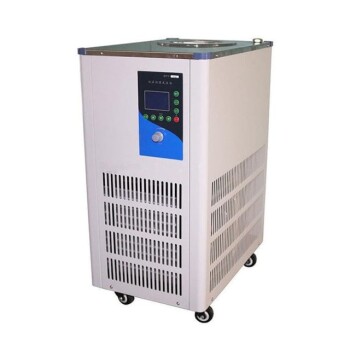
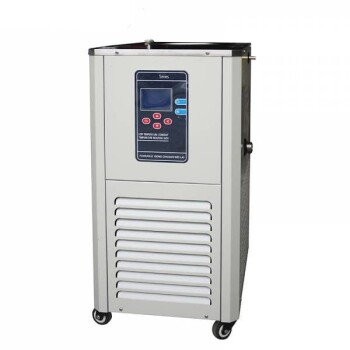
- High Temperature Constant Temperature Heating Circulator Water Bath Chiller Circulator for Reaction Bath
- 100L Chilling Circulator Cooling Water Circulator for Low Temperature Constant Temperature Reaction Bath Water Bath Cooling
- 80L Chilling Circulator Cooling Water Circulator for Water Bath Cooling and Low Temperature Constant Temperature Reaction Bath
- 5L Chilling Circulator Cooling Water Bath Circulator for Low Temperature Constant Temperature Reaction Bath
- 40L Chiller Water Bath Cooling Circulator Low Temperature Constant Temperature Reaction Bath
People Also Ask
- What is the necessity of a circulating water bath in chlorate production? Optimize Yield & Purity with Precision
- How does a constant temperature circulator support the leaching reaction of gold scrap? Optimize Gold Recovery Results
- How do constant temperature circulators impact weight-loss immersion tests? Ensure Precision in Corrosion Analysis
- Why is a constant temperature water bath used for precursor storage in CVD? Achieve Stable Nanocrystalline SiC Deposition
- Why is a high-precision constant temperature water bath necessary for anaerobic digestion? Ensure Success at 37±0.02°C