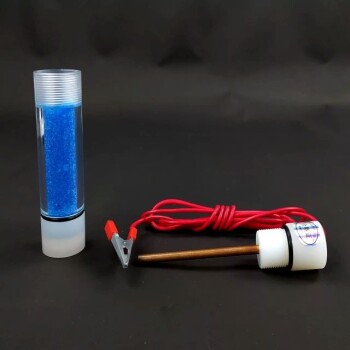
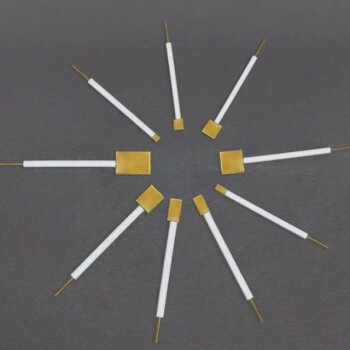
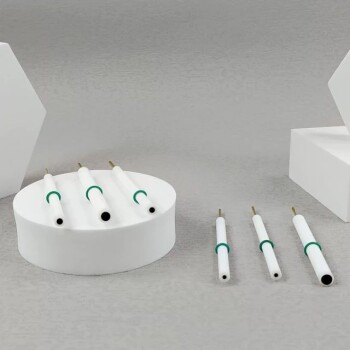
The primary purpose of a Saturated Calomel Electrode (SCE) is to serve as an immutable voltage benchmark. In a three-electrode corrosion testing system, it provides a constant, known reference potential that remains stable regardless of the electrochemical reactions occurring in the cell. This stability ensures that the voltage readings you capture reflect the actual behavior of your test material (the working electrode) rather than artifacts or fluctuations in the measurement system itself.
The SCE acts as the "ground truth" for your data. By isolating voltage measurement from the current-carrying path, it guarantees that corrosion metrics—such as pitting potential and corrosion rate—are accurate, repeatable, and comparable across different laboratories.
The Mechanics of the Three-Electrode System
Isolating Potential from Current
In a standard two-electrode system, the reference point can easily become unstable because significant current flows through it.
A three-electrode configuration solves this by splitting the duties. The working electrode (your sample) and the auxiliary electrode (often platinum or graphite) handle the current loop needed to drive the reaction.
The "Quiet" Observer
The SCE acts as the third component: a "quiet" observer that carries negligible current.
Because it sits outside the high-current path, the SCE does not suffer from polarization interference. This allows it to monitor the potential at the interface of the test coating and the electrolyte with extreme precision.
Why the SCE is the Standard Choice
Absolute Reference Point
Corrosion data is useless without context; you must know where "zero" is.
The SCE provides a scientifically accepted standard potential. This allows for the precise determination of critical values like corrosion potential ($E_{corr}$) and pitting breakdown potential ($E_b$), particularly when evaluating ODS (Oxide Dispersion Strengthened) steels or stainless steel samples.
Reproducibility Across Environments
Scientific validity relies on the ability to replicate results.
Using an SCE ensures that data collected in one batch or laboratory can be directly compared to data from another. Whether testing in saline solutions or other electrolytes, the SCE removes variability from the equation, ensuring the data reflects material properties, not setup inconsistencies.
The Role of the Salt Bridge
Managing Liquid Junction Potential
The SCE typically functions in conjunction with a salt bridge.
This component is critical for reducing liquid junction potential—a voltage error that occurs where two dissimilar solutions meet. By minimizing this interference, the system ensures the voltage reading remains pure.
Preventing Contamination
Direct contact between the harsh test environment and the delicate internal chemistry of the reference electrode is dangerous.
The salt bridge acts as a physical buffer, preventing acidic test solutions from entering the SCE. This protects the internal electrolyte from contamination, preserving the electrode's lifespan and the reliability of the potential data.
Operational Considerations and Limitations
The Necessity of Maintenance
While the SCE provides stability, it is not a "set and forget" component.
The integrity of the salt bridge is paramount; if it becomes clogged or dries out, the electrical continuity breaks, leading to noisy or useless data.
Chemical Compatibility
The barrier provided by the salt bridge is effective, but not invincible.
You must ensure the internal electrolyte of the SCE does not leak into the test solution, which could alter the chemistry of your corrosion environment. Conversely, aggressive diffusion of test analytes into the reference body can permanently drift the reference potential.
Making the Right Choice for Your Goal
To ensure your corrosion testing yields actionable engineering data, consider how the SCE aligns with your specific objectives.
- If your primary focus is scientific benchmarking: Rely on the SCE to define exact values for $E_{corr}$ and $E_b$, as these allow you to publish data that is scientifically comparable to global standards.
- If your primary focus is process quality control: Use the SCE's stability to eliminate measurement drift, ensuring that batch-to-batch variations in your coating protection efficiency are real, not instrumental errors.
The value of the Saturated Calomel Electrode lies in its ability to turn chaotic electrochemical noise into clear, comparable, and actionable data.
Summary Table:
| Feature | Function in Three-Electrode System | Benefit to Corrosion Research |
|---|---|---|
| Reference Potential | Provides an immutable voltage benchmark | Ensures accurate and repeatable $E_{corr}$ and $E_{b}$ values |
| Current Isolation | Sits outside the high-current path | Eliminates polarization interference for clean data |
| Salt Bridge | Manages liquid junction potential | Minimizes voltage errors and prevents chemical contamination |
| Standardization | Acts as a global "ground truth" | Enables data comparison across different laboratories |
Elevate Your Electrochemical Research with KINTEK
Precision in corrosion testing starts with the right tools. KINTEK specializes in high-performance laboratory equipment, offering a comprehensive range of electrolytic cells and electrodes—including precision Saturated Calomel Electrodes—to ensure your data is accurate and scientifically valid.
Whether you are evaluating ODS steels or developing advanced coatings, our portfolio supports every stage of your workflow with:
- Advanced Reactors & Autoclaves for high-pressure environments.
- Precision Crushing & Milling Systems for sample preparation.
- Specialized Battery Research Tools and high-temperature furnaces.
Don't let measurement drift compromise your results. Partner with KINTEK for reliable consumables and cutting-edge laboratory solutions.
Contact Our Experts Today to Optimize Your Lab Setup
References
- Paweł Lochyński, Maciej Karczewski. Electrochemical Reduction of Industrial Baths Used for Electropolishing of Stainless Steel. DOI: 10.1155/2018/8197202
This article is also based on technical information from Kintek Solution Knowledge Base .
Related Products
- Reference Electrode Calomel Silver Chloride Mercury Sulfate for Laboratory Use
- Copper Sulfate Reference Electrode for Laboratory Use
- Gold Disc Electrode
- Platinum Sheet Electrode for Laboratory and Industrial Applications
- Platinum Auxiliary Electrode for Laboratory Use
People Also Ask
- What is the function of a reference electrode? Master Precision in Three-Electrode Reactor Reconstruction
- What is the recommended maintenance for the filling solution of a reference electrode? A Guide to Stable & Accurate Readings
- Which electrode is used as a ground reference? Master the Key to Accurate Electrochemical Measurements
- What is the reference electrode in potentiometry? The Key to Stable & Accurate Measurements
- Which electrode is used as a reference? A Guide to Accurate Electrochemical Measurements