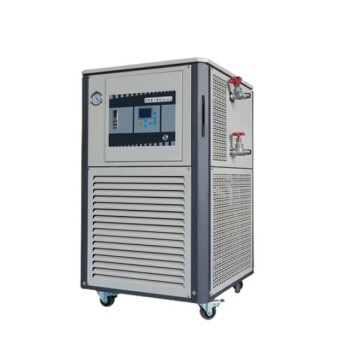
The primary purpose of a water-cooled condenser at a tubular furnace outlet is to act as a thermal barrier for equipment protection. It functions by rapidly cooling gaseous reaction products exiting the high-temperature zone. This process immediately condenses volatile substances, specifically water vapor and hydrogen chloride (HCl), preventing them from traveling further down the line in a gaseous state.
During reduction reactions, the condenser serves as a critical safety checkpoint; it prevents hot, corrosive gases from reaching downstream components like washing bottles or the general exhaust system, effectively neutralizing the threat of heat and chemical damage.
The Mechanics of Protection
Rapid Phase Change
The condenser facilitates an immediate phase change from gas to liquid.
By circulating cold water around the gas path, it strips thermal energy from the exiting vapors. This prevents the high temperatures of the furnace from propagating into the rest of your apparatus.
Neutralizing Corrosive Threats
Reduction reactions frequently generate byproducts like hydrogen chloride (HCl).
In a gaseous, superheated state, HCl is highly aggressive and corrosive. Condensing this into a liquid state confines the corrosive material to a controlled area, preventing it from eating through downstream tubing or seals.
Safeguarding Downstream Components
Protecting Gas Washing Bottles
Gas washing bottles are often the next stage in the filtration line.
If hot gases enter these bottles, they can cause the scrubbing solvents to boil or evaporate. The condenser ensures the gas entering these bottles is cool, maintaining the efficacy of your filtration media.
Preserving the Exhaust Infrastructure
Your laboratory’s exhaust system is likely not designed for high-temperature corrosive vapor.
Allowing hot HCl or steam to enter the building's ventilation can lead to long-term structural damage. The condenser captures these elements before they ever reach the vent.
Operational Trade-offs and Considerations
Management of Toxic Condensate
While the condenser protects the air, it creates a new challenge: liquid waste.
The liquid collected (the condensate) is often highly concentrated and acidic (if HCl is present). You must have a protocol for safely draining and neutralizing this hazardous liquid.
Dependency on Active Cooling
The system introduces a point of failure: the water supply.
If the flow of cooling water stops or the pump fails, the protection vanishes instantly. This requires constant monitoring or flow-interlock systems to ensure the furnace shuts down if cooling is lost.
Ensuring System Reliability
To ensure your setup is safe and effective, consider your primary operational goals:
- If your primary focus is Equipment Longevity: Ensure the condenser surface area is large enough to handle the maximum expected gas flow without allowing "breakthrough" of hot vapors.
- If your primary focus is Laboratory Safety: Implement a flow sensor on the cooling water line that triggers an alarm or furnace shut-off if water circulation fails.
A properly installed condenser effectively isolates the intense conditions of the furnace from the sensitive environment of your laboratory.
Summary Table:
| Feature | Function in Reduction Reactions | Primary Benefit |
|---|---|---|
| Thermal Barrier | Rapidly cools exiting gaseous products | Protects downstream apparatus from heat damage |
| Phase Change | Condenses volatile substances (H2O, HCl) | Confines corrosive materials to a liquid state |
| Exhaust Safety | Prevents hot vapors from entering vents | Preserves laboratory infrastructure and air quality |
| Media Stability | Cools gas before washing bottles | Prevents scrubbing solvents from boiling or evaporating |
Secure Your Laboratory with Precision Engineering from KINTEK
Don’t let corrosive byproducts and extreme temperatures compromise your research. KINTEK specializes in advanced laboratory equipment, including high-performance tubular furnaces, vacuum systems, and CVD solutions designed for maximum durability.
Whether you are conducting complex reduction reactions or scaling up production, our comprehensive range of high-temperature furnaces, high-pressure reactors, and crushing systems ensures your lab operates at peak efficiency and safety.
Ready to upgrade your experimental setup? Contact KINTEK today to discover how our expert-grade furnaces and essential consumables can protect your equipment and streamline your workflow.
References
- Miroslav Sokić, Milorad Gavrilovski. Kinetics of NiO and NiCl<sub>2</sub> Hydrogen Reduction as Precursors and Properties of Produced Ni/Al<sub>2</sub>O<sub>3</sub> and Ni‐Pd/Al<sub>2</sub>O<sub>3</sub> Catalysts. DOI: 10.1155/2015/601970
This article is also based on technical information from Kintek Solution Knowledge Base .
Related Products
- Vacuum Cold Trap Chiller Indirect Cold Trap Chiller
- 1200℃ Split Tube Furnace with Quartz Tube Laboratory Tubular Furnace
- 80L Chilling Circulator Cooling Water Circulator for Water Bath Cooling and Low Temperature Constant Temperature Reaction Bath
- Low-Temperature Water-Cooled Touchscreen Vibratory Ultrafine Pulverizer
- Vacuum Cold Trap Direct Cold Trap Chiller
People Also Ask
- Why are precision Condensers and Cold Traps necessary at the collection end of a pyrolysis system? Maximize Yield & Purity
- Why is it necessary to configure efficient cold traps in membrane distillation? Ensure Flux Stability & Data Accuracy
- What is the purpose of connecting a cold trap at the reactor outlet? Protect Equipment and Analyze Liquid Products
- What is the role of glass condensation components in arsenic collection? Optimize Niccolite Roasting & Kinetics
- What is the function of a cold trap in bio-ethanol and methane reforming experiments? Optimize Purity & Protect Systems