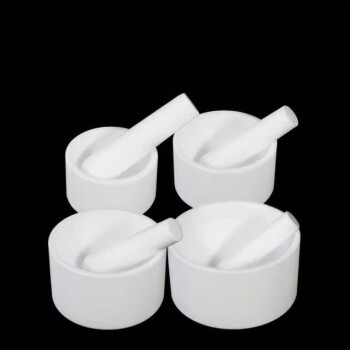
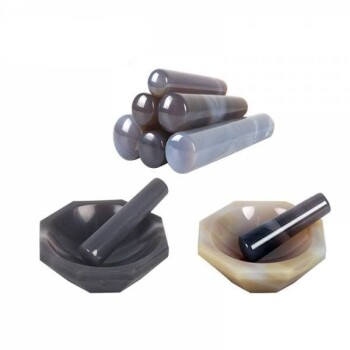
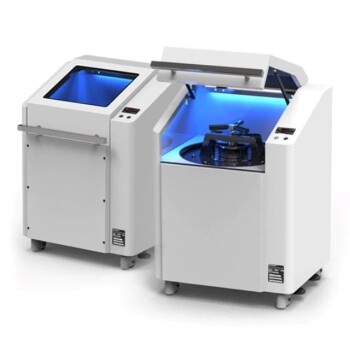
The primary purpose of using a grinding bowl is to facilitate thorough mechanical mixing between active materials, such as biochar-MOF composites, and binders like N-methylpyrrolidone (NMP). This process ensures the fine grinding necessary to integrate active substances and binders at a molecular level, resulting in a paste with the consistent viscosity required for high-quality coating on current collectors.
Core Takeaway Simply mixing components is insufficient for high-performance electrodes; they must be integrated physically. A grinding bowl breaks down particle agglomerates to create a slurry with stable rheology, ensuring a uniform, defect-free application that maximizes electrochemical performance.
The Mechanisms of Slurry Quality
Achieving Molecular-Level Integration
The grinding bowl serves a function far more critical than simple stirring. It applies mechanical force to ensure that active substances and binders are integrated uniformly.
Ideally, this mixing occurs at a molecular level. This deep integration is essential to ensure that the binder effectively holds the active material together without insulating it electrically.
Breaking Down Agglomerates
Raw powders used in electrodes often contain sub-micron clumps, known as agglomerates. If left untreated, these clumps create inconsistencies in the final electrode structure.
Grinding utilizes friction and impact to perform deep grinding, effectively breaking down these agglomerates. This results in an atomic-level uniform distribution of all components throughout the mixture.
Establishing Consistent Viscosity
For an electrode to be manufactured correctly, the slurry must behave predictably during application. This characteristic is known as stable rheology.
Using a grinding bowl homogenizes the mixture to produce a paste with consistent viscosity. This prevents the solid particles from settling out of the solvent and ensures the slurry spreads evenly during coating.
The Link to Coating Performance
Enabling High-Quality Adhesion
The ultimate goal of the slurry preparation is a successful application onto the current collector (the metal foil or grid).
A well-ground slurry creates a smooth, continuous layer. This uniformity is vital for high-quality coating, minimizing defects like pinholes or cracks that could lead to device failure.
Preparing for Advanced Processing
In complex applications, such as Solid Oxide Fuel Cells (SOFC), the slurry may be subjected to spraying or tape casting.
The excellent dispersion achieved through grinding ensures the material creates a uniform film. This is critical for maintaining the structural integrity of the electrode during drying and sintering.
Common Pitfalls and Trade-offs
The Cost of Uniformity
Achieving the necessary level of dispersion is not instantaneous. Deep grinding often requires significant processing time, with some protocols lasting up to 24 hours.
While time-consuming, cutting this process short is a critical error. Insufficient grinding leads to unstable rheology and poor dispersion, rendering the slurry unsuitable for precision coating processes.
Optimization for Your Specific Application
To ensure your electrode slurry meets the requirements of your specific project, consider the following:
- If your primary focus is standard coating quality: Prioritize grinding until the paste reaches a consistent viscosity that allows for smooth, uninterrupted spreading on the current collector.
- If your primary focus is maximizing active surface area: extend the grinding duration to ensure the breakdown of sub-micron agglomerates, achieving the atomic-level distribution required for high-efficiency reactions.
The grinding bowl is not just a mixing tool; it is the gatekeeper of your electrode's structural and electrochemical integrity.
Summary Table:
| Key Function | Impact on Slurry Quality | Benefit to Final Electrode |
|---|---|---|
| Agglomerate Breakdown | Eliminates sub-micron clumps | Ensures atomic-level uniform distribution |
| Molecular Integration | Deeply blends active material & binder | Optimal adhesion without electrical insulation |
| Rheology Stabilization | Achieves consistent viscosity | Prevents settling; ensures defect-free coating |
| Mechanical Grinding | Intense friction and impact | Enables smooth application on current collectors |
Elevate Your Battery Research with KINTEK Precision Solutions
Don't let poor slurry consistency compromise your electrochemical performance. KINTEK specializes in high-performance laboratory equipment designed for the most demanding research environments. From our advanced crushing and milling systems to precision pellet and isostatic hydraulic presses, we provide the tools you need for superior material preparation.
Whether you are developing biochar-MOF composites or next-generation solid-state batteries, KINTEK offers a comprehensive range of high-temperature furnaces, high-pressure reactors, and specialized battery research consumables to ensure your success.
Ready to optimize your electrode fabrication? Contact our technical experts today to find the perfect equipment for your laboratory needs!
References
- Meixiang Gao, Jiaqi Xiao. Application of Fiber Biochar–MOF Matrix Composites in Electrochemical Energy Storage. DOI: 10.3390/polym14122419
This article is also based on technical information from Kintek Solution Knowledge Base .
Related Products
- Custom PTFE Teflon Parts Manufacturer Grinding Bowl
- Nature Agate Mortar and Pestle for Grinding and Mixing
- Laboratory Jar Ball Mill with Alumina Zirconia Grinding Jar and Balls
- Laboratory Ball Mill Jar Mill with Metal Alloy Grinding Jar and Balls
- High Energy Planetary Ball Mill Milling Machine for Laboratory
People Also Ask
- How is PTFE utilized for insulation in Alloy 22 corrosion setups? Ensure Signal Purity & Accuracy
- What are the specific applications of PTFE in micro-batch slug flow systems? Enhance Your Microfluidic Reaction Purity
- Is PTFE corrosion resistant? Discover the Ultimate Chemical Resistance for Your Lab
- What is the primary function of PTFE in Gas Diffusion Electrodes (GDE)? Ensure Peak Electrochemical Performance
- What is the function of PTFE in a gas diffusion electrode? Mastering CO2 Electrolyzer Stability