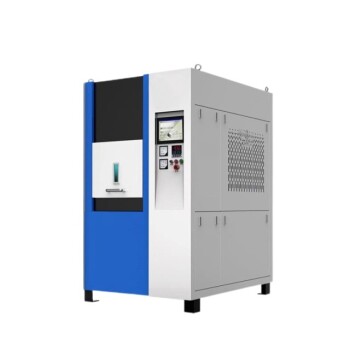
The primary purpose of a high-temperature heat treatment furnace during the pre-sintering of 316L stainless steel is to facilitate the formation of sintering necks between metal particles. This process significantly increases the mechanical strength of components that are extremely fragile following the debinding phase, ensuring they can be handled and transferred to final sintering stages without breaking or deforming.
Core Takeaway: Pre-sintering serves as a critical bridge between debinding and final densification by providing the thermal energy needed to bond particles together, transforming a delicate "brown part" into a structurally sound component capable of withstanding further processing.
Enhancing Structural Integrity for Handling
The Formation of Sintering Necks
During pre-sintering, the furnace raises the temperature to a level where metal atoms begin to migrate across the contact points of individual 316L powder particles. This atomic diffusion creates "sintering necks," which are microscopic bridges that fuse the particles together.
Prevention of Damage and Deformation
Prior to this stage, the removal of binders leaves the 316L component in a porous and highly unstable state. By inducing early-stage bonding, the high-temperature furnace provides the necessary rigidity to prevent the part from collapsing under its own weight or fracturing during manual handling and transfer.
Managing the Material Environment
Oxidation Prevention and Atmosphere Control
316L stainless steel is highly susceptible to oxidation when heated above 1000°C. High-temperature furnaces utilize inert gas environments, such as high-purity argon, or vacuum controls to create an oxygen-free zone.
Preservation of Chemical Composition
Using a controlled atmosphere prevents the loss of critical alloying elements and protects the surface from decarburization. This ensures that the final product maintains the specific corrosion-resistant properties and chemical integrity required for 316L applications.
Thermal Energy for Atomic Migration
The furnace provides a precise, constant thermal environment that drives grain boundary migration. This energy is essential for the initial homogenization of the microstructure, which sets the foundation for a dense, high-strength material in the final sintering stage.
Understanding the Trade-offs
Temperature Precision vs. Energy Costs
While higher temperatures accelerate the formation of sintering necks, excessive heat during the pre-sintering phase can lead to premature shrinkage or non-uniform grain growth. Maintaining a precise "pre-sintering" window is more energy-intensive but vital for dimensional accuracy.
Atmosphere Purity vs. Production Speed
Using high-purity argon or a high vacuum significantly improves surface quality and prevents oxidation. However, achieving and maintaining these environments can increase cycle times and operational costs compared to less rigorous atmospheric controls.
Applying Heat Treatment to Your Project
Recommendations Based on Your Goals
- If your primary focus is structural reliability during assembly: Ensure the pre-sintering temperature is held long enough to develop robust sintering necks that prevent "green part" fracturing.
- If your primary focus is corrosion resistance: Prioritize a furnace with superior atmosphere control (argon or vacuum) to prevent the oxidation of chromium and the loss of other alloying elements.
- If your primary focus is dimensional precision: Use a furnace with high thermal uniformity to ensure that initial particle bonding occurs simultaneously across the entire geometry of the part.
By effectively utilizing a high-temperature furnace for pre-sintering, you ensure that fragile 316L components gain the necessary strength and chemical protection required for successful high-density sintering.
Summary Table:
| Key Pre-Sintering Function | Mechanism | Benefit for 316L Components |
|---|---|---|
| Sintering Neck Formation | Atomic diffusion at particle contact points | Increases mechanical strength for safe handling. |
| Atmosphere Control | Use of high-purity Argon or Vacuum | Prevents oxidation and preserves corrosion resistance. |
| Structural Integrity | Early-stage particle bonding | Prevents deformation or fracturing after debinding. |
| Microstructure Foundation | Grain boundary migration | Ensures base for high-density final sintering. |
Optimize Your 316L Sintering Process with KINTEK
Achieve unmatched precision and structural integrity in your material production. KINTEK specializes in high-performance laboratory equipment, offering an extensive range of high-temperature furnaces (vacuum, atmosphere, muffle, and tube) designed to meet the rigorous demands of 316L stainless steel pre-sintering.
Our thermal solutions provide the stable environments—including high-purity argon and vacuum controls—necessary to prevent oxidation and ensure the chemical integrity of your components. Whether you are scaling production or conducting advanced research, our team is ready to provide the expertise and reliable equipment (including hydraulic presses and milling systems) you need to succeed.
Ready to enhance your lab's efficiency and product quality?
Contact our specialists today for a custom consultation!
References
- Pengfei Zhu, Xuanhui Qu. Investigation on the Attainment of High-Density 316L Stainless Steel with Selective Laser Sintering. DOI: 10.3390/ma17010110
This article is also based on technical information from Kintek Solution Knowledge Base .
Related Products
- High Temperature Muffle Oven Furnace for Laboratory Debinding and Pre Sintering
- Vacuum Heat Treat and Pressure Sintering Furnace for High Temperature Applications
- 2200 ℃ Tungsten Vacuum Heat Treat and Sintering Furnace
- 2200 ℃ Graphite Vacuum Heat Treat Furnace
- 600T Vacuum Induction Hot Press Furnace for Heat Treat and Sintering
People Also Ask
- Why is the annealing treatment in a high-temperature muffle furnace critical for the preparation of an Sb-SnO2 interlayer?
- What is the role of a high-temperature muffle furnace in preparing Cs-aluminosilicate waste? Key Simulation Insights
- What conditions does a muffle furnace provide for molten salt energy storage? Expert Simulation for CSP Environments
- What is the primary function of high-temperature muffle or tube furnaces for ceramic coatings? Ensure Peak Durability
- Why is a high-temp muffle furnace essential for ZnO-WO3 & ZnO-BiOI? Optimize Heterojunction Catalyst Performance