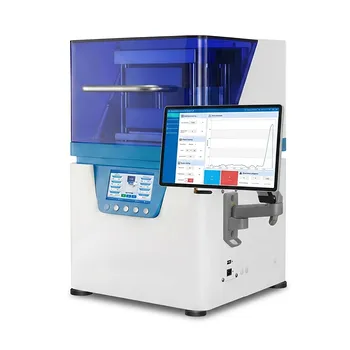
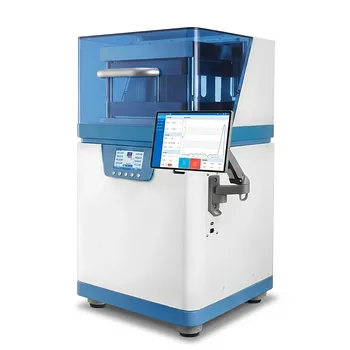
Standardizing the physical form of a catalyst is a prerequisite for accurate performance evaluation. By using a laboratory hydraulic press and standard grading sieves, researchers transform fine catalyst powders into uniform particles with controlled dimensions. This process eliminates physical variables—such as unpredictable pressure drops and mass transfer limitations—ensuring that the observed data reflects the catalyst's intrinsic chemical activity rather than its physical configuration.
The primary purpose of this preparation is to ensure a consistent packing density and particle size within the reactor bed. This standardization allows for precise control over gas flow dynamics and eliminates internal and external diffusion "noise" that would otherwise invalidate the SCR activity results.
Standardizing Reactor Hydrodynamics
Precise Control of Space Velocity
The use of a hydraulic press creates a solid "cake" that is subsequently crushed and sieved to a specific mesh range, such as 40–60 mesh. This uniformity is critical for calculating and maintaining a consistent Gas Hourly Space Velocity (GHSV). Without uniform particles, the volume of the catalyst bed can shift, leading to inconsistent contact times between the flue gas and the catalyst surface.
Eliminating Pressure Drop Fluctuations
In a fixed-bed reactor, uneven particle sizes lead to irregular voids, which cause pressure drop fluctuations. Standard grading sieves ensure that the catalyst bed remains permeable and predictable. By maintaining a uniform flow field, researchers prevent the formation of "preferred paths" where gas bypasses the catalyst, a phenomenon that leads to false readings of low efficiency.
Overcoming Kinetic and Physical Barriers
Minimizing Diffusion and Mass Transfer Limitations
If catalyst particles are too large, the reactant gases (NOx and NH3) cannot reach the inner active sites, a problem known as internal diffusion limitation. Conversely, if the catalyst remains in a fine powder form, it may clump, creating external mass transfer barriers. The pressing and sieving process optimizes the surface-area-to-volume ratio, ensuring that the reaction rate is governed by chemical kinetics rather than the speed of gas transport.
Enhancing Mechanical Integrity
Vanadium-based SCR catalysts are often evaluated in high-flow environments where gas friction can be significant. The hydraulic press provides the necessary compressive strength to ensure particles do not pulverize under the weight of the bed or the force of the gas stream. This prevents the loss of catalyst material and protects downstream equipment from fine powder contamination.
Understanding the Trade-offs and Pitfalls
The Risk of Over-Compression
While high pressure is necessary to form a solid pellet, excessive force can collapse the internal pore structure of the vanadium catalyst. If the molding pressure is too high, the resulting decrease in porosity will compromise the intrinsic catalytic activity. It is essential to find the "sweet spot" where mechanical strength is achieved without sacrificing the active surface area.
Particle Size vs. Signal Accuracy
Choosing the wrong sieve range can lead to data errors. If the particles are sieved too coarsely, localized overheating can occur because the heat of the exothermic SCR reaction is not distributed evenly. If sieved too finely, the bed may become overly dense, leading to excessive backpressure that can damage laboratory-scale reactor seals.
How to Apply This to Your Catalyst Evaluation
When preparing vanadium-based SCR catalysts for evaluation, your choice of pressure and mesh size should align with your specific testing objectives.
- If your primary focus is intrinsic kinetic studies: Use a higher mesh count (smaller particles) to completely eliminate internal diffusion limitations, ensuring the data reflects pure chemical reaction rates.
- If your primary focus is industrial simulation: Choose a particle size and molding pressure that mimics the mechanical stresses and flow characteristics of commercial honeycomb or plate catalysts.
- If your primary focus is comparative screening: Maintain a strictly identical pressing duration and sieve range (e.g., exactly 40-60 mesh) across all samples to ensure that physical differences do not skew the performance ranking.
Standardizing the physical state of your catalyst is the only way to ensure that the results you measure in the lab are reproducible, scalable, and scientifically sound.
Summary Table:
| Process Step | Equipment Used | Primary Purpose | Impact on Evaluation |
|---|---|---|---|
| Compaction | Laboratory Hydraulic Press | Transform powder into a solid "cake" | Enhances mechanical integrity and particle density |
| Sizing | Standard Grading Sieves | Achieve uniform mesh range (e.g., 40–60) | Eliminates mass transfer and diffusion limitations |
| Standardization | Press & Sieve Combo | Control Gas Hourly Space Velocity (GHSV) | Ensures reproducible reactor hydrodynamics and data accuracy |
Elevate Your Catalyst Research with KINTEK Precision
To achieve scientifically sound and reproducible SCR activity results, the physical standardization of your catalyst is non-negotiable. KINTEK specializes in providing high-performance laboratory equipment designed for the rigorous demands of material science.
Our range of manual and automated hydraulic presses ensures optimal pelleting without compromising pore structure, while our standard grading sieves and crushing systems provide the precise particle uniformity required for consistent reactor hydrodynamics. Beyond preparation, we offer the complete testing ecosystem, including high-temperature reactors, high-pressure autoclaves, and furnaces (muffle, tube, vacuum) to evaluate your catalysts under real-world conditions.
Maximize your lab's efficiency and data reliability today.
Contact KINTEK Experts for a Custom Solution
References
- Dongwei Yao, Yuxi Li. Hydrothermal Aging Mechanism and Modeling for SCR Catalysts. DOI: 10.1021/acsomega.2c06902
This article is also based on technical information from Kintek Solution Knowledge Base .
Related Products
- Laboratory Hydraulic Press Lab Pellet Press Machine for Glove Box
- Laboratory Hydraulic Press Split Electric Lab Pellet Press
- Fully Automatic Heated Hydraulic Lab Press for Materials Sintering and Sample Preparation
- Laboratory Hydraulic Press Lab Pellet Press for Button Battery
- Automatic Laboratory Hydraulic Press for XRF & KBR Pellet Press
People Also Ask
- What is the function of a laboratory hydraulic press in W-Cu composites? Control Porosity and Material Ratio
- What is the role of a laboratory hydraulic press in the initial stages of Li6PS5Cl preparation? Key to Green Pellets
- What role does a laboratory hydraulic press play in triboelectric testing? Achieve Precision Alloy Sample Prep
- How can a laboratory hydraulic press be applied to chitosan for wastewater treatment? Optimize Pores & Strength
- How do a precision laboratory hydraulic press and specialized molds contribute to the fabrication of spherical ceramic samples? Achieving High-Density Material Precision