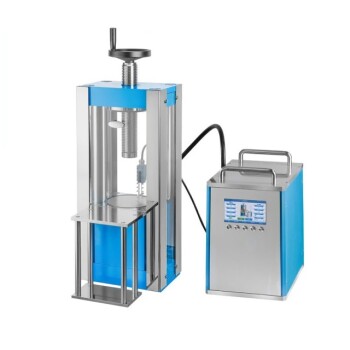
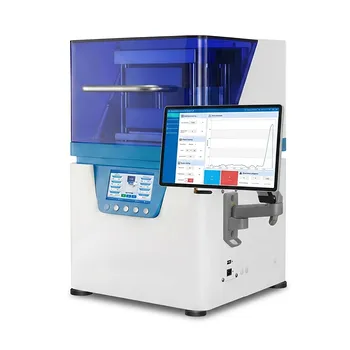
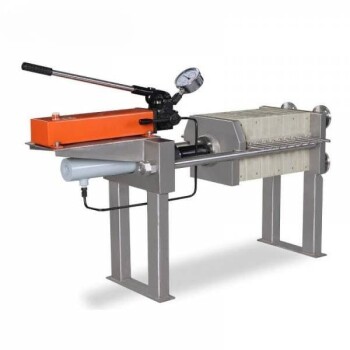
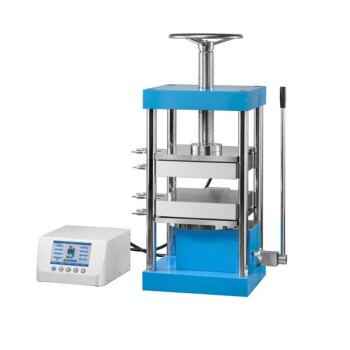
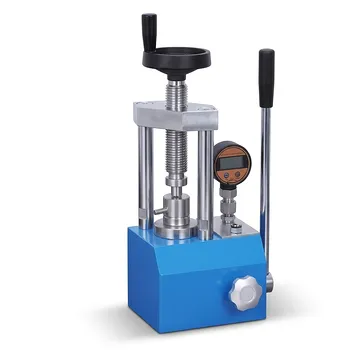
Maximizing interfacial contact is the primary objective. Using a laboratory hydraulic press to form pellets ensures that boron and carbon particles are in intimate physical contact, which is the fundamental requirement for the diffusion-controlled synthesis of Boron Carbide (B4C). This pre-forming step significantly reduces atomic diffusion distances, enabling a complete and uniform phase transformation during high-temperature thermal processing.
The core purpose of pelletizing B4C precursor powders is to transition from loose, disconnected particles to a dense "green body" that facilitates rapid solid-state diffusion. This mechanical compression is essential for achieving high phase purity, preventing material stratification, and ensuring structural uniformity in the final ceramic product.
The Role of Physical Proximity in Synthesis
Reducing Atomic Diffusion Paths
The synthesis of Boron Carbide (B4C) is primarily a diffusion-controlled mechanism. Because atoms must move from one particle to another to react, the distance between the boron source and the carbon source is the limiting factor in reaction speed.
A laboratory hydraulic press forces these particles into a tight packing arrangement. By shortening atomic diffusion paths, the system allows for faster and more consistent chemical reactions during the heating cycle.
Enhancing Phase Transformation Efficiency
Without high-pressure compaction, loose powders often result in incomplete reactions or the formation of undesirable intermediate phases. Pelleted powders facilitate a more complete phase transformation when processed in a high-temperature furnace.
This physical compression ensures that as temperature increases, the reactive components are already positioned to recombine into the target B4C phase. This results in a final product with higher crystallinity and phase purity.
Engineering the "Green Body" Characteristics
Eliminating Entrapped Air and Increasing Density
Applying initial pressure (pre-pressing) inside a mold serves to expel entrapped air between the powder particles. This initial densification creates a green compact with sufficient mechanical strength to be handled and processed further.
Removing air and increasing the green body density also improves the efficiency of subsequent vacuum hot pressing or sintering. A denser starting pellet leads directly to a more robust and less porous final product.
Controlling Porosity for Secondary Processes
In specific applications, such as the creation of B4C-aluminum composites, the press is used to create a ceramic skeleton with controlled porosity. The specific hydraulic pressure applied—often up to 373 MPa—determines how well molten metal can later infiltrate the material.
By carefully controlling the density of the pellet, technicians can determine the final phase content and the filling efficiency of subsequent infiltration processes. This level of control is impossible with loose, uncompacted powders.
Understanding the Trade-offs
The Risk of Density Gradients
While high pressure is beneficial, applying it unevenly can lead to density gradients within the pellet. If one part of the pellet is denser than another, the diffusion rates will vary, potentially leading to structural non-uniformity or warping during sintering.
Microstructural Stress and Cracking
Excessive pressure can occasionally cause lamination or micro-cracks in the green body, especially if the powder lacks a binder or has air trapped in the center. These defects can weaken the final ceramic or cause the pellet to fail catastrophically when subjected to high furnace temperatures.
How to Apply This to Your Project
When preparing Boron Carbide precursor powders, your choice of pressing parameters should align with your specific material requirements and downstream equipment.
- If your primary focus is maximizing phase purity: Use higher hydraulic pressures to ensure the shortest possible diffusion paths for a complete solid-state reaction.
- If your primary focus is subsequent metal infiltration: Carefully calibrate the pressure to achieve a specific green body density that allows for optimal molten metal flow through the pores.
- If your primary focus is preventing material loss: Use pelletization to suppress the volatilization of components and prevent the material from stratifying within the furnace during heating.
By mastering the mechanical compaction of precursor powders, you lay the necessary foundation for high-performance ceramic synthesis.
Summary Table:
| Key Role | Mechanical/Chemical Function | Impact on B4C Quality |
|---|---|---|
| Maximizing Contact | Reduces atomic diffusion distances between B and C particles. | Faster, more complete phase transformation. |
| Densification | Expels entrapped air to create a dense "green body." | Higher final crystallinity and reduced porosity. |
| Structural Control | Eliminates material stratification and ensures uniform packing. | Prevents warping and structural non-uniformity. |
| Porosity Tuning | Calibrates pellet density for secondary processes (e.g., infiltration). | Optimized filling efficiency for metal-ceramic composites. |
Elevate Your Ceramic Synthesis with KINTEK Precision
Achieving high-purity Boron Carbide requires more than just high temperatures—it demands perfect precursor preparation. At KINTEK, we specialize in the high-performance laboratory equipment essential for advanced material science.
Whether you are forming high-density pellets with our manual or automatic hydraulic presses or performing final sintering in our high-temperature vacuum or atmosphere furnaces, our tools are engineered for consistency and durability. From crushing and milling systems to ensure particle uniformity to high-pressure reactors and specialized crucibles, KINTEK provides the end-to-end solutions your lab needs to achieve superior structural and phase purity.
Ready to optimize your B4C production? Contact KINTEK today to discuss how our pelletizing and thermal processing solutions can enhance your research outcomes!
References
- Seyed Faridaddin Feiz, Esmaeil Salahi. Influences of mechanical activation and tartaric acid addition on the efficiency of B4C synthesis. DOI: 10.53063/synsint.2023.31140
This article is also based on technical information from Kintek Solution Knowledge Base .
Related Products
- Laboratory Hydraulic Press Lab Pellet Press Machine for Glove Box
- Laboratory Hydraulic Press Split Electric Lab Pellet Press
- Fully Automatic Heated Hydraulic Lab Press for Materials Sintering and Sample Preparation
- Laboratory Hydraulic Press Lab Pellet Press for Button Battery
- Automatic Laboratory Hydraulic Press for XRF & KBR Pellet Press
People Also Ask
- How do laboratory hydraulic presses contribute to zero-gap electrolyzers? Optimize Performance & Safety
- Why is a laboratory hydraulic press necessary for ZrO2/Cr2O3 interface analysis? Optimize Sample Density and Accuracy
- How do a precision laboratory hydraulic press and specialized molds contribute to the fabrication of spherical ceramic samples? Achieving High-Density Material Precision
- What is the role of a laboratory hydraulic press in the preparation of rare earth denitrification catalysts?
- How does pressure control of a laboratory hydraulic press affect W-Ti alloys? Optimize Grain Structure & Density