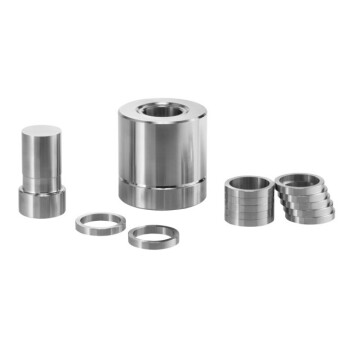
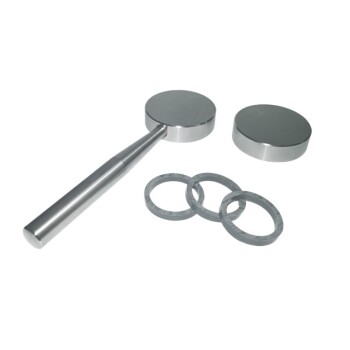
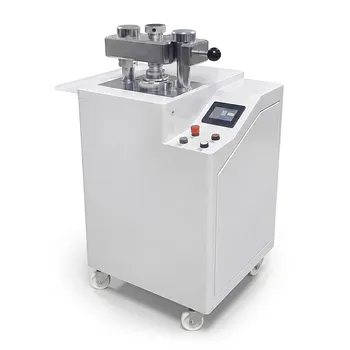
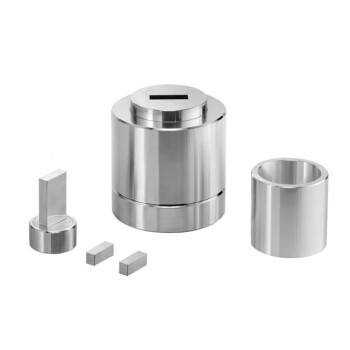
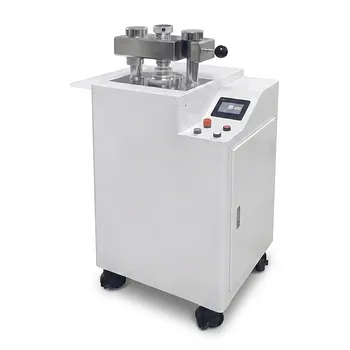
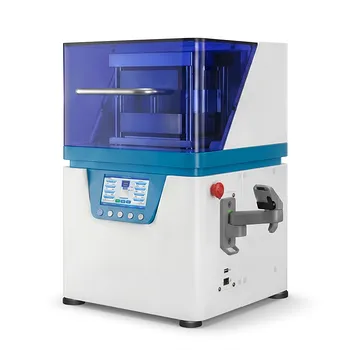
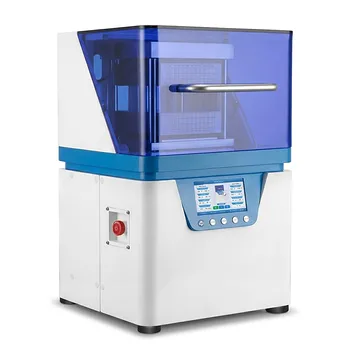
The primary purpose of a laboratory pellet press in carbon powder analysis is the elimination of inter-particle contact resistance. By applying significant mechanical pressure, the press transforms loose, air-filled powder into a dense, uniform pellet with standardized dimensions. This physical densification ensures that subsequent electrical measurements reflect the intrinsic electronic transmission capability of the material itself rather than the bulk packing state of the powder.
Using a pellet press standardizes the physical environment of carbon particles, creating robust electrical contact channels and eliminating voids. This process is essential for obtaining accurate, reproducible conductivity data that characterizes the material's true performance.
Overcoming the Challenges of Powder Morphology
Bridging the Gap Between Particles
Loose carbon powders are characterized by high surface area and significant air gaps, which act as insulators. A laboratory pellet press applies high pressure—often ranging from 20 MPa to over 400 MPa—to force these particles into intimate physical contact. This compression establishes robust electrical contact channels, allowing electrons to flow across particle boundaries without the interference of high resistance.
Eliminating Voids and Porosity
Internal voids and high porosity within a powder sample can lead to artificially low conductivity readings. The pelletizing process physically eliminates these voids, ensuring the sample reaches a high compaction density. By reducing the "grain boundary resistance," the resulting measurement more accurately reflects the interconnected nature of the material’s molecular or crystalline structure, such as graphene sheets.
Ensuring Data Accuracy and Reproducibility
Standardizing Geometric Dimensions
For conductivity measurements to be valid, the geometry of the sample must be consistent and measurable. A pellet press creates uniform, flat discs or cylindrical pellets with precise dimensions. This standardization allows researchers to use the four-probe method or semiconductor analyzers to calculate conductivity with high mathematical confidence.
Monitoring Dynamic Relationships
Advanced hydraulic presses allow for the synchronous recording of conductivity, applied pressure, and compaction density. By integrated conductivity modules, researchers can observe how electronic transmission changes under variable loads. This data is critical for identifying how carbon materials will perform in real-world applications, such as electrode networks in batteries or fuel cells.
Understanding the Trade-offs and Pitfalls
Risk of Structural Deformation
Applying extreme pressure can occasionally alter the intrinsic morphology of certain carbonaceous materials. If the pressure is too high (e.g., exceeding 490 MPa), it may crush delicate "spine-like" or porous structures, potentially changing the material's properties before the test begins. It is vital to determine the optimal pressure threshold that ensures density without compromising structural integrity.
The Influence of Binders
In some cases, a small amount of PTFE binder is mixed with the powder to help the pellet hold its shape. While binders improve mechanical stability, they are typically non-conductive and can introduce a new variable into the measurement. Researchers must carefully account for the volume fraction of these additives to avoid masking the true electronic properties of the carbon powder.
Making the Right Choice for Your Goal
To achieve the best results when preparing carbon powder samples, align your pressing strategy with your specific analytical objectives:
- If your primary focus is measuring intrinsic material properties: Use high-pressure pelletization (above 200 MPa) to minimize all contact resistance and eliminate internal voids.
- If your primary focus is simulating real-world battery electrodes: Utilize a press with a precision pressure-holding function to measure conductivity at the specific compaction density found in the final device.
- If your primary focus is sample durability and handling: Incorporate a minimal amount of binder and use a hydraulic press to create uniform, sieved particles that resist mechanical failure.
By precisely controlling the physical state of your carbon powder through pelletization, you transition from measuring "bulk behavior" to uncovering the true electronic potential of your material.
Summary Table:
| Key Function | Role in Conductivity Analysis | Impact on Results |
|---|---|---|
| Elimination of Voids | Removes insulating air gaps between particles | Enhances measurement accuracy |
| Contact Resistance | Establishes robust electrical contact channels | Reflects intrinsic conductivity |
| Geometric Standardization | Creates uniform discs or cylindrical pellets | Facilitates precise calculations |
| Densification Control | Reaches optimal compaction density (20-400+ MPa) | Mimics real-world applications |
Optimize Your Material Analysis with KINTEK Precision
Achieving accurate conductivity data starts with flawless sample preparation. KINTEK specializes in high-performance laboratory equipment, offering a comprehensive range of hydraulic pellet presses (manual, electric, and automatic), as well as isostatic and hot presses designed specifically for demanding research environments.
Whether you are characterizing graphene, battery electrodes, or advanced carbon powders, our equipment ensures the density and uniformity required for reproducible results. Beyond presses, we provide a full suite of solutions including high-temperature furnaces, crushing systems, and specialized consumables like PTFE products and crucibles to support your entire workflow.
Ready to elevate your lab's efficiency? Contact our technical experts today for a tailored consultation and discover how KINTEK can enhance your material characterization capabilities.
References
- Huaxin Gong, Zhenan Bao. Carbon flowers as electrocatalysts for the reduction of oxygen to hydrogen peroxide. DOI: 10.1007/s12274-023-5903-8
This article is also based on technical information from Kintek Solution Knowledge Base .
Related Products
- Laboratory Hydraulic Pellet Press for XRF KBR FTIR Lab Applications
- Automatic Laboratory Hydraulic Pellet Press Machine for Lab Use
- Laboratory Manual Hydraulic Pellet Press for Lab Use
- Laboratory Manual Hydraulic Pellet Press for Lab Use
- Automatic Laboratory Hydraulic Press for XRF & KBR Pellet Press
People Also Ask
- What is the role of a laboratory hydraulic pellet press and stainless steel molds in the fabrication of RuO2/NbC anodes?
- What is the necessity of using a laboratory hydraulic pellet press in the preparation of biomass fuel pellets? Guide
- What is the significance of applying 200 MPa of pressure with a laboratory hydraulic pellet press for composite ceramics?
- How does a laboratory hydraulic pellet press contribute to SiCw/2024 aluminum composite preforms? Optimize Densification
- What function does a laboratory pellet press or rolling mill serve? Enhance Electrode Density and Performance