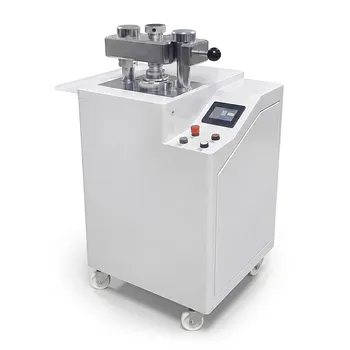
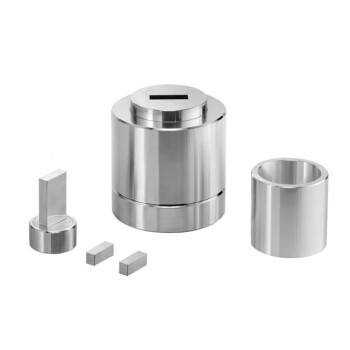
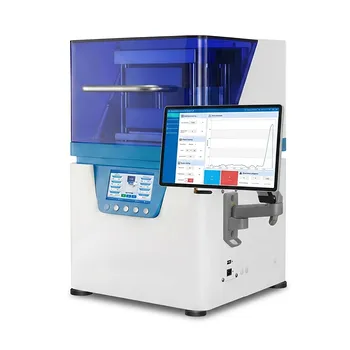
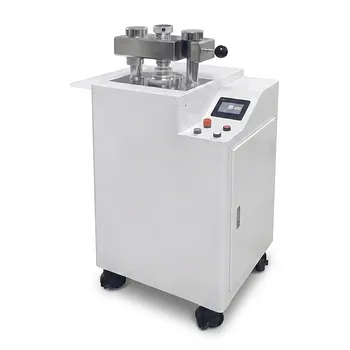
The laboratory hydraulic pellet press is the essential tool for transforming loose, low-density biomass waste into standardized, high-energy fuel samples. By applying precise mechanical loads, these presses increase the energy density and mechanical strength of raw materials like sawdust or straw. This transformation is necessary to ensure that laboratory combustion experiments are stable, repeatable, and representative of industrial-scale energy production.
The core necessity of a laboratory hydraulic pellet press lies in its ability to densify biomass for improved energy output while providing a controlled environment to determine the optimal pressure, temperature, and moisture parameters required for industrial-scale manufacturing.
Enhancing Physical and Energy Characteristics
Achieving High Energy Density
Raw biomass is naturally bulky and has a low bulk density, which makes it inefficient to transport and store. The hydraulic press uses high-pressure physical extrusion to compact wood or agricultural powders into dense cylindrical pellets.
This process significantly increases the energy density per unit volume. It allows researchers to simulate the transport and feeding characteristics of commercial fuels, ensuring the material is viable for real-world application.
Improving Mechanical Strength and Durability
A hydraulic press imparts the mechanical strength necessary for pellets to remain intact during the rigors of transportation and storage. By applying a stable pressure load, the press ensures the pellets resist fracturing or crumbling back into dust.
Researchers use this equipment to quantitatively measure vertical compressive strength and radial tensile strength. These metrics are vital for evaluating how different binders or moisture levels affect the physical integrity of the final fuel product.
Precision for Scientific Research and Repeatability
Standardization of Experimental Samples
For scientific experiments to be valid, samples must be uniform in dimension and density. The laboratory press creates pellets with standardized dimensions, such as a specific diameter (e.g., 15mm) and length.
This uniformity allows for precise mass-percentage blending with other materials, such as coal powders. It ensures that variables in combustion or thermochemical conversion studies are controlled, leading to accurate and stable data.
Studying Material Behavior and Agglomeration
Biomass materials often exhibit particle swelling, which can increase volume by 50-80% after compression. The laboratory press allows researchers to monitor this behavior and study how natural tars act as binders.
Understanding these internal chemical and physical reactions is critical for ensuring the repeatability of experimental data. Without the controlled environment of a hydraulic press, the unpredictable nature of loose biomass would compromise research findings.
Bridging the Gap to Industrial Production
Simulating Industrial Molding Processes
Laboratory presses can simulate single-hole molding by providing precise compression pressures, often ranging from 200 to 555 MPa. They allow for the adjustment of die wall temperatures between 60°C and 130°C.
By manipulating these variables, researchers can identify the optimal pressure curves and stability boundaries for specific materials. This data is the foundation for designing industrial-scale pellet mill dies and optimizing manufacturing workflows.
Predicting Energy Consumption and Friction
The laboratory environment allows for the recording of extrusion friction during the pelletization process. This is a critical metric for predicting the energy requirements of a full-scale industrial facility.
By analyzing the force required to eject a pellet from the die, engineers can calculate the energy efficiency of the fuel production process. This step is essential for determining the economic viability of new biomass sources.
Understanding the Trade-offs and Limitations
Batch vs. Continuous Production
A laboratory hydraulic press is a batch-processing tool, meaning it produces one or a few pellets at a time. This differs significantly from industrial pellet mills, which use continuous extrusion through rotating dies.
While the lab press provides high precision for individual samples, it may not perfectly replicate the heat accumulation or mechanical wear found in 24/7 industrial operations. Results must be scaled carefully when moving from the lab to the factory floor.
Material Sensitivity
Different biomass types—such as straw versus hardwood—respond differently to high pressures. The elastic recovery of certain materials can cause pellets to crack if the pressure is released too quickly in a manual press.
Consistency in "holding time" (how long the pressure is maintained) is critical. Variations in how a technician operates a manual hydraulic press can lead to slight discrepancies in pellet density compared to automated industrial systems.
How to Apply This to Your Research or Production
Making the Right Choice for Your Goal
- If your primary focus is experimental accuracy: Use a press with precise pressure gauges and standardized die sets to ensure your samples are perfectly uniform for combustion testing.
- If your primary focus is industrial scaling: Prioritize a press with controllable die wall heating and friction-recording capabilities to accurately simulate factory conditions.
- If your primary focus is material durability: Focus on evaluating the relationship between moisture content and radial tensile strength to optimize your binder recipes.
The laboratory hydraulic pellet press is the definitive tool for turning raw ecological waste into a sophisticated, high-performance energy source.
Summary Table:
| Requirement | Laboratory Necessity | Key Outcome |
|---|---|---|
| Energy Density | Compresses bulky raw waste | Increased energy per unit volume |
| Durability | Quantifies mechanical strength | Pellets resist fracture during transit |
| Standardization | Creates uniform sample sizes | repeatable combustion data |
| Scaling | Simulates P & T variables | Foundation for industrial manufacturing |
Ready to Optimize Your Biomass Research?
Precision is the key to transforming raw waste into high-performance fuel. KINTEK specializes in advanced laboratory equipment designed for accuracy and durability. Our high-performance hydraulic presses (pellet, hot, and isostatic) ensure your samples meet the most rigorous standards for energy density and mechanical strength.
Beyond pellet preparation, KINTEK provides a comprehensive range of crushing and milling systems, high-temperature furnaces (muffle, tube, vacuum), and high-pressure reactors to support your entire material science workflow. Whether you are a researcher refining fuel recipes or an industrial distributor looking for reliable OEM/ODM support and certified supply reliability, we deliver the tools you need to succeed.
References
- Suyatno Suyatno, Yudi Hidayat. Investigation on Potential of Slagging Fouling and Corrosion in Co-firing Bituminous Coal and Sorghum Waste Pellet. DOI: 10.24912/ijaste.v1.i1.197-203
This article is also based on technical information from Kintek Solution Knowledge Base .
Related Products
- Laboratory Hydraulic Pellet Press for XRF KBR FTIR Lab Applications
- Automatic Laboratory Hydraulic Pellet Press Machine for Lab Use
- Laboratory Manual Hydraulic Pellet Press for Lab Use
- Automatic Laboratory Hydraulic Press for XRF & KBR Pellet Press
- Laboratory Hydraulic Press Lab Pellet Press for Button Battery
People Also Ask
- What is the role of a laboratory hydraulic pellet press and stainless steel molds in the fabrication of RuO2/NbC anodes?
- How does a laboratory hydraulic pellet press contribute to SiCw/2024 aluminum composite preforms? Optimize Densification
- What is the significance of applying 200 MPa of pressure with a laboratory hydraulic pellet press for composite ceramics?
- What function does a laboratory pellet press or rolling mill serve? Enhance Electrode Density and Performance
- What key role does a laboratory pellet press play in FTIR analysis? Master KBr Sample Preparation Excellence