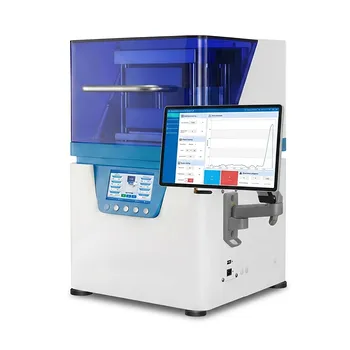
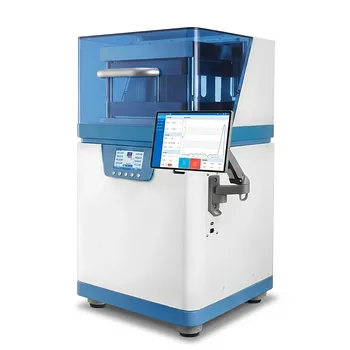
The laboratory hydraulic press is the critical instrument for transforming raw Ti3C2Tx MXene powder into high-density, standardized forms required for rigorous testing. By applying precise uniaxial pressure, it enables researchers to eliminate internal voids, optimize electrical connectivity, and produce the uniform thin films necessary for both performance validation and Life Cycle Assessment (LCA) optimization.
The hydraulic press serves as the bridge between synthesized MXene powder and functional material characterization. Its primary role is to ensure sample uniformity and high structural density, which are fundamental to achieving accurate, repeatable data regarding MXene’s electrical, electrochemical, and shielding capabilities.
Performance Optimization through Precision Compaction
Achieving Uniform Density and Controlled Thickness
A high-precision hydraulic press, used with specialized molds, is essential for pressing MXene powder into films with uniform density. This level of control allows for direct performance comparisons against traditional materials like aluminum and copper foil, particularly in Electromagnetic Interference (EMI) shielding applications.
Enhancing Electrical and Electrochemical Connectivity
Applying specific high-pressure loads, often reaching 0.8 GPa, is critical for eliminating pores between particles and increasing structural density. This reduction in contact resistance ensures that electrical measurements—such as those taken via the four-probe method—reflect the material's intrinsic resistivity rather than air-filled voids.
Improving Electrode Stability and Rate Performance
In energy storage research, the press is used to compact MXene slurry or composite powders into dense, free-standing pellets. This compaction enhances the mechanical connection between active material particles and current collectors, significantly improving the cycling stability and rate performance of battery electrodes.
Standardizing Samples for Advanced Spectroscopy
For techniques like X-ray Absorption Spectroscopy (XAS), the press ensures highly consistent sample thickness and density by mixing MXene with binders like cellulose. This standardization is vital for achieving the high signal-to-noise ratio required for accurate transmission-mode measurements.
The Link to Environmental Sustainability
Optimizing Life Cycle Assessment (LCA)
The ability to produce high-quality, high-performance films while minimizing material consumption is a core component of MXene's sustainability profile. By maximizing shielding effectiveness at lower volumes, the hydraulic press helps optimize the overall LCA performance of MXene compared to energy-intensive traditional metals.
Refining Precursor Synthesis and Phase Purity
Sustainability is also addressed during the synthesis of the precursor MAX phase, such as Ti3AlC2. High-pressure compaction of raw material powders facilitates the flow and reaction of elements during sintering, leading to higher phase purity and reducing waste from unsuccessful chemical reactions.
Minimizing Material Waste in Green Body Formation
High-pressure compaction creates a "green body" with optimal density and strength, preventing the sample from cracking or shrinking excessively during high-temperature sintering. This reliability reduces the need for repeated synthesis cycles, thereby conserving raw materials and energy.
Understanding the Trade-offs
Risk of Material Degradation
While high pressure increases density, excessive force can lead to the mechanical degradation of the MXene flakes themselves. Over-compaction may cause structural defects or unwanted phase changes that could negatively impact the very electrical properties the researcher is trying to measure.
Limitations of Cold-Pressing
Cold-pressing is a fundamental step, but it cannot entirely replace the need for thermal treatment in all applications. While it reduces interfacial resistance, it does not achieve the same level of atomic diffusion as sintering, meaning the mechanical strength of cold-pressed pellets may be insufficient for some long-term industrial uses.
How to Apply This to Your Research Goals
Making the Right Choice for Your Goal
To maximize the value of your laboratory hydraulic press when working with Ti3C2Tx, consider the following specific objectives:
- If your primary focus is EMI shielding validation: Use precision molds to create the thinnest possible films with high density to minimize material usage and improve your LCA metrics.
- If your primary focus is electrochemical characterization: Apply pressure in the 4–5 ton range to ensure tight contact between the MXene and the current collector, reducing interfacial resistance for better rate performance.
- If your primary focus is material synthesis and phase purity: Utilize high uniaxial pressure (up to 800 MPa) during precursor compaction to ensure intimate particle contact, which facilitates complete reactions during sintering.
Mastering precision compaction is the definitive step in moving Ti3C2Tx MXene from a laboratory curiosity to a high-performance, sustainable industrial solution.
Summary Table:
| Research Application | Role of Hydraulic Press | Key Research Benefit |
|---|---|---|
| EMI Shielding | Produces uniform thin films | Accurate performance benchmarking vs. metals |
| Electrical Testing | Eliminates internal voids | Ensures measurements reflect intrinsic resistivity |
| Energy Storage | Compacts electrode pellets | Improves cycling stability and rate performance |
| Material Synthesis | High-pressure precursor forming | Increases phase purity and reduces material waste |
| Sustainability | Optimizes sample density | Minimizes material consumption for LCA metrics |
Optimize Your MXene Research with KINTEK Precision
Achieving repeatable, high-performance results with Ti3C2Tx MXene requires the ultimate control over sample density and uniformity. KINTEK specializes in advanced laboratory equipment, offering a premium range of hydraulic presses (pellet, hot, and isostatic) designed to meet the rigorous demands of material science.
By choosing KINTEK, you benefit from:
- Superior Compaction: Eliminate voids and enhance electrical connectivity in your MXene films.
- Sustainability Focus: Minimize material waste and energy consumption during synthesis and testing.
- Comprehensive Support: From specialized molds to high-pressure reactors, we provide the tools needed for cutting-edge characterization.
Don't let sample variability compromise your data. Contact KINTEK today to discuss how our hydraulic systems can enhance your lab's efficiency and sustainability profile.
References
- Mostafa Dadashi Firouzjaei, Babak Anasori. Life‐Cycle Assessment of Ti<sub>3</sub>C<sub>2</sub>T<i><sub>x</sub></i> MXene Synthesis. DOI: 10.1002/adma.202300422
This article is also based on technical information from Kintek Solution Knowledge Base .
Related Products
- Laboratory Hydraulic Press Lab Pellet Press Machine for Glove Box
- Laboratory Hydraulic Press Split Electric Lab Pellet Press
- Fully Automatic Heated Hydraulic Lab Press for Materials Sintering and Sample Preparation
- Laboratory Hydraulic Press Lab Pellet Press for Button Battery
- Automatic Laboratory Hydraulic Press for XRF & KBR Pellet Press
People Also Ask
- How do laboratory hydraulic presses contribute to zero-gap electrolyzers? Optimize Performance & Safety
- Why is a laboratory hydraulic press necessary for ZrO2/Cr2O3 interface analysis? Optimize Sample Density and Accuracy
- How do a precision laboratory hydraulic press and specialized molds contribute to the fabrication of spherical ceramic samples? Achieving High-Density Material Precision
- What is the role of a laboratory hydraulic press in the preparation of rare earth denitrification catalysts?
- How does pressure control of a laboratory hydraulic press affect W-Ti alloys? Optimize Grain Structure & Density