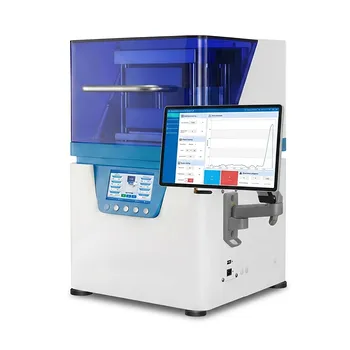
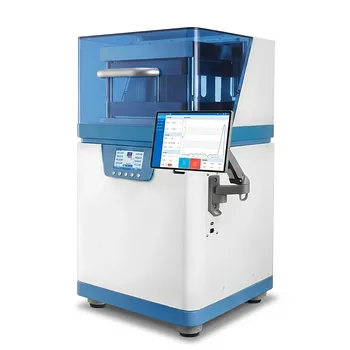
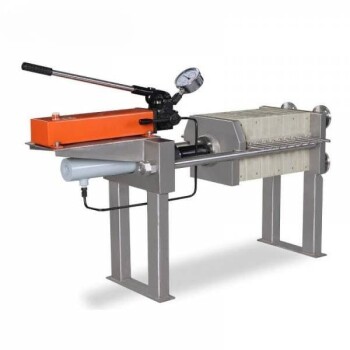
The laboratory hydraulic press is the primary tool for transforming loose zirconia ($ZrO_2$) powder into a dense, geometrically precise "green body" precursor. This mechanical compaction ensures the close particle contact and uniform density required for subsequent high-temperature sintering, resulting in stable, standardized polycrystalline reference materials.
A laboratory hydraulic press serves as the critical bridge between raw powder and a solid specimen. By applying controlled axial pressure, it establishes the initial density and structural framework necessary for the zirconia to survive sintering without warping or cracking.
Achieving Structural Integrity Through Compaction
Formation of the Green Body
The press utilizes uniaxial compression to force zirconia powder into a predetermined geometric shape, such as a disk or cylinder. This initial state, known as a green body, possesses enough mechanical strength to be handled and measured before it undergoes thermal processing.
Increasing Particle Interconnectivity
High pressure—often ranging from 20.7 MPa to 30 MPa—removes large voids between individual powder particles. By maximizing the contact points between grains, the press facilitates the creation of continuous three-dimensional ion conduction channels during the final heating stage.
Precision and Standardization for Reference Materials
Ensuring Uniform Density Gradients
A hydraulic press provides a consistent initial density gradient across the entire sample. This uniformity is vital for reference samples, as it prevents uneven shrinkage and internal stresses that could lead to structural failure or inaccurate analytical data.
Meeting International Standards
For laboratory samples to serve as valid benchmarks, they must meet strict dimensional and structural requirements, such as ISO 6872. Using a hydraulic press with high-precision steel molds ensures that every sample is identical, minimizing experimental errors caused by manual inconsistencies.
Preparation for Analytical Techniques
Beyond physical testing, the press is essential for preparing samples for X-ray fluorescence (XRF) and other spectroscopic methods. It compresses powder mixtures into solid, flat pellets that provide a uniform surface for non-destructive analysis.
Facilitating High-Performance Sintering
Minimizing Final Porosity
The density achieved during the pressing stage directly correlates to the relative density of the finished product. A well-pressed green body significantly reduces residual porosity during sintering, which is necessary for creating high-purity, transparent, or high-strength zirconia.
Simulating Industrial Conditions
Researchers use the press to simulate industrial pelletization by collapsing macroporous structures under specific loads (often up to 5 tons). This allows for the study of how pore structure changes influence the chemical reactivity and surface properties of the zirconia.
Understanding the Trade-offs and Limitations
The Risk of Pressure Gradients
While hydraulic presses offer stability, uniaxial pressing can sometimes result in uneven pressure distribution where the powder meets the mold walls. This can lead to "hour-glassing" or density variations if the height-to-diameter ratio of the sample is too high.
Tooling Wear and Contamination
The use of hardened steel molds is necessary for high-pressure applications, but repeated use can lead to microscopic wear. If not properly maintained or lubricated, the mold can introduce trace metallic contaminants into the pure zirconia powder, compromising its status as a reference material.
How to Apply This to Your Project
To ensure your zirconia reference samples meet the highest quality standards, consider your specific experimental goals when configuring your pressing process:
- If your primary focus is analytical accuracy (e.g., XRF): Prioritize a press with variable speed and direction controls to ensure a perfectly smooth, flat pellet surface.
- If your primary focus is structural testing (e.g., ISO 6872): Utilize high-precision steel molds and documented pressure settings (typically 30MPa) to ensure repeatable geometry and density.
- If your primary focus is advanced material research: Use the press as a precursor to isostatic pressing to achieve the highest possible green density and eliminate the directional stresses of uniaxial compaction.
By mastering the mechanical compaction of zirconia powder, you ensure the reliability and reproducibility of your final sintered reference materials.
Summary Table:
| Process Stage | Role of Hydraulic Press | Key Outcome for Zirconia |
|---|---|---|
| Compaction | Applies 20.7–30 MPa uniaxial pressure | Transforms loose powder into a solid "green body" |
| Structural Framework | Increases particle interconnectivity | Facilitates 3D ion conduction during sintering |
| Standardization | Uses high-precision steel molds | Ensures compliance with ISO 6872 dimensions |
| Pre-Analysis Prep | Creates flat, solid pellets | Provides uniform surfaces for XRF and spectroscopy |
| Sintering Prep | Minimizes initial porosity | Resulting in high-purity, high-strength final materials |
Elevate your material research with KINTEK’s precision laboratory solutions. Whether you are preparing zirconia pellets for ISO 6872 testing or advanced XRF analysis, our range of manual, automatic, and isostatic hydraulic presses ensures the consistent green body density and structural integrity your samples demand.
As specialists in laboratory equipment, KINTEK offers a comprehensive portfolio including high-temperature furnaces (muffle, vacuum, tube), crushing and milling systems, and high-pressure reactors, alongside essential consumables like cruibles and ceramics. Partner with us to achieve reproducible results and superior analytical data. Contact our experts today to find the perfect pressing solution for your laboratory!
References
- Leander Haug, Bernhard Klötzer. Pivotal Role of Ni/ZrO2 Phase Boundaries for Coke-Resistant Methane Dry Reforming Catalysts. DOI: 10.3390/catal13050804
This article is also based on technical information from Kintek Solution Knowledge Base .
Related Products
- Laboratory Hydraulic Press Lab Pellet Press Machine for Glove Box
- Laboratory Hydraulic Press Split Electric Lab Pellet Press
- Fully Automatic Heated Hydraulic Lab Press for Materials Sintering and Sample Preparation
- Laboratory Hydraulic Press Lab Pellet Press for Button Battery
- Automatic Laboratory Hydraulic Press for XRF & KBR Pellet Press
People Also Ask
- How do laboratory hydraulic presses contribute to zero-gap electrolyzers? Optimize Performance & Safety
- Why is a laboratory hydraulic press necessary for ZrO2/Cr2O3 interface analysis? Optimize Sample Density and Accuracy
- How do a precision laboratory hydraulic press and specialized molds contribute to the fabrication of spherical ceramic samples? Achieving High-Density Material Precision
- What is the role of a laboratory hydraulic press in the preparation of rare earth denitrification catalysts?
- How does pressure control of a laboratory hydraulic press affect W-Ti alloys? Optimize Grain Structure & Density