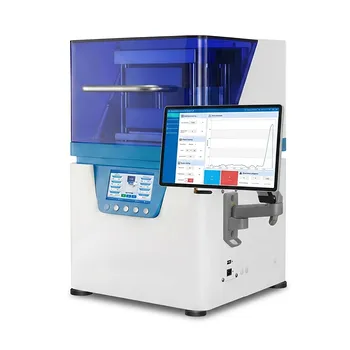
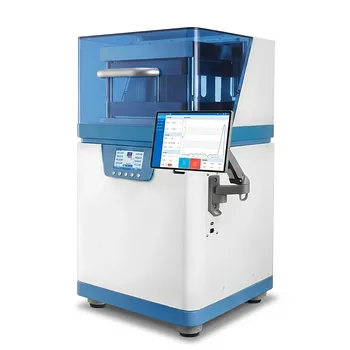
In the preparation of Rh/Al2O3 catalysts, the laboratory hydraulic press serves as the primary tool for transforming fine powders into uniform, high-density pellets. This compression provides the precise control necessary to eliminate internal mass transfer limitations, ensuring that the data collected during kinetic studies reflects the intrinsic reaction rates of the catalyst rather than physical diffusion constraints.
The laboratory hydraulic press is essential for creating catalyst bodies with uniform density and mechanical integrity. By controlling compaction pressure, researchers can accurately apply the Weisz-Prater criterion to prove that measured reaction rates are not biased by internal diffusion issues.
Eliminating Internal Mass Transfer Limitations
Precision Compaction for Kinetic Accuracy
To determine the intrinsic kinetics of a Rh/Al2O3 catalyst, researchers must ensure that the reactant molecules can reach the active sites without being slowed down by the catalyst's internal structure. The hydraulic press allows for the creation of pellets with a predictable and uniform density.
This uniformity is critical when calculating the Weisz-Prater criterion, a dimensionless number used to evaluate if internal pore diffusion is limiting the reaction rate. Without the consistent density provided by a hydraulic press, these calculations would be unreliable, potentially leading to inaccurate kinetic models.
From Powder to Structured Particles
While the initial catalyst exists as a powder, kinetic studies often require specific particle size ranges, such as 250–500 µm or 600–800 µm. The press creates a "green compact" or disk that is subsequently crushed and sieved to reach these targets.
This "press-crush-sieve" method ensures that each resulting particle possesses the same internal pore structure and density. This consistency is vital for reproducibility across multiple experimental runs.
Ensuring Structural and Fluid Dynamic Stability
Preventing Catalyst Attrition and "Powdering"
In pressurized flow reactors or fluidized beds, catalysts are subjected to significant stress from high-speed gas flows and friction. A hydraulic press increases the mechanical strength of the Rh/Al2O3 particles, preventing them from breaking back down into powder during the test.
If the catalyst were to "powder" during a kinetic study, it could lead to clogging or the loss of active material in the gas stream. This would result in fluctuating data and could physically damage the experimental setup.
Maintaining Consistent Bed Pressure Drops
Fluid dynamic stability is required for accurate kinetic measurements in packed-bed reactors. By producing dense, regularly shaped particles, the hydraulic press helps maintain a stable pressure drop across the catalyst bed.
Unstable bed pressure can cause "channeling," where reactants bypass parts of the catalyst, or sudden spikes in back pressure. Both scenarios would invalidate the kinetic data by creating non-ideal flow patterns within the reactor.
Understanding the Trade-offs and Pitfalls
The Impact of Over-Compression
While high pressure increases mechanical strength, applying excessive force can lead to the collapse of the alumina support's macropores. This reduces the total surface area available for the rhodium (Rh) active sites and can actually introduce the mass transfer limitations the researcher is trying to avoid.
Density vs. Porosity Balance
There is an inherent trade-off between mechanical durability and catalyst activity. A pellet that is too dense may be incredibly strong but will exhibit low permeability, while a pellet that is too porous may provide excellent kinetic data initially but crumble before the study is complete.
How to Apply This to Your Project
Recommendations Based on Research Goals
- If your primary focus is determining intrinsic reaction rates: Use the hydraulic press to create high-density pellets, then sieve to the smallest practical particle size to minimize the diffusion path.
- If your primary focus is long-term stability in high-flow reactors: Prioritize higher compaction pressures to maximize mechanical strength and prevent catalyst attrition over time.
- If your primary focus is surface characterization (XRD/XPS): Use the press to create flat, smooth pellets with consistent surface heights to maximize signal intensity and analytical accuracy.
The laboratory hydraulic press is not merely a molding tool, but a precision instrument that bridges the gap between raw chemical synthesis and rigorous kinetic validation.
Summary Table:
| Key Function | Impact on Kinetic Studies | Recommended Practice |
|---|---|---|
| Precision Compaction | Eliminates internal mass transfer limitations | Apply Weisz-Prater criterion for validation |
| Particle Structuring | Ensures uniform density and pore structure | Utilize the "press-crush-sieve" method |
| Mechanical Strength | Prevents catalyst attrition and reactor clogging | Balance compaction pressure with porosity |
| Fluid Dynamics | Maintains stable bed pressure and flow patterns | Produce dense, regularly shaped particles |
Optimize Your Catalyst Research with KINTEK
Achieving accurate kinetic data requires absolute precision in sample preparation. KINTEK specializes in high-performance laboratory equipment, offering a comprehensive range of manual and automatic hydraulic presses (pellet, hot, isostatic), crushing systems, and sieving tools tailored for catalyst development.
Our solutions empower researchers to:
- Control Density: Achieve predictable compaction for Rh/Al2O3 catalysts to eliminate diffusion bias.
- Ensure Stability: Produce mechanically robust pellets that withstand high-speed gas flows in reactors.
- Guarantee Reproducibility: Support consistent "press-crush-sieve" workflows for reliable analytical outcomes.
Beyond presses, KINTEK provides high-temperature furnaces, reactors, and essential consumables like crucibles and ceramics to support your entire lab workflow.
Ready to elevate your material science research? Contact KINTEK today to find the perfect hydraulic solution for your laboratory!
References
- Silvia Mariño, William S. Epling. Rhodium Catalyst Structural Changes during, and Their Impacts on the Kinetics of, CO Oxidation. DOI: 10.1021/jacsau.2c00595
This article is also based on technical information from Kintek Solution Knowledge Base .
Related Products
- Laboratory Hydraulic Press Lab Pellet Press Machine for Glove Box
- Laboratory Hydraulic Press Split Electric Lab Pellet Press
- Fully Automatic Heated Hydraulic Lab Press for Materials Sintering and Sample Preparation
- Automatic Laboratory Hydraulic Pellet Press Machine for Lab Use
- Laboratory Hydraulic Press Lab Pellet Press for Button Battery
People Also Ask
- How do laboratory hydraulic presses contribute to zero-gap electrolyzers? Optimize Performance & Safety
- Why is a laboratory hydraulic press necessary for ZrO2/Cr2O3 interface analysis? Optimize Sample Density and Accuracy
- How do a precision laboratory hydraulic press and specialized molds contribute to the fabrication of spherical ceramic samples? Achieving High-Density Material Precision
- What is the role of a laboratory hydraulic press in the preparation of rare earth denitrification catalysts?
- How does pressure control of a laboratory hydraulic press affect W-Ti alloys? Optimize Grain Structure & Density