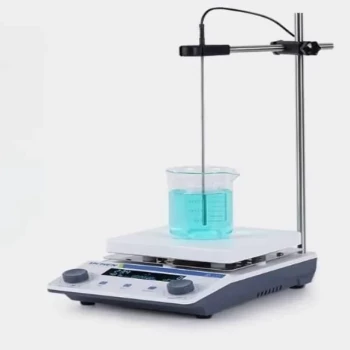
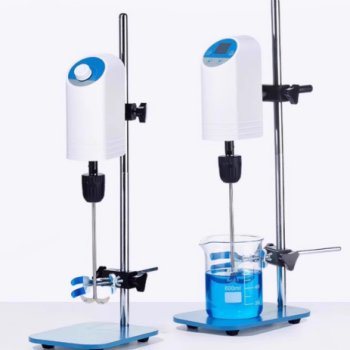
The primary function of a laboratory magnetic stirrer in this context is to act as a mechanical pre-mixing agent. When preparing nanofluid-enhanced 2-Amino-2-methyl-1-propanol (AMP) solutions, the stirrer integrates nanoparticles—such as TiO2, Al2O3, or SiO2—into a 15 wt% AMP aqueous base. This process requires continuous stirring for 30 minutes to achieve a preliminary macroscopic uniform distribution, which is a necessary precursor to high-intensity ultrasonic dispersion.
The magnetic stirrer provides the essential "coarse" mixing stage, breaking up large initial particle clusters to ensure a uniform suspension. This step is a mandatory prerequisite that maximizes the efficiency of the subsequent ultrasonic dispersion stage.
The Mechanics of the Pre-Mixing Stage
Achieving Macroscopic Homogeneity
When nanoparticles are introduced to the 15 wt% AMP solution, they naturally tend to clump due to surface forces.
The magnetic stirrer generates a vortex and convective flow within the beaker.
This mechanical action physically separates large clusters of powder, distributing them throughout the liquid volume to create a macroscopically uniform suspension.
The Critical Time Window
The protocol specifically mandates a duration of 30 minutes of continuous stirring.
This timeframe is not arbitrary; it allows sufficient time for the fluid dynamics to overcome the initial resistance of the dry powder.
It ensures that the entire volume of the solution interacts with the nanoparticles, preventing dry pockets or sedimentation before the next stage.
The Strategic Role in the Workflow
Preparing for Ultrasonication
It is vital to understand that magnetic stirring is not the final step for nanofluid stability.
The primary reference defines this as a preliminary stage.
Its purpose is to prepare the mixture for ultrasonic dispersion. Attempting to sonicate a solution where nanoparticles are still in large, dry clumps would result in uneven dispersion and poor stability.
Mitigating Agglomeration
Nanoparticles possess high surface energy and are prone to agglomeration due to van der Waals forces.
While ultrasonic energy is required to break these bonds at the molecular level, the magnetic stirrer performs the initial battle against agglomeration.
It ensures that the particles are sufficiently suspended to be acted upon effectively by the ultrasound waves later in the process.
Understanding the Trade-offs
Macroscopic vs. Microscopic Limits
A common misconception is that a magnetic stirrer can achieve a truly stable nanofluid on its own.
This is incorrect. The stirrer achieves macroscopic uniformity (visible evenness), not microscopic or molecular-level dispersion.
Relying solely on magnetic stirring without subsequent ultrasonication will likely lead to rapid sedimentation and unstable thermal properties.
Torque and Viscosity Constraints
Magnetic stirrers rely on a rotating magnetic field to turn a stir bar.
While effective for the 15 wt% AMP solution described, they have limits regarding viscosity and shear force.
If the particle loading becomes too high, or the fluid too viscous, the magnetic coupling may break, leading to inconsistent mixing speeds and failure to suspend the particles.
Optimizing Your Nanofluid Preparation Workflow
To ensure the highest quality nanofluid-enhanced AMP solutions, consider the following recommendations based on your specific objectives:
- If your primary focus is process consistency: Adhere strictly to the 30-minute pre-mixing window to guarantee that every batch enters the ultrasonic stage in the exact same state of suspension.
- If your primary focus is fluid stability: View the magnetic stirring as merely the setup phase; do not skip or shorten the subsequent ultrasonic dispersion, as the stirrer cannot break nanoscale agglomerates alone.
- If your primary focus is scaling up: Monitor the stir bar closely; if you increase the volume or particle concentration, ensure your stirrer has sufficient torque to maintain a constant speed.
By treating the magnetic stirring stage as a critical foundation rather than a standalone solution, you ensure the integrity of the final nanofluid.
Summary Table:
| Stage | Role & Function | Key Duration | Outcome |
|---|---|---|---|
| Pre-Mixing | Mechanical breakdown of large nanoparticle clusters | 30 Minutes | Macroscopic Uniformity |
| Mechanics | Vortex & convective flow in 15 wt% AMP solution | Continuous | Prevents Sedimentation |
| Preparation | Sets foundation for high-intensity ultrasonication | Mandatory Step | Optimized Dispersion |
| Limitations | Cannot achieve molecular-level stability alone | Variable | Needs Sonicator Support |
Elevate Your Nanofluid Research with KINTEK
Precise nanofluid preparation starts with the right equipment. KINTEK specializes in high-performance laboratory solutions designed to handle the rigorous demands of material science and chemical engineering.
Whether you need robust magnetic stirrers for consistent pre-mixing, high-intensity ultrasonic dispersion tools, or specialized high-temperature high-pressure reactors, our comprehensive portfolio ensures your research is backed by precision and durability. From PTFE consumables and ceramics to advanced crushing and milling systems, we provide everything you need to achieve microscopic homogeneity and long-term fluid stability.
Ready to optimize your lab's workflow?
Contact our technical experts today to find the perfect equipment for your specific application.
References
- Qiuli Zhang, Jun Zhou. Experimental study of CO<sub>2</sub> capture by nanoparticle-enhanced 2-amino-2-methyl-1-propanol aqueous solution. DOI: 10.1039/d3ra06767j
This article is also based on technical information from Kintek Solution Knowledge Base .
Related Products
- Laboratory Small Constant Temperature Heated Magnetic Stirrer Heater and Stirrer
- High Performance Laboratory Stirrers for Diverse Applications
- Custom PTFE Teflon Parts Manufacturer for Magnetic Stirring Bar
- Laboratory Vibratory Sieve Shaker Machine for Dry and Wet Three-Dimensional Sieving
- Laboratory Vortex Mixer Orbital Shaker Multifunctional Rotation Oscillation Mixer
People Also Ask
- What role does a magnetic stirrer with heating play in ZnO nanoparticle synthesis? Precision Control for Quality Results
- What role does a constant temperature heating magnetic stirrer play in MFC-HAp synthesis? Achieve Material Homogeneity
- What is the function of a laboratory magnetic stirrer in Ni–Cr–P electrodeposition? Optimize Ion Transport & Coating
- Why is a laboratory magnetic stirrer required for benzoic acid esters? Boost Reaction Speed & Yield with High RPM
- What role does a laboratory magnetic stirrer play in TiO2 and TiO2-Ag sol preparation? Master Chemical Kinetics