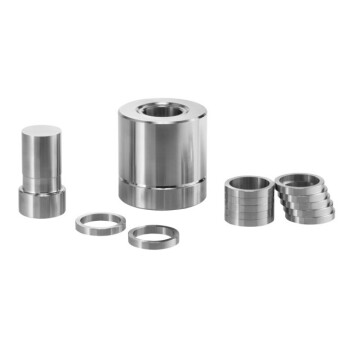
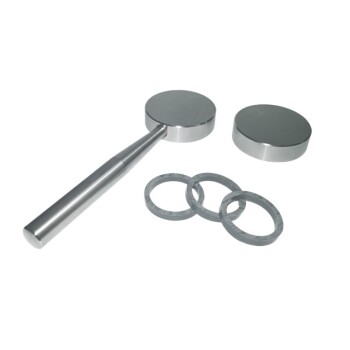
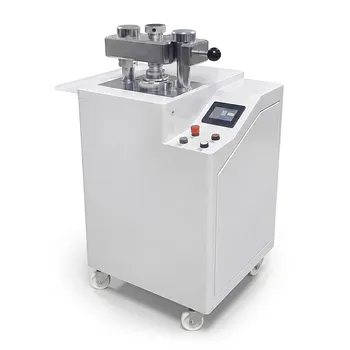
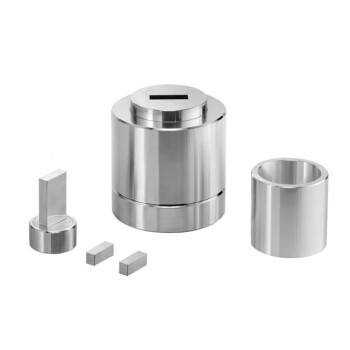
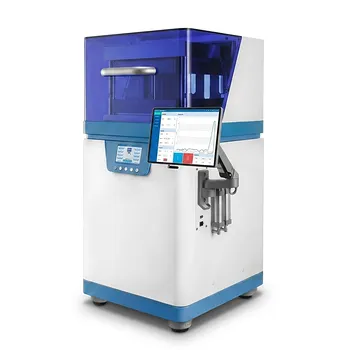
The laboratory pellet press is the essential bridge between raw biomass waste and standardized co-firing research samples. It transforms loose, low-density materials like hardwood or agricultural waste into high-density, uniform pellets through high-pressure physical extrusion. This standardization allows researchers to establish precise and stable mixing ratios with bituminous coal—typically at levels such as 5%, 10%, or 15%—ensuring that combustion simulations and material characterizations are scientifically accurate and reproducible.
A laboratory pellet press enables the creation of uniform, high-density biomass samples that mimic industrial fuel properties. This allows researchers to precisely control blending ratios with coal while gathering critical data on energy density, material behavior, and compression energy requirements.
Achieving Material Uniformity and Precise Blending
Standardizing Physical Properties
Raw biomass is inherently inconsistent, possessing low bulk density and irregular shapes that make it difficult to mix with coal. The pellet press resolves this by creating cylindrical pellets with uniform dimensions and mechanical strength.
Facilitating Mass-Percentage Blending
Once densified, biomass pellets can be blended with coal powders at precise mass percentages. This accuracy is vital for researchers simulating industrial co-firing environments, as it ensures the stability of the fuel feed during experimental combustion.
Optimizing Energy Density
The extrusion process significantly increases the energy density of the biomass. By compressing agricultural by-products or hardwood waste, the press creates a fuel source that more closely matches the combustion stability and volumetric energy requirements of coal-fired furnaces.
Simulating Industrial Processes and Data Acquisition
Lignin Plastification and Binding
Under the high-pressure conditions of a pellet press, the lignin within the biomass undergoes plastification. This natural polymer acts as a binder, gluing the waste powder together into a solid geometric form without the mandatory need for external additives.
Evaluating Compaction Behavior
Advanced hydraulic presses allow researchers to apply loads up to 160 MPa with specific dwell times. By recording compression and ejection curves, scientists can analyze how different raw materials behave under stress and identify the glass transition point of the lignin.
Calculating Specific Energy Consumption (SEC)
Monitoring the displacement and pressure during the pressing cycle allows for the calculation of Specific Energy Consumption (SEC). This data is critical for determining the economic feasibility of scaling a particular biomass type for large-scale industrial pellet production.
Understanding the Trade-offs and Limitations
Lab-Scale vs. Industrial Realities
While a laboratory press provides precise control over variables like compaction pressure and die temperature, it may not perfectly replicate the continuous friction heat of a full-scale ring die mill. Results regarding pellet durability and throughput must be carefully extrapolated when moving to industrial applications.
Material Sensitivity
The success of the pelletizing process is highly dependent on the moisture content and particle size of the raw biomass. If the material is too dry or the particles are too coarse, the lignin may fail to plastify, resulting in "spring-back" where the pellet loses its structural integrity immediately after ejection.
Equipment Maintenance
High-pressure extrusion causes significant wear on die holes and pistons, especially when processing abrasive biomass or coal dust mixtures. Regular calibration and monitoring of the length-to-diameter (L/D) ratio of the die are necessary to maintain the consistency of the experimental samples.
How to Apply This to Your Research Project
Choosing the Right Press Configuration
Selecting the appropriate laboratory press depends on whether your research focuses on material properties or process optimization.
- If your primary focus is material characterization: Use a single-pellet hydraulic press to achieve maximum precision in pressure and dwell time for individual samples.
- If your primary focus is process optimization for scaling: Utilize a flat die pellet press to better simulate the mechanical friction and heat generation found in industrial production environments.
- If your primary focus is binder effectiveness: Opt for a press with integrated temperature control to isolate the effects of chemical additives from the thermal plastification of natural lignin.
By utilizing the laboratory pellet press as a precision instrument rather than just a preparation tool, researchers can generate the high-fidelity data required to advance biomass-coal co-firing technologies.
Summary Table:
| Feature | Function in Co-Firing Research | Key Benefit for Researchers |
|---|---|---|
| Densification | Converts loose waste into uniform, high-density pellets | Standardizes physical properties for accurate blending |
| Lignin Plastification | Uses high pressure to activate natural binders | Creates stable samples without the need for additives |
| Data Acquisition | Records compression curves and displacement | Calculates Specific Energy Consumption (SEC) for scaling |
| Blending Precision | Enables specific mass-percentage ratios (e.g., 5%, 10%) | Ensures stable combustion simulations and reproducibility |
| Thermal Simulation | Integrated temperature control for die heating | Analyzes the impact of heat on material binding behavior |
Advance Your Biomass Research with KINTEK Precision
To achieve scientifically accurate co-firing results, your sample preparation must be flawless. KINTEK specializes in high-performance laboratory equipment designed for the rigors of energy research. Our comprehensive range includes:
- Hydraulic Presses: Advanced pellet, hot, and isostatic presses for precise material densification.
- Material Processing: High-efficiency crushing, milling, and sieving systems to ensure uniform particle size.
- Thermal Systems: High-temperature furnaces (muffle, tube, vacuum) and high-pressure reactors for combustion testing.
- Lab Essentials: A full suite of cooling solutions, homogenizers, and durable ceramic or PTFE consumables.
Whether you are optimizing blending ratios or evaluating the economic feasibility of industrial scaling, KINTEK provides the reliability and precision your lab demands. Contact our technical experts today to find the perfect pellet press configuration for your project!
References
- Adi Prismantoko, Hariana Hariana. Potential for Slagging, Fouling, and Abrasion during Co-firing of Indonesian Bituminous Coal and Hardwood Waste Pellet.. DOI: 10.24912/ijaste.v1.i1.210-216
This article is also based on technical information from Kintek Solution Knowledge Base .
Related Products
- Automatic Laboratory Hydraulic Pellet Press Machine for Lab Use
- Laboratory Manual Hydraulic Pellet Press for Lab Use
- Laboratory Hydraulic Pellet Press for XRF KBR FTIR Lab Applications
- Automatic Laboratory Hydraulic Press for XRF & KBR Pellet Press
- Laboratory Hydraulic Press Lab Pellet Press Machine for Glove Box
People Also Ask
- What is the role of a laboratory hydraulic pellet press and stainless steel molds in the fabrication of RuO2/NbC anodes?
- What role does a laboratory pellet press play in the enhancement of biomass energy products? Optimize Fuel Efficiency
- What is the purpose of using a laboratory pellet press when evaluating the electronic conductivity of carbon powders? Guide
- How does a laboratory hydraulic pellet press contribute to SiCw/2024 aluminum composite preforms? Optimize Densification
- What is the significance of applying 200 MPa of pressure with a laboratory hydraulic pellet press for composite ceramics?