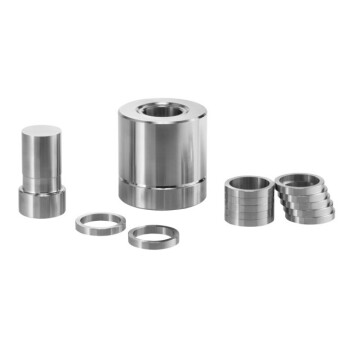
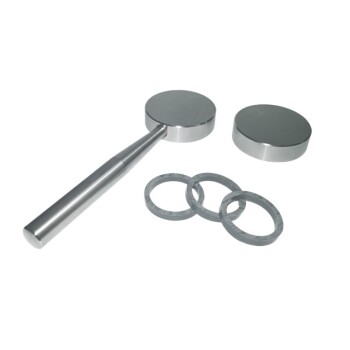
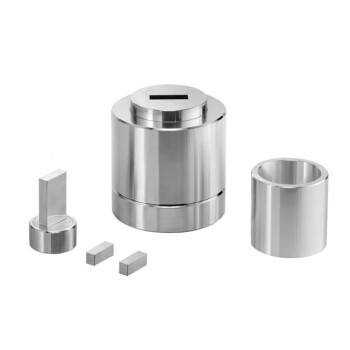
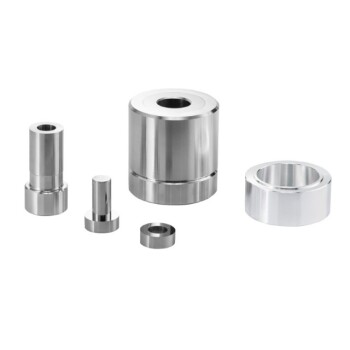
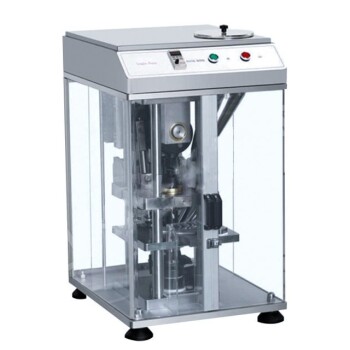
The primary role of a laboratory pellet press in FTIR analysis is to apply high mechanical pressure to fuse a mixture of spectroscopic-grade Potassium Bromide (KBr) powder and a specific sample into a solid, translucent disc. This physical transformation serves as the fundamental bridge between a raw, scattering powder and a readable optical medium. By compressing the material, the press eliminates air voids and fixes the sample particles within a transparent matrix, enabling infrared radiation to penetrate directly and detect internal functional group structures.
The press functions not merely as a compactor, but as an optical clarifying tool. By leveraging the high pressure to merge the sample with KBr—which is transparent to infrared light—it creates a uniform "window" that allows for the precise transmission of light required to generate accurate spectral data.
The Mechanics of Transparency
KBr as the Optical Carrier
The press utilizes Potassium Bromide (KBr) because of its unique property: excellent transparency in the infrared range.
Under the high pressure exerted by the press, the KBr powder flows and fuses, acting as a carrier matrix. This effectively "freezes" the trace sample particles in place, ensuring they are evenly distributed throughout the pellet rather than clumped together.
Forming a Uniform Optical Path
Without compression, loose powders scatter light, resulting in noise and poor signal quality.
The press forces the mixture into a dense, flat geometric shape. This creates a uniform optical path length, allowing the spectrometer's laser to pass through the sample with minimal scattering, facilitating the detection of the sample's internal chemical bonds.
Critical Process Parameters
Establishing the Correct Ratio
The press relies on a precise mixture to function correctly, typically requiring 200 to 250 mg of KBr powder mixed with only 0.1% to 1.0% of the target sample.
If the sample concentration is too high, the pellet becomes opaque to the infrared beam. Conversely, if the mixture is not homogenous, the resulting spectrum will lack reproducibility.
The Necessity of High Pressure
Achieving a usable pellet generally requires applying a force of approximately 8 to 10 tons for a standard 13 mm diameter die.
This immense pressure (often held for several minutes) is what physically forces the KBr crystals to coalesce into a glass-like state. Insufficient pressure results in a fragile, opaque disc that scatters light and ruins the analysis.
Vacuum Integration
The pressing process is frequently conducted under a vacuum of several mm Hg.
This removes trapped air and moisture from the KBr powder during compression. Eliminating these pockets is essential, as air bubbles scatter light and residual moisture introduces broad, unwanted peaks in the resulting spectrum.
Understanding the Trade-offs
The Risk of Moisture Absorption
KBr is hygroscopic, meaning it greedily absorbs water from the air.
While grinding the mixture facilitates interaction, over-grinding increases the surface area of the material, accelerating moisture absorption. If the press environment is humid or the procedure takes too long, water bands will appear in your spectrum, potentially obscuring key data points.
Structural Integrity vs. Optical Quality
Applying too little pressure leads to "cloudy" pellets that scatter light. However, applying excessive pressure rapidly without a vacuum can trap stress within the crystal lattice.
This can result in pellets that crack upon ejection or eventually become cloudy over time as the internal stress releases. The balance of pressure, time, and vacuum is critical for a stable result.
Making the Right Choice for Your Goal
To maximize the effectiveness of your laboratory pellet press, align your technique with your specific analytical goals:
- If your primary focus is Spectral Clarity: Ensure you apply a vacuum during the pressing phase to degas the mixture, as this eliminates air pockets that cause light scattering and brittle pellets.
- If your primary focus is Quantitative Accuracy: Strictly adhere to the weight ratios (0.1% - 1.0% sample to KBr) and mixing times to ensure the optical path length is consistent across different samples.
- If your primary focus is Sample Throughput: Optimize your grinding time; mix thoroughly enough for homogeneity but stop immediately after to prevent excessive moisture uptake from the ambient air.
The laboratory pellet press is the gatekeeper of your data quality; treat the physical formation of the pellet with the same precision as the spectral analysis itself.
Summary Table:
| Parameter | Requirement/Value | Purpose in FTIR Analysis |
|---|---|---|
| Sample Concentration | 0.1% - 1.0% | Prevents opacity; ensures beam penetration |
| KBr Powder Weight | 200 - 250 mg | Standard amount for a 13mm diameter pellet |
| Applied Pressure | 8 - 10 Tons | Fuses KBr crystals into a glass-like state |
| Vacuum Level | Several mm Hg | Removes air/moisture to prevent light scattering |
| Compression Time | 2 - 5 Minutes | Ensures structural integrity and uniform density |
Elevate Your Analytical Precision with Kintek
High-quality FTIR spectra begin with perfect sample preparation. KINTEK specializes in precision laboratory equipment designed to meet the rigorous demands of material science and chemical analysis. Our range of manual and automatic hydraulic pellet presses, along with high-performance die sets, ensures you achieve the uniform, transparent KBr pellets necessary for repeatable, noise-free results.
Beyond pelletizing, KINTEK offers a comprehensive portfolio including:
- High-Temperature Furnaces (Muffle, Vacuum, CVD/PECVD) for advanced material synthesis.
- Crushing and Milling Systems for perfect sample homogeneity.
- Battery Research Tools and high-pressure reactors for cutting-edge energy studies.
Don't let poor sample preparation compromise your research. Contact our technical experts today to find the ideal pressing solution for your lab and experience the KINTEK advantage in durability and precision.
References
- Meng Li, Zhenzhong Gao. Synergistic effect of mixed fungal pretreatment on thermogravimetric characteristics of rice straw. DOI: 10.15376/biores.16.2.3978-3990
This article is also based on technical information from Kintek Solution Knowledge Base .
Related Products
- Laboratory Hydraulic Pellet Press for XRF KBR FTIR Lab Applications
- Automatic Laboratory Hydraulic Pellet Press Machine for Lab Use
- Laboratory Manual Hydraulic Pellet Press for Lab Use
- Laboratory Manual Hydraulic Pellet Press for Lab Use
- Automatic Laboratory Hydraulic Press for XRF & KBR Pellet Press
People Also Ask
- What is the role of a laboratory hydraulic pellet press and stainless steel molds in the fabrication of RuO2/NbC anodes?
- What is the significance of applying 200 MPa of pressure with a laboratory hydraulic pellet press for composite ceramics?
- How does a laboratory hydraulic pellet press contribute to SiCw/2024 aluminum composite preforms? Optimize Densification
- What is the necessity of using a laboratory hydraulic pellet press in the preparation of biomass fuel pellets? Guide
- What function does a laboratory pellet press or rolling mill serve? Enhance Electrode Density and Performance