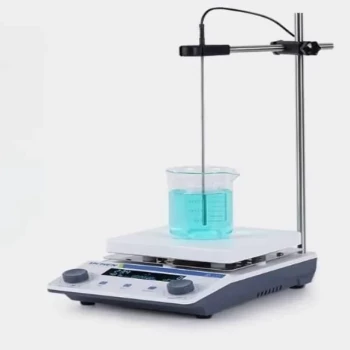
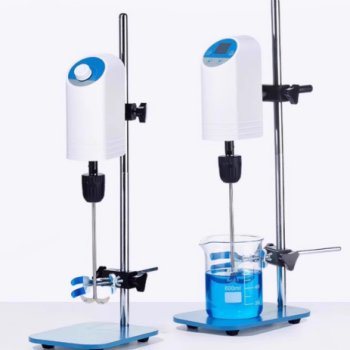
In the preparation of Zn-Based Zeolite, the magnetic stirrer serves a critical mechanical function: it generates continuous power to maintain the natural zeolite powder in a highly suspended state within the zinc sulfate solution. This sustained agitation is the primary mechanism for maximizing the contact frequency between the liquid-phase ions and the solid-phase microporous structure.
By preventing sedimentation and forcing a suspended state, magnetic stirring drives efficient ion exchange and ensures the uniform distribution of zinc ions deep within the zeolite framework cavities.
The Mechanics of Ion Exchange Efficiency
Maintaining the Suspended State
The fundamental challenge in this process is the physical state of the reactants. Natural zeolite is a solid powder that will naturally settle out of the liquid zinc sulfate solution due to gravity.
Continuous mechanical power is required to counteract this settling. The magnetic stirrer provides the kinetic energy necessary to keep the zeolite particles buoyant and circulating throughout the fluid volume.
Maximizing Contact Frequency
Ion exchange is a contact-dependent process. For zinc ions to replace other cations in the zeolite, they must physically encounter the zeolite surface.
By keeping the powder suspended, the stirrer maximizes the frequency of collisions between the liquid-phase zinc ions and the solid zeolite particles. This dynamic environment ensures that the reaction proceeds efficiently rather than stalling due to lack of contact.
Ensuring Structural Homogeneity
Uniform Ion Distribution
Beyond simple mixing, the quality of the final material depends on where the zinc ions end up. A static solution would lead to uneven saturation, where particles at the bottom interacts differently than those at the top.
Stirring creates a uniform chemical environment. This ensures that zinc ions are evenly distributed across the entire batch of zeolite, resulting in a consistent chemical composition throughout the final product.
Accessing the Microporous Structure
Zeolites are defined by their internal cavities and porous frameworks. The goal is not just to coat the surface, but to facilitate exchange within these micropores.
The suspension maintained by the stirrer exposes the solid-phase microporous structure to the solution from all angles. This allows zinc ions to penetrate effectively into the framework cavities, maximizing the functional capacity of the zeolite.
Understanding the Trade-offs
The Risk of Sedimentation
If the magnetic stirring is insufficient or intermittent, the system faces immediate degradation of quality.
Without continuous power, the zeolite powder will settle. This creates a concentration gradient where particles at the bottom may be oversaturated or inadequately exposed compared to freely floating particles, leading to significant heterogeneity in the final batch.
Mechanical Power vs. Particle Integrity
While not explicitly detailed in the primary text, the requirement for "continuous mechanical power" implies a need for balance.
The stirring must be vigorous enough to maintain suspension, but consistent enough to ensure the contact frequency remains stable throughout the duration of the ion exchange process.
Making the Right Choice for Your Goal
To ensure the highest quality Zn-Based Zeolite, you must tune your mixing parameters to the specific needs of the microporous structure.
- If your primary focus is Process Efficiency: Ensure the stirrer provides enough power to prevent any visible settling, maximizing the active surface area available for immediate ion exchange.
- If your primary focus is Product Uniformity: Prioritize continuous, uninterrupted agitation to guarantee that zinc ions are distributed evenly into the framework cavities of every particle.
Ultimately, the magnetic stirrer is not just a mixing tool; it is the active controller of the kinetic environment that dictates the chemical consistency of your final material.
Summary Table:
| Feature | Role in Zn-Zeolite Preparation | Impact on Quality |
|---|---|---|
| Suspension State | Prevents sedimentation of zeolite powder | Ensures continuous reactant availability |
| Contact Frequency | Maximizes liquid-ion and solid-phase collisions | Increases ion exchange rate and efficiency |
| Kinetic Energy | Drives zinc ions into microporous cavities | Achieves deep structural penetration |
| Uniform Mixing | Eliminates chemical concentration gradients | Ensures consistent batch-to-batch composition |
Elevate Your Material Research with KINTEK Precision
Achieving uniform ion exchange in Zn-Based Zeolites requires more than just stirring; it requires reliable, continuous performance. KINTEK specializes in high-performance laboratory equipment, offering advanced magnetic stirrers and shakers designed for consistent kinetic control.
Beyond mixing, our comprehensive portfolio supports your entire workflow—from crushing and milling systems for powder preparation to high-temperature furnaces and vacuum reactors for material synthesis. Whether you are conducting battery research or developing advanced catalysts, KINTEK provides the high-quality consumables like crucibles, ceramics, and PTFE products you need for success.
Ready to optimize your lab's efficiency and product uniformity? Contact us today to find the perfect equipment for your application!
References
- Wenshuo Shang, Litao Kang. Boosting Zn||I2 Battery’s Performance by Coating a Zeolite-Based Cation-Exchange Protecting Layer. DOI: 10.1007/s40820-022-00825-5
This article is also based on technical information from Kintek Solution Knowledge Base .
Related Products
- Laboratory Small Constant Temperature Heated Magnetic Stirrer Heater and Stirrer
- Custom PTFE Teflon Parts Manufacturer for Magnetic Stirring Bar
- High Performance Laboratory Stirrers for Diverse Applications
- Three-dimensional electromagnetic sieving instrument
- Custom PTFE Teflon Parts Manufacturer for PTFE Stirring Bar Recovery Rod
People Also Ask
- What role does a magnetic stirrer with heating play in ZnO nanoparticle synthesis? Precision Control for Quality Results
- What role does a constant temperature heating magnetic stirrer play in MFC-HAp synthesis? Achieve Material Homogeneity
- What is the function of a laboratory magnetic stirrer in Ni–Cr–P electrodeposition? Optimize Ion Transport & Coating
- Why is a laboratory magnetic stirrer required for benzoic acid esters? Boost Reaction Speed & Yield with High RPM
- What role does a laboratory magnetic stirrer play in TiO2 and TiO2-Ag sol preparation? Master Chemical Kinetics