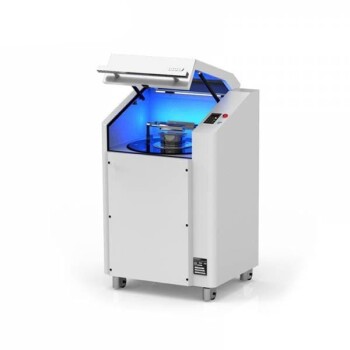
In the preparation of A356 aluminum alloy and SiCp metal matrix composites, the planetary ball mill serves as the primary mechanism for achieving micro-structural homogeneity.
Specifically, it utilizes wet ball milling to perform high-energy grinding. This process is essential for achieving a uniform dispersion of micron-sized silicon carbide (SiC) particles within the A356 alloy matrix. By subjecting the powders to intense mechanical impact, the mill ensures that the ceramic reinforcement is thoroughly integrated with the metallic binder.
Core Takeaway The planetary ball mill overcomes the physical limitations of mixing materials with different densities. It replaces the inconsistency of traditional stirring with high-energy mechanical impact, preventing particle segregation and ensuring the composite material has uniform properties throughout.
The Mechanics of Uniform Dispersion
High-Energy Grinding
The planetary ball mill does not merely mix powders; it creates high-energy collisions. The rotation generates centrifugal forces that drive grinding balls into the powder mixture.
Microscopic Integration
This mechanical energy forces the micron-sized SiC particles into the A356 matrix. The result is a uniform dispersion at the microscopic level, which is critical for the mechanical performance of the final composite.
Solving Traditional Processing Problems
Preventing Density-Driven Segregation
A major challenge in creating metal matrix composites is the density difference between the ceramic reinforcement and the metal matrix. In traditional processes like stir casting, particles often float or settle.
Eliminating Agglomeration
Small particles naturally tend to clump together due to inter-particle forces (such as Van der Waals forces). The intense impact and shear forces of the planetary ball mill effectively break down these agglomerates, ensuring that individual SiC particles are distinct and evenly spaced within the aluminum.
The Role of Wet Milling
Enhanced Mixing Medium
The process specifically utilizes wet ball milling. Using a liquid medium aids in the lubrication and movement of the particles, facilitating a more efficient transfer of kinetic energy from the grinding media to the powder.
Prevention of Defects
By maintaining a wet environment and constant agitation, the process locks the particles into a homogeneous state. This prevents the formation of structural defects that usually arise from inconsistent particle distribution.
Understanding the Trade-offs
Risk of Contamination
High-energy milling involves constant friction between the grinding balls and the container. There is a potential risk that material from the grinding media may wear off and contaminate the A356/SiCp powder mixture.
Processing Time and Complexity
Compared to simple mechanical stirring, planetary ball milling is a more time-intensive batch process. It requires careful control of rotation speeds and milling duration to prevent over-grinding, which could alter the desired morphology of the A356 particles.
Making the Right Choice for Your Goal
When designing a powder metallurgy process for A356/SiCp composites, consider your specific performance requirements:
- If your primary focus is mechanical reliability: Prioritize planetary ball milling to ensure the SiC particles are uniformly distributed, avoiding weak points caused by agglomeration.
- If your primary focus is preventing segregation: Use this method to counteract the natural tendency of SiC particles to float or settle within the aluminum matrix.
Ultimately, the planetary ball mill provides the mechanical force necessary to turn a mixture of distinct powders into a unified, high-performance composite material.
Summary Table:
| Feature | Role in A356/SiCp Preparation | Key Benefit |
|---|---|---|
| Milling Type | High-energy wet ball milling | Enhances kinetic energy transfer and lubrication. |
| Dispersion | Microscopic integration of SiC | Prevents particle agglomeration and clustering. |
| Mechanical Impact | Intense centrifugal forces | Overcomes density differences between Al and SiC. |
| Structural Integrity | Eliminates structural defects | Ensures uniform mechanical properties and reliability. |
Elevate Your Materials Research with KINTEK Precision
Achieving perfect homogeneity in A356 aluminum alloy and SiCp metal matrix composites requires high-performance equipment that can handle the rigors of high-energy mechanical impact. KINTEK specializes in advanced planetary ball mills, crushing and milling systems, and sieving equipment designed to eliminate particle segregation and deliver superior micro-structural uniformity.
From high-temperature furnaces for sintering to isostatic hydraulic presses for pellet formation, KINTEK provides the comprehensive toolkit needed for cutting-edge powder metallurgy.
Ready to optimize your composite preparation? Contact KINTEK experts today to find the perfect milling and processing solution for your laboratory's needs.
Related Products
- High Energy Planetary Ball Mill for Laboratory Horizontal Tank Type Milling Machine
- Laboratory Planetary Ball Mill Rotating Ball Milling Machine
- High-Energy Omnidirectional Planetary Ball Mill Milling Machine for Laboratory
- High Energy Planetary Ball Mill Milling Machine for Laboratory
- Laboratory Horizontal Planetary Ball Mill Milling Machine
People Also Ask
- What is the role of a planetary ball mill in sulfide-based solid-state batteries? Engineer High-Performance Cathodes
- What are the parameters of a planetary ball mill? Master Speed, Time, and Media for Perfect Grinding
- What is the function of a planetary ball mill for nanostructured eutectic steel? Essential Prep for High-Strength Alloys
- What role does a planetary ball mill play in the preparation of NASICON-type solid electrolytes like LATP and LAGP?
- What is the function of a planetary ball mill in solid-state electrolyte prep? Milling vs. SDS Methods Explained