Knowledge What is the significance of the intrinsic reaction rate constant in high-pressure reactors for calcite dissolution?
Author avatar

Tech Team · Kintek Solution

Updated 4 hours ago

What is the significance of the intrinsic reaction rate constant in high-pressure reactors for calcite dissolution?


The intrinsic reaction rate constant is the foundational metric for quantifying the inherent chemical activity of calcite dissolution under specific subsurface conditions. Derived from high-pressure reactors (autoclaves) that replicate environments such as 323 K and 10 MPa, this constant serves as the critical baseline for modeling how calcite interacts with CO2-saturated water without the interference of physical transport factors.

By isolating the chemical reaction speed from physical flow dynamics, this constant enables pore-scale simulations to accurately model deep-earth processes. It is the essential "ground truth" that allows machine learning models to distinguish between reaction-limited and transport-limited kinetic regimes.

Simulating Deep Geological Environments

Replicating Subsurface Conditions

Standard laboratory tests at room temperature cannot predict how rock behaves deep underground. High-pressure reactors, or autoclaves, are necessary to generate the specific high-temperature and high-pressure conditions (e.g., 323 K and 10 MPa) found in geological formations.

Isolating Chemical Activity

The primary goal of using an autoclave is to measure the reaction in CO2-saturated water under these controlled stresses. This isolation provides the intrinsic value—the speed at which the chemistry occurs naturally when not limited by the speed of fluid flow.

The Foundation of Numerical Simulations

A Core Input Parameter

Pore-scale numerical simulations are only as good as the data fed into them. The intrinsic reaction rate constant acts as a core input parameter for these complex models.

Defining Inherent Reactivity

This constant provides a mathematical definition of the inherent chemical activity of the fluid-solid reaction. It ensures the simulation starts with a realistic representation of how aggressive the dissolution process is at a molecular level.

Enhancing Machine Learning Capabilities

Distinguishing Kinetic Regimes

In fluid-solid reactions, the overall speed is controlled either by how fast the chemicals react (reaction-limited) or how fast the fluid moves reactants to the surface (transport-limited).

Improving Classification Accuracy

Machine learning models rely on the intrinsic rate constant to accurately distinguish between these two regimes. Without this specific constant, an ML model might misinterpret a transport delay as a slow chemical reaction, leading to flawed predictions.

Understanding the Trade-offs

Idealized Conditions vs. Heterogeneity

While autoclave data provides a precise "pure" rate, it represents an idealized scenario. Real-world geological formations often possess physical heterogeneities that can complicate how this intrinsic rate manifests across a larger scale.

The Necessity of High-Fidelity Data

Obtaining this constant requires specialized, resource-intensive equipment. However, relying on ambient-pressure data for deep-earth simulations will result in significant errors, as it fails to account for the thermodynamic realities of the subsurface environment.

Making the Right Choice for Your Modeling Strategy

To ensure your simulations are predictive rather than just descriptive, consider the following:

  • If your primary focus is pore-scale simulation: You must utilize the intrinsic rate constant to establish a valid baseline for chemical activity.
  • If your primary focus is training machine learning models: You need this data to correctly label and distinguish between reaction-limited and transport-limited processes.

Accurate modeling begins with the rigorous isolation of pure chemical kinetics from physical transport phenomena.

Summary Table:

Metric Category Key Feature Significance in Simulations
Environmental Conditions 323 K & 10 MPa Replicates deep subsurface geological environments
Reaction Type CO2-saturated water Isolates chemical activity from physical transport factors
Model Role Core Input Parameter Provides the mathematical 'ground truth' for pore-scale models
Kinetic Regime Reaction vs. Transport Enables ML models to distinguish between chemical and flow limits

Precision Engineering for Geological Simulation

Unlock the full potential of your geological modeling with KINTEK’s high-temperature high-pressure reactors and autoclaves. Designed to replicate the extreme conditions of deep-earth environments (like 323 K and 10 MPa), our equipment provides the high-fidelity data necessary to define intrinsic reaction kinetics and train advanced machine learning models.

Beyond reactors, KINTEK specializes in a comprehensive range of laboratory solutions, including:

  • High-Pressure Systems: Autoclaves, CVD, and PECVD systems.
  • Material Processing: Crushing, milling, and hydraulic presses (isostatic, pellet).
  • Research Consumables: Electrolytic cells, PTFE products, and specialized ceramics.

Ensure your simulations are predictive, not just descriptive. Partner with KINTEK for durable, high-performance tools that bridge the gap between lab data and real-world geochemistry.

Contact KINTEK Experts Today

References

  1. Min Liu, Peter K. Kang. Machine learning to predict effective reaction rates in 3D porous media from pore structural features. DOI: 10.1038/s41598-022-09495-0

This article is also based on technical information from Kintek Solution Knowledge Base .

Related Products

People Also Ask

Related Products

Stainless High Pressure Autoclave Reactor Laboratory Pressure Reactor

Stainless High Pressure Autoclave Reactor Laboratory Pressure Reactor

Discover the versatility of Stainless High Pressure Reactor - a safe and reliable solution for direct and indirect heating. Built with stainless steel, it can withstand high temperatures and pressures. Learn more now.

Mini SS High Pressure Autoclave Reactor for Laboratory Use

Mini SS High Pressure Autoclave Reactor for Laboratory Use

Mini SS High Pressure Reactor - Ideal for medicine, chemical, and scientific research industries. Programmed heating temp and stirring speed, up to 22Mpa pressure.

High Pressure Laboratory Autoclave Reactor for Hydrothermal Synthesis

High Pressure Laboratory Autoclave Reactor for Hydrothermal Synthesis

Discover the applications of Hydrothermal Synthesis Reactor - a small, corrosion-resistant reactor for chemical labs. Achieve rapid digestion of insoluble substances in a safe and reliable way. Learn more now.

Customizable Laboratory High Temperature High Pressure Reactors for Diverse Scientific Applications

Customizable Laboratory High Temperature High Pressure Reactors for Diverse Scientific Applications

High-pressure lab reactor for precise hydrothermal synthesis. Durable SU304L/316L, PTFE liner, PID control. Customizable volume & materials. Contact us!

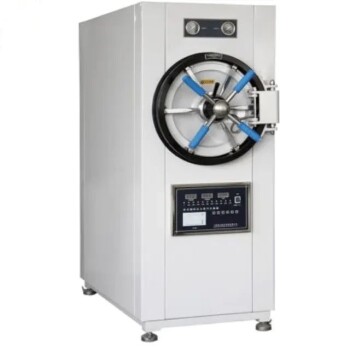
Laboratory High Pressure Horizontal Autoclave Steam Sterilizer for Lab Use

Laboratory High Pressure Horizontal Autoclave Steam Sterilizer for Lab Use

The horizontal autoclave steam sterilizer adopts the gravity displacement method to remove the cold air in the inner chamber, so that the inner steam and cold air content is less, and the sterilization is more reliable.

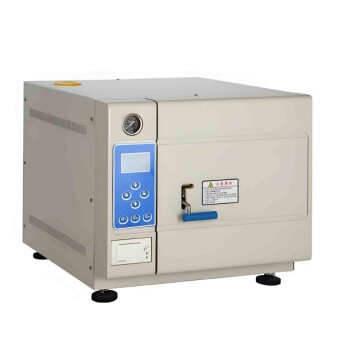
Desktop Fast High Pressure Laboratory Autoclave Sterilizer 16L 24L for Lab Use

Desktop Fast High Pressure Laboratory Autoclave Sterilizer 16L 24L for Lab Use

The desktop fast steam sterilizer is a compact and reliable device used for rapid sterilization of medical, pharmaceutical, and research items.

Manual High Temperature Heated Hydraulic Press Machine with Heated Plates for Lab

Manual High Temperature Heated Hydraulic Press Machine with Heated Plates for Lab

The High Temperature Hot Press is a machine specifically designed for pressing, sintering and processing materials in a high temperature environment. It is capable of operating in the range of hundreds of degrees Celsius to thousands of degrees Celsius for a variety of high temperature process requirements.

Automatic High Temperature Heated Hydraulic Press Machine with Heated Plates for Lab

Automatic High Temperature Heated Hydraulic Press Machine with Heated Plates for Lab

The High Temperature Hot Press is a machine specifically designed for pressing, sintering and processing materials in a high temperature environment. It is capable of operating in the range of hundreds of degrees Celsius to thousands of degrees Celsius for a variety of high temperature process requirements.

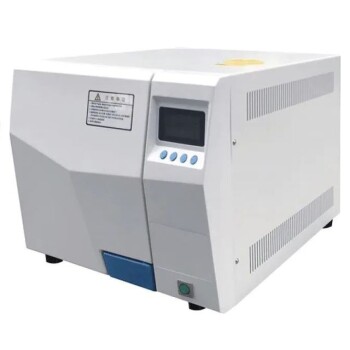
Laboratory Sterilizer Lab Autoclave Vertical Pressure Steam Sterilizer for Liquid Crystal Display Automatic Type

Laboratory Sterilizer Lab Autoclave Vertical Pressure Steam Sterilizer for Liquid Crystal Display Automatic Type

Liquid crystal display automatic vertical sterilizer is a safe, reliable and automatic control sterilization equipment, which is composed of heating system, microcomputer control system and overheating and overvoltage protection system.

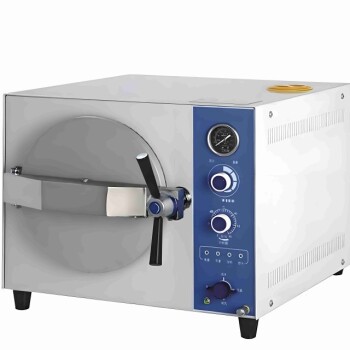
Desktop Fast Laboratory Autoclave Sterilizer 20L 24L for Lab Use

Desktop Fast Laboratory Autoclave Sterilizer 20L 24L for Lab Use

The desktop fast steam sterilizer is a compact and reliable device used for rapid sterilization of medical, pharmaceutical, and research items.

Desktop Fast Laboratory Autoclave Sterilizer 35L 50L 90L for Lab Use

Desktop Fast Laboratory Autoclave Sterilizer 35L 50L 90L for Lab Use

The desktop fast steam sterilizer is a compact and reliable device used for rapid sterilization of medical, pharmaceutical, and research items. It efficiently sterilizes surgical instruments, glassware, medicines, and resistant materials, making it suitable for various applications.

Visual High-Pressure Reactor for In-Situ Observation

Visual High-Pressure Reactor for In-Situ Observation

The visual high-pressure reactor uses transparent sapphire or quartz glass, maintaining high strength and optical clarity under extreme conditions for real-time reaction observation.

Square Bidirectional Pressure Mold for Lab Use

Square Bidirectional Pressure Mold for Lab Use

Discover precision in molding with our Square Bidirectional Pressure Mold. Ideal for creating diverse shapes and sizes, from squares to hexagons, under high pressure and uniform heating. Perfect for advanced material processing.

Special Shape Press Mold for Lab

Special Shape Press Mold for Lab

Discover high-pressure special shape press molds for diverse applications, from ceramics to automotive parts. Ideal for precise, efficient molding of various shapes and sizes.

Round Bidirectional Press Mold for Lab

Round Bidirectional Press Mold for Lab

The round bidirectional press mold is a specialized tool used in high-pressure molding processes, particularly for creating intricate shapes from metal powders.

Polygon Press Mold for Lab

Polygon Press Mold for Lab

Discover precision polygon press molds for sintering. Ideal for pentagon-shaped parts, our molds ensure uniform pressure and stability. Perfect for repeatable, high-quality production.

Electric Lab Cold Isostatic Press CIP Machine for Cold Isostatic Pressing

Electric Lab Cold Isostatic Press CIP Machine for Cold Isostatic Pressing

Produce dense, uniform parts with improved mechanical properties with our Electric Lab Cold Isostatic Press. Widely used in material research, pharmacy, and electronic industries. Efficient, compact, and vacuum-compatible.

Custom PTFE Teflon Parts Manufacturer for PTFE Buchner Funnel and Triangular Funnel

Custom PTFE Teflon Parts Manufacturer for PTFE Buchner Funnel and Triangular Funnel

The PTFE funnel is a piece of laboratory equipment used primarily for filtration processes, particularly in the separation of solid and liquid phases in a mixture. This setup allows for efficient and rapid filtration, making it indispensable in various chemical and biological applications.

Platinum Sheet Electrode for Laboratory and Industrial Applications

Platinum Sheet Electrode for Laboratory and Industrial Applications

Elevate your experiments with our Platinum Sheet Electrode. Crafted with quality materials, our safe and durable models can be tailored to fit your needs.

915MHz MPCVD Diamond Machine Microwave Plasma Chemical Vapor Deposition System Reactor

915MHz MPCVD Diamond Machine Microwave Plasma Chemical Vapor Deposition System Reactor

915MHz MPCVD Diamond Machine and its multi-crystal effective growth, the maximum area can reach 8 inches, the maximum effective growth area of single crystal can reach 5 inches. This equipment is mainly used for the production of large-size polycrystalline diamond films, the growth of long single crystal diamonds, the low-temperature growth of high-quality graphene, and other materials that require energy provided by microwave plasma for growth.


Leave Your Message