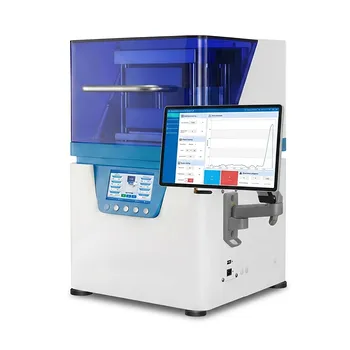
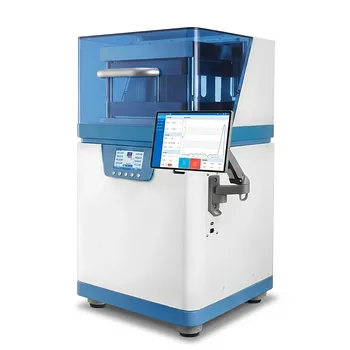
The laboratory hydraulic press is a critical precision tool used to optimize electrode density and ensure hermetic cell sealing. By applying uniform mechanical pressure, it reduces internal resistance and increases volumetric energy density, which are essential for both electrochemical performance and operational safety.
A laboratory hydraulic press serves as the technical bridge between raw materials and a functional battery by establishing low-resistance electrical and ionic pathways. It provides the controlled environment necessary to densify active materials and secure the physical integrity of the battery casing.
Electrode Densification and Resistance Reduction
Optimizing the Current Collector Interface
A hydraulic press applies uniform pressure to ensure that the active material maintains tight, consistent contact with the current collector foil. This contact is vital because it significantly reduces contact resistance, allowing electrons to flow more efficiently between the electrode and the external circuit.
Enhancing Volumetric Energy Density
By compacting the electrode sheets after the coating process, the press increases the compaction density of the active particles. This reduction in volume without a loss of material allows for a higher volumetric energy density, which is a key metric for maximizing the capacity of a battery in a limited space.
Improving Particle-to-Particle Contact
Beyond the current collector, the press forces conductive carbon and active material particles into closer proximity. This compaction establishes continuous electronic contact paths, which minimizes ohmic resistance and improves the cycling stability of materials like Fe3O4@N-C.
Interface Engineering in Solid-State Systems
Eliminating Voids in Solid Electrolytes
In solid-state battery research, the press is used for uniaxial compression molding of cathode and electrolyte powders. Applying high axial pressure—often reaching up to 380 MPa—is necessary to eliminate pores and gaps between powder particles.
Reducing Grain Boundary Resistance
High-pressure compaction creates a dense bilayer structure that is essential for efficient lithium-ion transport. By maximizing the contact area between the active material and the solid electrolyte, the press reduces grain boundary resistance and establishes effective ion transport channels.
Structural Integrity of the Solid Matrix
The use of a hydraulic press ensures the structural integrity of the electrode-electrolyte interface. Without this high-pressure cold-press molding, the solid-solid interfaces would be too loose to maintain reliable ion flow during the expansion and contraction of battery cycling.
Structural Integrity and Sealing
Hermetic Sealing for Safety and Stability
During the final assembly of coin cells, a hydraulic press provides the stable force required to hermetically seal the battery case. This prevents electrolyte leakage and blocks the ingress of air and moisture, which would otherwise degrade the internal chemistry.
Ensuring Experimental Reproducibility
The ability to apply constant and monitorable pressure allows researchers to achieve consistent results across multiple test cells. Uniform pressure ensures that the electrolyte fully wets the electrode pores and that the internal components—anode, separator, and cathode—maintain tight physical contact.
Understanding the Trade-offs
Risk of Over-Compaction
While high pressure increases density, excessive force can lead to over-compaction, which may crush the active material particles or damage the current collector foil. If the porosity is reduced too much, the electrolyte cannot effectively penetrate the electrode, leading to poor ion transport and reduced rate performance.
Material Deformation and Stress
Repeated high-pressure cycles can induce mechanical stress within the electrode structure. If the binder system is not robust enough to handle the compaction, the active material layer may delaminate from the current collector during subsequent cycling.
Precision and Calibration Requirements
The significance of the hydraulic press is dependent on its calibration and precision. Inconsistent pressure application across a single electrode can lead to "hot spots" where current density is higher, potentially leading to uneven lithium plating and safety risks.
How to Apply This to Your Battery Project
Making the Right Choice for Your Goal
- If your primary focus is maximizing energy density: Use the hydraulic press to achieve the highest possible compaction density while monitoring porosity to ensure the electrolyte can still wet the material.
- If your primary focus is solid-state battery development: Prioritize a press capable of reaching at least 370-380 MPa to ensure the elimination of voids at the solid-solid interface.
- If your primary focus is experimental data consistency: Use a press with a digital pressure gauge to apply identical sealing forces across every cell in your test batch.
Precision pressure control is the foundation of turning high-performance materials into reliable, high-capacity battery systems.
Summary Table:
| Function | Impact on Battery Performance | Key Laboratory Use Case |
|---|---|---|
| Electrode Densification | Increases energy density & reduces resistance | Post-coating compaction |
| Interface Engineering | Reduces grain boundary & contact resistance | Solid-state electrolyte molding |
| Hermetic Sealing | Prevents leakage & atmospheric contamination | Coin cell assembly |
| Pressure Control | Ensures data reproducibility & uniform wetting | Experimental validation |
Optimize Your Battery Research with KINTEK
Precision is the foundation of high-capacity energy systems. KINTEK specializes in high-performance laboratory hydraulic presses, including pellet, hot, and isostatic models, engineered to provide the uniform pressure essential for electrode densification and hermetic cell sealing.
Our extensive portfolio supports every stage of your workflow, featuring high-temperature furnaces (muffle, vacuum, CVD), crushing and milling systems, and battery research consumables. Whether you are developing solid-state interfaces or traditional lithium-ion cells, KINTEK delivers the reliability and technical precision your research demands.
Ready to elevate your laboratory’s efficiency? Contact us today to explore our full range of solutions and find the perfect equipment for your next breakthrough!
References
- Zikun Liang, Erjun Kan. Tailoring the Microstructure of Porous Carbon Spheres as High Rate Performance Anodes for Lithium-Ion Batteries. DOI: 10.3390/ma16134828
This article is also based on technical information from Kintek Solution Knowledge Base .
Related Products
- Laboratory Hydraulic Press Lab Pellet Press Machine for Glove Box
- Laboratory Hydraulic Press Split Electric Lab Pellet Press
- Fully Automatic Heated Hydraulic Lab Press for Materials Sintering and Sample Preparation
- Laboratory Hydraulic Press Lab Pellet Press for Button Battery
- Automatic Laboratory Hydraulic Press for XRF & KBR Pellet Press
People Also Ask
- How do laboratory hydraulic presses contribute to zero-gap electrolyzers? Optimize Performance & Safety
- Why is a laboratory hydraulic press necessary for ZrO2/Cr2O3 interface analysis? Optimize Sample Density and Accuracy
- How do a precision laboratory hydraulic press and specialized molds contribute to the fabrication of spherical ceramic samples? Achieving High-Density Material Precision
- What is the role of a laboratory hydraulic press in the preparation of rare earth denitrification catalysts?
- How does pressure control of a laboratory hydraulic press affect W-Ti alloys? Optimize Grain Structure & Density