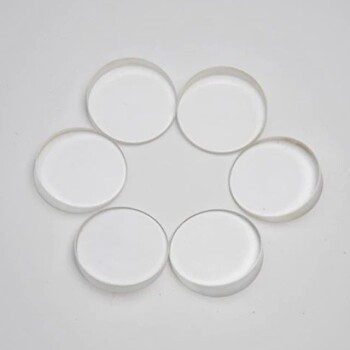
The use of a standard sieve is the critical final quality control step before CaF2 nanopowders enter the sintering phase. Its primary function is to physically intercept and remove oversized particles and residual agglomerates that persist after the grinding process, ensuring that the powder entering the mold possesses a narrow and uniform particle size distribution.
Core Insight: High powder uniformity is not just about consistency; it is the structural prerequisite for optical quality. By eliminating large agglomerates, sieving enables the high packing density required to minimize pore defects and achieve high transparency in the final CaF2 ceramic product.
The Mechanics of Particle Uniformity
Eliminating Residual Agglomerates
Even after rigorous grinding, nanopowders often retain large, hard particles or re-clump into agglomerates.
A standard sieve acts as a physical barrier, intercepting these inconsistencies. This ensures they are removed from the bulk powder before they can compromise the mixture.
Ensuring Narrow Size Distribution
The goal of ceramic processing is homogeneity. The sieve acts as a filter to enforce a strict upper limit on particle size.
This results in a powder batch where all particles fall within a specific, narrow range, which is essential for predictable behavior during the heating phase.
Impact on Sintering and Structure
Maximizing Packing Density
To create a solid ceramic, the powder must be packed as tightly as possible in the mold.
Uniform particles created by sieving allow for tighter, more efficient packing. This increases the density of the "green body" (the pressed powder) before heat is even applied.
Minimizing Pore Defects
Large particles or agglomerates create bridges and gaps within the powder bed.
These gaps turn into pore defects during sintering. By removing the large particles, you remove the primary cause of these structural voids.
The Critical Link to Transparency
Why Uniformity Matters for Optics
For CaF2 (Calcium Fluoride) ceramics, the ultimate performance metric is often transparency.
Pores and structural defects scatter light, ruining optical clarity. Therefore, the removal of agglomerates via sieving is directly linked to the transparency of the final product.
Achieving High-End Finish
You cannot achieve a glass-like, transparent ceramic with an inconsistent feedstock.
Sieving ensures the microstructure is uniform enough to sinter into a defect-free, highly transparent solid.
Understanding the Trade-offs
Process Efficiency vs. Quality Assurance
Sieving introduces an additional step in the manufacturing workflow, potentially increasing processing time.
However, skipping this step creates a high risk of rejection later in the process. The time "saved" by not sieving is often lost to failed batches that lack the required density or transparency.
Material Yield Considerations
Sieving will naturally result in some material loss (the oversized particles that are removed).
This reduction in yield is a necessary trade-off. Attempting to use the rejected material would degrade the quality of the entire batch.
Optimizing Your Sintering Workflow
To ensure the best results for your CaF2 ceramics, evaluate your goals:
- If your primary focus is High Transparency: You must prioritize a strict sieving protocol to eliminate the pore defects that cause light scattering.
- If your primary focus is Structural Integrity: Use sieving to ensure the high packing density required for a mechanically sound, defect-free ceramic body.
Sieving is not merely a separation method; it is the foundational step for achieving optical clarity in ceramic processing.
Summary Table:
| Key Feature | Impact on CaF2 Sintering | Benefit to Final Product |
|---|---|---|
| Agglomerate Removal | Eliminates large particles and hard clusters | Prevents light-scattering pore defects |
| Narrow Size Distribution | Ensures uniform particle behavior during heating | Achieves high structural homogeneity |
| Packing Density | Increases "green body" density in the mold | Minimizes voids and structural gaps |
| Quality Control | Final physical check post-grinding | Guarantees optical transparency and finish |
Elevate Your Material Research with KINTEK Precision Solutions
Achieving the perfect transparency in CaF2 ceramics starts with the right equipment. KINTEK specializes in providing high-performance laboratory solutions tailored for advanced material science. From high-precision sieving equipment and crushing systems to ensure your powder uniformity, to industrial-grade hydraulic presses and vacuum/atmosphere sintering furnaces for final processing, we empower researchers to eliminate defects and maximize yield.
Whether you are developing next-generation optics or high-strength ceramics, our comprehensive range of laboratory equipment and consumables—including crucibles, ceramics, and cooling solutions—is designed to meet the most rigorous standards.
Ready to optimize your sintering workflow? Contact our technical experts today to find the perfect tools for your lab’s success!
Related Products
People Also Ask
- Is Sputter Tint good? Premium Heat Rejection & Long-Term Durability Explained
- Why is fluorine-doped tin oxide (FTO) glass an ideal substrate? Discover the Ultimate Base for Photoelectrodes
- What is the role of a flat optical window in spectroscopic reaction cells? Precision Design for Fast Gas Exchange
- What materials are used in optical coating? A Guide to Metal Oxides, Fluorides, and More
- What are optical coatings made of? Metals, Dielectrics & Polymers for Light Control