Knowledge Resources What is the temperature at the bottom of the blast furnace? Unlocking the Heart of Iron Production
Author avatar

Tech Team · Kintek Solution

Updated 2 months ago

What is the temperature at the bottom of the blast furnace? Unlocking the Heart of Iron Production


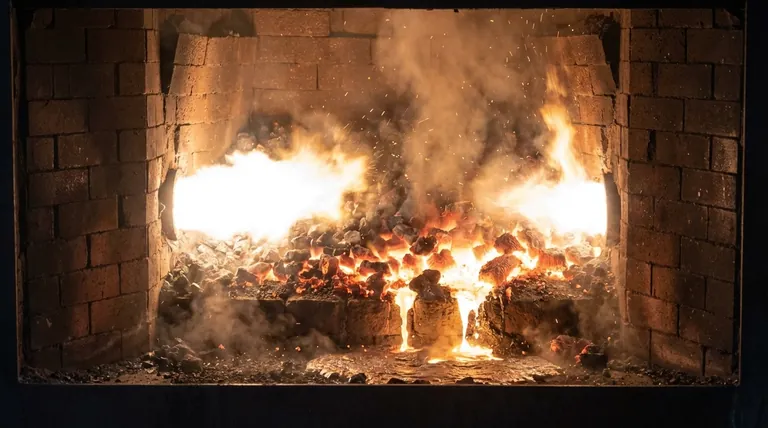
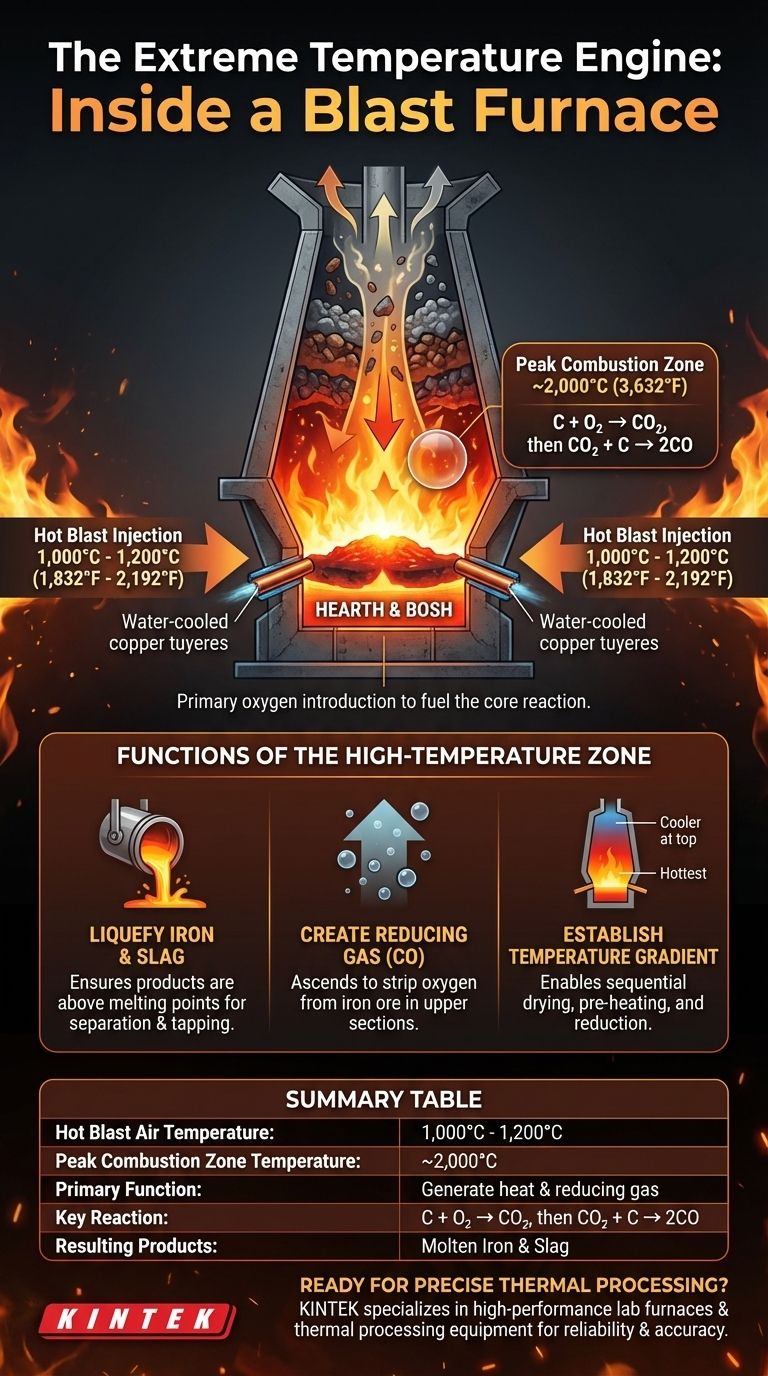
At the very bottom of a blast furnace, the temperature of the hot air being injected is between 1,000°C and 1,200°C (1,832°F to 2,192°F). This injection of superheated air initiates a series of chemical reactions with coke and coal that can drive the localized temperature in this combustion zone even higher, often approaching 2,000°C (3,632°F).

The extreme temperature at the bottom of the furnace is not just for melting materials. Its primary purpose is to initiate the combustion that creates both the intense heat and the crucial reducing gases required to transform iron ore into liquid iron throughout the entire furnace.
What is the temperature at the bottom of the blast furnace? Unlocking the Heart of Iron Production

The Function of the High-Temperature Zone

The bottom section of a blast furnace, known as the hearth or bosh, is the engine room for the entire iron-making process. The temperature here is the highest in the furnace for very specific reasons.

The Hot Blast Injection

Hot air, pre-heated to between 1,000°C and 1,200°C, is blasted into the furnace through water-cooled copper nozzles called tuyeres. This is the primary introduction of oxygen to fuel the core reaction.

The Primary Combustion Reaction

This blast of hot oxygen immediately reacts with the coke (a high-carbon fuel) and any pulverized coal that has been added. This combustion reaction (C + O₂) is intensely exothermic, releasing a massive amount of energy and heat.

Creating the Reducing Agent

The intense heat from the initial combustion instantly drives a second reaction. The carbon dioxide (CO₂) produced reacts with more hot coke to form carbon monoxide (CO), as described by the equation CO₂ + C → 2CO. This carbon monoxide is the critical reduction gas that travels up the furnace.

Why This Extreme Temperature is Necessary

The heat generated at the bottom serves multiple critical functions that enable the entire operation. It is the foundation upon which the rest of the furnace's chemistry and physics depend.

To Liquefy the Iron and Slag

The temperature must be high enough to ensure that the final products—the molten iron and the liquid impurities known as slag—are well above their melting points. This allows them to trickle down through the coke bed and collect in separate layers in the hearth, ready for tapping.

To Drive the Chemical Process

The column of hot carbon monoxide gas rising from the bottom is what strips the oxygen atoms from the iron ore (iron oxides) in the upper sections of the furnace. Without the intense heat at the bottom to create this gas, the reduction of iron ore to iron simply cannot occur.

To Establish a Temperature Gradient

The furnace operates on a temperature gradient, being hottest at the bottom and progressively cooler towards the top. This gradient allows the raw materials descending from the top to be dried, pre-heated, and chemically reduced in a controlled, sequential manner before they finally reach the melting zone.

Making the Right Choice for Your Goal

Understanding the function of this heat is more important than memorizing a single number. The temperature at the bottom is the starting point for everything that happens above it.

  • If your primary focus is the energy source: The bottom of the furnace is the primary combustion zone where coke and hot air react, generating the thermal energy for the entire process.
  • If your primary focus is the chemistry: This high-temperature zone is where the crucial reducing gas (carbon monoxide) is created, which then travels upward to convert iron ore into iron.
  • If your primary focus is the physical process: The intense heat ensures both the final iron and the waste slag become fully liquid, allowing for their effective separation and removal.

Ultimately, viewing the blast furnace not as a simple oven but as a dynamic counter-current chemical reactor is the key to understanding its operation.

Summary Table:

Parameter Value
Hot Blast Air Temperature 1,000°C - 1,200°C (1,832°F - 2,192°F)
Peak Combustion Zone Temperature ~2,000°C (3,632°F)
Primary Function Generate heat and reducing gas (CO)
Key Reaction C + O₂ → CO₂, then CO₂ + C → 2CO
Resulting Products Molten Iron and Slag

Ready to achieve precise thermal processing in your own operations? KINTEK specializes in high-performance lab furnaces and thermal processing equipment designed for reliability and accuracy. Whether your work involves materials testing, metallurgy, or chemical synthesis, our solutions deliver the controlled high-temperature environments you need. Contact our experts today to discuss how we can support your laboratory's specific heating and processing requirements!

Visual Guide
What is the temperature at the bottom of the blast furnace? Unlocking the Heart of Iron Production Visual Guide

Related Products

People Also Ask

Related Products

High Temperature Muffle Oven Furnace for Laboratory Debinding and Pre Sintering

High Temperature Muffle Oven Furnace for Laboratory Debinding and Pre Sintering

KT-MD High temperature debinding and pre-sintering furnace for ceramic materials with various molding processes. Ideal for electronic components such as MLCC and NFC.

Vacuum Heat Treat Sintering Brazing Furnace

Vacuum Heat Treat Sintering Brazing Furnace

A vacuum brazing furnace is a type of industrial furnace used for brazing, a metalworking process that joins two pieces of metal using a filler metal that melts at a lower temperature than the base metals. Vacuum brazing furnaces are typically used for high-quality applications where a strong, clean joint is required.

Laboratory Muffle Oven Furnace Bottom Lifting Muffle Furnace

Laboratory Muffle Oven Furnace Bottom Lifting Muffle Furnace

Efficiently produce batches with excellent temperature uniformity using our Bottom Lifting Furnace. Features two electric lifting stages and advanced temperature control up to 1600℃.

1200℃ Muffle Furnace Oven for Laboratory

1200℃ Muffle Furnace Oven for Laboratory

Upgrade your lab with our 1200℃ Muffle Furnace. Achieve fast, precise heating with Japan alumina fibers and Molybdenum coils. Features TFT touch screen controller for easy programming and data analysis. Order now!

Ultra-High Temperature Graphite Vacuum Graphitization Furnace

Ultra-High Temperature Graphite Vacuum Graphitization Furnace

The ultra-high temperature graphitization furnace utilizes medium frequency induction heating in a vacuum or inert gas environment. The induction coil generates an alternating magnetic field, inducing eddy currents in the graphite crucible, which heats up and radiates heat to the workpiece, bringing it to the desired temperature. This furnace is primarily used for graphitization and sintering of carbon materials, carbon fiber materials, and other composite materials.

Vacuum Hot Press Furnace Machine Heated Vacuum Press

Vacuum Hot Press Furnace Machine Heated Vacuum Press

Discover the advantages of Vacuum Hot Press Furnace! Manufacture dense refractory metals & compounds, ceramics, and composites under high temp and pressure.

1200℃ Controlled Atmosphere Furnace Nitrogen Inert Atmosphere Furnace

1200℃ Controlled Atmosphere Furnace Nitrogen Inert Atmosphere Furnace

Discover our KT-12A Pro Controlled atmosphere furnace - high precision, heavy duty vacuum chamber, versatile smart touch screen controller, and excellent temperature uniformity up to 1200C. Ideal for both laboratory and industrial application.

1700℃ Controlled Atmosphere Furnace Nitrogen Inert Atmosphere Furnace

1700℃ Controlled Atmosphere Furnace Nitrogen Inert Atmosphere Furnace

KT-17A Controlled atmosphere furnace: 1700℃ heating, vacuum sealing technology, PID temperature control, and versatile TFT smart touch screen controller for laboratory and industrial use.

Vertical High Temperature Graphite Vacuum Graphitization Furnace

Vertical High Temperature Graphite Vacuum Graphitization Furnace

Vertical high temperature graphitization furnace for carbonization and graphitization of carbon materials up to 3100℃.Suitable for shaped graphitization of carbon fiber filaments and other materials sintered in a carbon environment.Applications in metallurgy, electronics, and aerospace for producing high-quality graphite products like electrodes and crucibles.

1700℃ Muffle Oven Furnace for Laboratory

1700℃ Muffle Oven Furnace for Laboratory

Get superior heat control with our 1700℃ Muffle Furnace. Equipped with intelligent temperature microprocessor, TFT touch screen controller & advanced insulation materials for precise heating up to 1700C. Order now!

Spark Plasma Sintering Furnace SPS Furnace

Spark Plasma Sintering Furnace SPS Furnace

Discover the benefits of Spark Plasma Sintering Furnaces for rapid, low-temperature material preparation. Uniform heating, low cost & eco-friendly.

Molybdenum Vacuum Heat Treat Furnace

Molybdenum Vacuum Heat Treat Furnace

Discover the benefits of a high-configuration molybdenum vacuum furnace with heat shield insulation. Ideal for high-purity, vacuum environments like sapphire crystal growth and heat treatment.

1400℃ Controlled Atmosphere Furnace with Nitrogen and Inert Atmosphere

1400℃ Controlled Atmosphere Furnace with Nitrogen and Inert Atmosphere

Achieve precise heat treatment with KT-14A controlled atmosphere furnace. Vacuum sealed with a smart controller, it's ideal for lab and industrial use up to 1400℃.

Vacuum Heat Treat and Pressure Sintering Furnace for High Temperature Applications

Vacuum Heat Treat and Pressure Sintering Furnace for High Temperature Applications

Vacuum pressure sintering furnaces are designed for high temperature hot pressing applications in metal and ceramic sintering. Its advanced features ensure precise temperature control, reliable pressure maintenance, and a robust design for seamless operation.

Large Vertical Graphite Vacuum Graphitization Furnace

Large Vertical Graphite Vacuum Graphitization Furnace

A large vertical high-temperature graphitization furnace is a type of industrial furnace used for the graphitization of carbon materials, such as carbon fiber and carbon black. It is a high-temperature furnace that can reach temperatures of up to 3100°C.

Vacuum Arc Induction Melting Furnace

Vacuum Arc Induction Melting Furnace

Discover the power of Vacuum Arc Furnace for melting active & refractory metals. High-speed, remarkable degassing effect, and free of contamination. Learn more now!

600T Vacuum Induction Hot Press Furnace for Heat Treat and Sintering

600T Vacuum Induction Hot Press Furnace for Heat Treat and Sintering

Discover the 600T Vacuum Induction Hot Press Furnace, designed for high-temperature sintering experiments in vacuum or protected atmospheres. Its precise temperature and pressure control, adjustable working pressure, and advanced safety features make it ideal for nonmetal materials, carbon composites, ceramics, and metal powders.

Horizontal High Temperature Graphite Vacuum Graphitization Furnace

Horizontal High Temperature Graphite Vacuum Graphitization Furnace

Horizontal Graphitization Furnace: This type of furnace is designed with the heating elements placed horizontally, allowing for uniform heating of the sample. It's well-suited for graphitizing large or bulky samples that require precise temperature control and uniformity.

1200℃ Split Tube Furnace with Quartz Tube Laboratory Tubular Furnace

1200℃ Split Tube Furnace with Quartz Tube Laboratory Tubular Furnace

KT-TF12 split tube furnace: high-purity insulation, embedded heating wire coils, and max. 1200C. Widely used for new materials and chemical vapour deposition.

Controlled Nitrogen Inert Hydrogen Atmosphere Furnace

Controlled Nitrogen Inert Hydrogen Atmosphere Furnace

KT-AH Hydrogen atmosphere furnace - induction gas furnace for sintering/annealing with built-in safety features, dual housing design, and energy-saving efficiency. Ideal for lab and industrial use.


Leave Your Message



















