Knowledge What is the temperature limit of silicon carbide? Maximize Performance from 1600°C to 2500°C
Author avatar

Tech Team · Kintek Solution

Updated 6 days ago

What is the temperature limit of silicon carbide? Maximize Performance from 1600°C to 2500°C


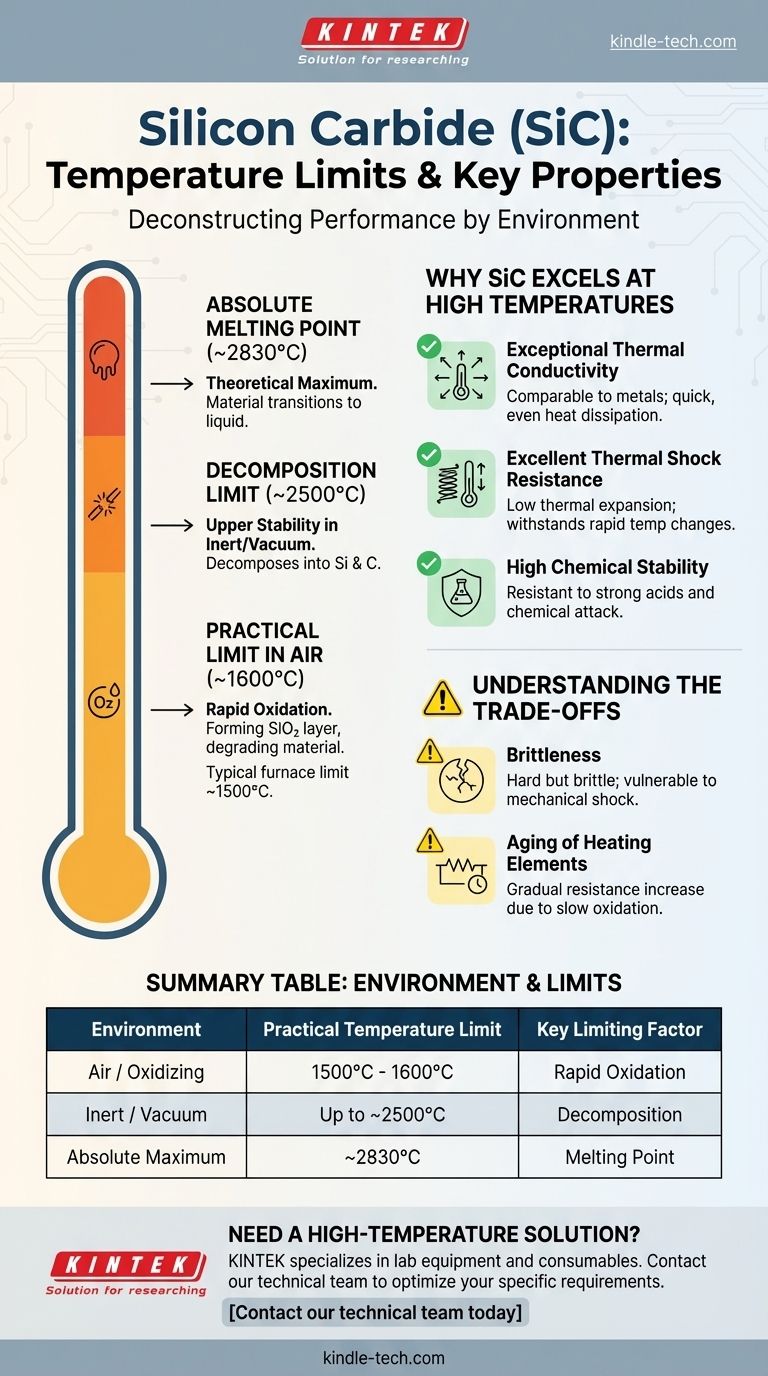
The temperature limit of silicon carbide (SiC) is not a single value but a series of thresholds that depend on the operating environment and the specific application. While its theoretical melting point is extremely high at approximately 2830°C, its practical limit in air is much lower, typically between 1500°C and 1600°C, due to oxidation. In inert atmospheres, its upper stability limit is closer to 2500°C.

The most critical factor determining silicon carbide's useful temperature range is its environment. In most real-world applications involving air, the practical limit is defined by the onset of rapid oxidation around 1600°C, not by its much higher melting point.
What is the temperature limit of silicon carbide? Maximize Performance from 1600°C to 2500°C

Deconstructing SiC's Temperature Limits

To use silicon carbide effectively, you must understand the difference between its absolute melting point, its stability limit, and its practical operating temperature in air.

The Absolute Limit: Melting Point (~2830°C)

This is the temperature at which solid silicon carbide transitions to a liquid state. This value represents the absolute theoretical maximum temperature the material can endure before complete structural failure.

The Structural Limit: Decomposition (~2500°C)

Before it melts, SiC can begin to decompose into its constituent elements, silicon and carbon. Its upper stability limit is therefore considered to be around 2500°C, making this a more realistic boundary for applications in inert or vacuum environments where oxidation is not a concern.

The Practical Limit: Oxidation in Air (~1600°C)

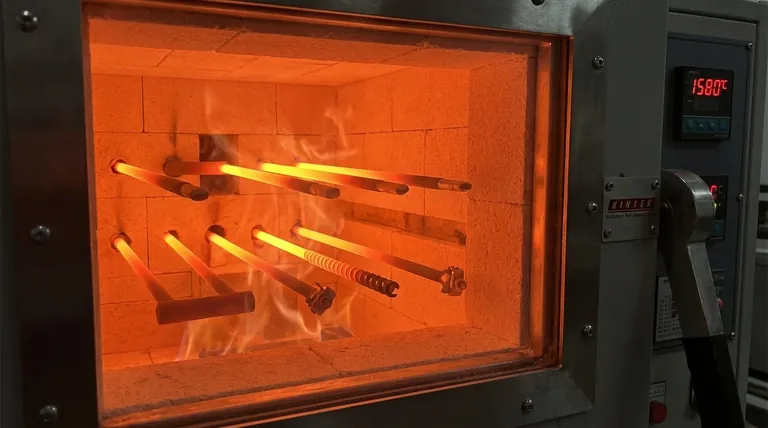
For most common applications, such as furnace heating elements operating in air, the limiting factor is oxidation. Above 1600°C, the silicon in SiC reacts with atmospheric oxygen, forming a layer of silicon dioxide (SiO₂).

While this oxide layer can be protective at lower temperatures, the rate of oxidation accelerates significantly above 1600°C, degrading the material and limiting its service life. This is why many SiC resistors are rated for use only up to about 1500°C.

Why SiC Excels at High Temperatures

Silicon carbide’s value extends beyond its heat tolerance. Several other properties make it a uniquely capable material for high-temperature and high-performance applications.

Exceptional Thermal Conductivity

SiC possesses a thermal conductivity comparable to that of some metals like copper. This unique trait for a ceramic allows it to dissipate heat quickly and evenly, preventing the formation of destructive hot spots and making it an ideal material for heating elements.

Excellent Thermal Shock Resistance

The material has a very low coefficient of thermal expansion. This means it expands and contracts very little when heated and cooled, giving it an outstanding ability to withstand rapid temperature changes without cracking or failing.

High Chemical Stability

Silicon carbide is extremely resistant to chemical attack, particularly from strong acids. This chemical inertness allows it to perform reliably in harsh environments where other materials would quickly corrode and fail.

Understanding the Trade-offs

No material is perfect. To properly engineer a solution with SiC, you must be aware of its practical limitations.

Brittleness is a Key Constraint

Like many other hard ceramics, SiC is brittle. While it is exceptionally hard and resistant to wear, it can fracture under sudden mechanical shock or impact. Designs must account for this by minimizing tensile stress and avoiding impact loads.

Aging of Heating Elements

When used as heating elements, SiC components experience a gradual increase in electrical resistance over time due to slow oxidation and changes in their crystalline structure. This "aging" process is a critical design consideration.

High-end systems often require a variable power source, such as an auto-transformer with multiple taps, to compensate for this resistance increase and maintain consistent power output throughout the element's lifespan.

Making the Right Choice for Your Application

Your final decision should be guided by the specific demands of your project.

  • If your primary focus is maximum temperature in an inert atmosphere: You can engineer your system to operate near SiC's stability limit of ~2500°C, but material integrity becomes the primary concern.
  • If your primary focus is long-term stability in air: Plan for a maximum continuous operating temperature between 1500°C and 1600°C to prevent rapid oxidative failure.
  • If your primary focus is thermal cycling and shock resistance: SiC is an excellent choice due to its low thermal expansion, but your mechanical design must protect it from physical impact due to its brittle nature.

Understanding these distinct environmental and application-driven limits is the key to successfully harnessing the power of silicon carbide.

Summary Table:

Environment Practical Temperature Limit Key Limiting Factor
Air / Oxidizing 1500°C - 1600°C Rapid Oxidation
Inert / Vacuum Up to ~2500°C Decomposition
Absolute Maximum ~2830°C Melting Point

Need a high-temperature solution for your lab?

Silicon carbide's exceptional properties—like high thermal conductivity and shock resistance—make it ideal for demanding applications. Choosing the right grade and design is critical for performance and longevity.

KINTEK specializes in lab equipment and consumables. Our experts can help you select the perfect silicon carbide components for your furnaces or high-temperature processes, ensuring reliability and efficiency.

Contact our technical team today to discuss your specific requirements and optimize your high-temperature operations!

Visual Guide
What is the temperature limit of silicon carbide? Maximize Performance from 1600°C to 2500°C Visual Guide

Related Products

People Also Ask

Related Products

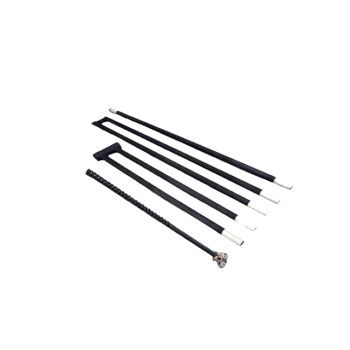
Silicon Carbide SiC Thermal Heating Elements for Electric Furnace

Silicon Carbide SiC Thermal Heating Elements for Electric Furnace

Experience the advantages of Silicon Carbide (SiC) Heating Element: Long service life, high corrosion and oxidation resistance, fast heating speed, and easy maintenance. Learn more now!

Custom-Made Alumina Zirconia Special-Shaped Ceramic Plates for Engineering Advanced Fine Ceramics Processing

Custom-Made Alumina Zirconia Special-Shaped Ceramic Plates for Engineering Advanced Fine Ceramics Processing

Alumina ceramics have good electrical conductivity, mechanical strength and high temperature resistance, while zirconia ceramics are known for their high strength and high toughness and are widely used.

Custom PTFE Teflon Parts Manufacturer for Non-Standard Insulator Customization

Custom PTFE Teflon Parts Manufacturer for Non-Standard Insulator Customization

PTFE insulator PTFE has excellent electrical insulation properties in a wide temperature and frequency range.

Custom PTFE Teflon Parts Manufacturer for PTFE Ball Valve Seat

Custom PTFE Teflon Parts Manufacturer for PTFE Ball Valve Seat

Seats and inserts are vital components in the valve industry. As a key component, polytetrafluoroethylene is usually selected as the raw material.

Custom PTFE Teflon Parts Manufacturer for Hydrothermal Synthesis Reactor Polytetrafluoroethylene Carbon Paper and Carbon Cloth Nano-growth

Custom PTFE Teflon Parts Manufacturer for Hydrothermal Synthesis Reactor Polytetrafluoroethylene Carbon Paper and Carbon Cloth Nano-growth

Acid and alkali resistant polytetrafluoroethylene experimental fixtures meet different requirements. The material is made of brand new polytetrafluoroethylene material, which has excellent chemical stability, corrosion resistance, airtightness, high lubricity and non-stickiness, electrical corrosion and good anti-aging ability, and can work for a long time at temperatures from -180℃ to +250℃.

Advanced Engineering Fine Ceramics Aluminum Nitride (AlN) Ceramic Sheet

Advanced Engineering Fine Ceramics Aluminum Nitride (AlN) Ceramic Sheet

Aluminum nitride (AlN) has the characteristics of good compatibility with silicon. It is not only used as a sintering aid or reinforcing phase for structural ceramics, but its performance far exceeds that of alumina.

High Temperature Resistant Optical Quartz Glass Sheet

High Temperature Resistant Optical Quartz Glass Sheet

Discover the power of optical glass sheets for precise light manipulation in telecommunications, astronomy, and beyond. Unlock advancements in optical technology with exceptional clarity and tailored refractive properties.

Laboratory Disc Rotary Mixer for Efficient Sample Mixing and Homogenization

Laboratory Disc Rotary Mixer for Efficient Sample Mixing and Homogenization

Efficient Laboratory Disc Rotary Mixer for Precise Sample Mixing, Versatile for Various Applications, DC Motor and Microcomputer Control, Adjustable Speed and Angle.

High Shear Homogenizer for Pharmaceutical and Cosmetic Applications

High Shear Homogenizer for Pharmaceutical and Cosmetic Applications

Enhance lab efficiency with our high-speed Laboratory Emulsifier Homogenizer for precise, stable sample processing. Ideal for pharmaceuticals & cosmetics.

Custom PTFE Teflon Parts Manufacturer for PTFE Measuring Cylinder 10/50/100ml

Custom PTFE Teflon Parts Manufacturer for PTFE Measuring Cylinder 10/50/100ml

PTFE measuring cylinder are a rugged alternative to traditional glass cylinders. They are chemically inert over a wide temperature range (up to 260º C), have excellent corrosion resistance and maintain a low coefficient of friction, ensuring ease of use and cleaning.

Custom PTFE Teflon Parts Manufacturer for Hollow Etching Flower Basket ITO FTO Developing Glue Removal

Custom PTFE Teflon Parts Manufacturer for Hollow Etching Flower Basket ITO FTO Developing Glue Removal

PTFE adjustable height flower basket (Teflon flower baskets) are made of high-purity experimental grade PTFE, with excellent chemical stability, corrosion resistance, sealing and high and low temperature resistance.

Lab Internal Rubber Mixer Rubber Kneader Machine for Mixing and Kneading

Lab Internal Rubber Mixer Rubber Kneader Machine for Mixing and Kneading

Lab internal rubber mixer is suitable for mixing, kneading and dispersing various chemical raw materials such as plastics, rubber, synthetic rubber, hot melt adhesive and various low-viscosity materials.

Custom PTFE Teflon Parts Manufacturer Corrosion Resistant Cleaning Rack Flower Basket

Custom PTFE Teflon Parts Manufacturer Corrosion Resistant Cleaning Rack Flower Basket

The PTFE cleaning rack, also known as the PTFE flower basket cleaning flower basket, is a specialized laboratory tool designed for the efficient cleaning of PTFE materials. This cleaning rack ensures thorough and safe cleaning of PTFE items, maintaining their integrity and performance in laboratory settings.

Electron Beam Evaporation Coating Oxygen-Free Copper Crucible and Evaporation Boat

Electron Beam Evaporation Coating Oxygen-Free Copper Crucible and Evaporation Boat

Electron Beam Evaporation Coating Oxygen-Free Copper Crucible enables precise co-deposition of various materials. Its controlled temperature and water-cooled design ensure pure and efficient thin film deposition.

Custom PTFE Teflon Parts Manufacturer for Centrifuge Tubes

Custom PTFE Teflon Parts Manufacturer for Centrifuge Tubes

PTFE centrifugal tubes are highly valued for their exceptional chemical resistance, thermal stability, and non-stick properties, making them indispensable in various high-demand sectors. These tubes are particularly useful in environments where exposure to corrosive substances, high temperatures, or stringent cleanliness requirements are prevalent.

Platinum Auxiliary Electrode for Laboratory Use

Platinum Auxiliary Electrode for Laboratory Use

Optimize your electrochemical experiments with our Platinum Auxiliary Electrode. Our high-quality, customizable models are safe and durable. Upgrade today!

Custom PTFE Teflon Parts Manufacturer for Culture Dish and Evaporation Dish

Custom PTFE Teflon Parts Manufacturer for Culture Dish and Evaporation Dish

The PTFE culture dish evaporating dish is a versatile laboratory tool known for its chemical resistance and high-temperature stability. PTFE, a fluoropolymer, offers exceptional non-stick properties and durability, making it ideal for various applications in research and industry, including filtration, pyrolysis, and membrane technology.

Optical Ultra-Clear Glass Sheet for Laboratory K9 B270 BK7

Optical Ultra-Clear Glass Sheet for Laboratory K9 B270 BK7

Optical glass, while sharing many characteristics with other types of glass, is manufactured using specific chemicals that enhance properties crucial for optics applications.

High Temperature Alumina (Al2O3) Furnace Tube for Engineering Advanced Fine Ceramics

High Temperature Alumina (Al2O3) Furnace Tube for Engineering Advanced Fine Ceramics

High temperature alumina furnace tube combines the advantages of high hardness of alumina, good chemical inertness and steel, and has excellent wear resistance, thermal shock resistance and mechanical shock resistance.

Custom CVD Diamond Coating for Lab Applications

Custom CVD Diamond Coating for Lab Applications

CVD Diamond Coating: Superior Thermal Conductivity, Crystal Quality, and Adhesion for Cutting Tools, Friction, and Acoustic Applications


Leave Your Message