Knowledge What mesh is used for sieving? A Guide to Choosing the Right Sieve Medium
Author avatar

Tech Team · Kintek Solution

Updated 1 week ago

What mesh is used for sieving? A Guide to Choosing the Right Sieve Medium


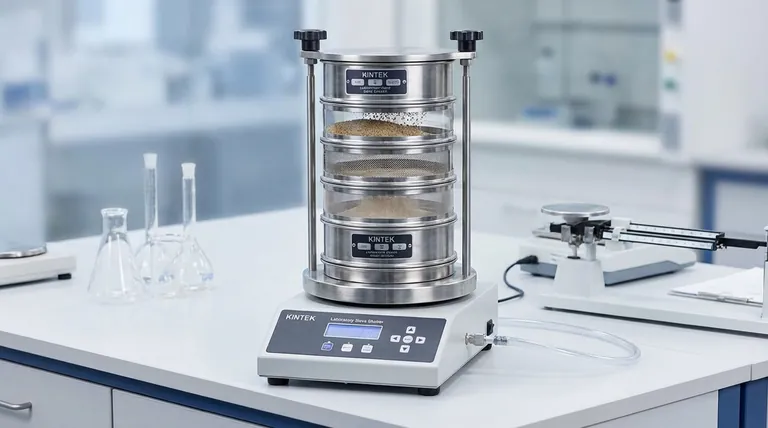
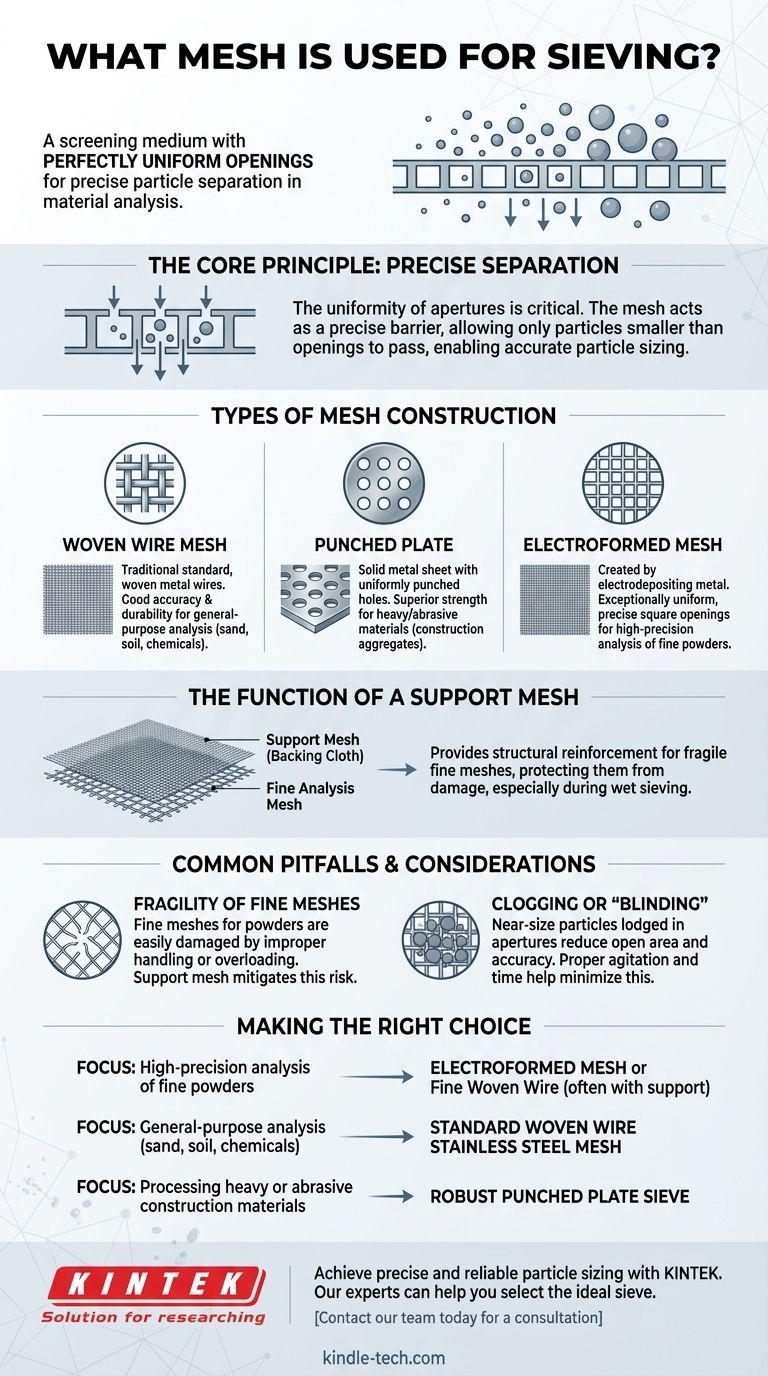
In short, the mesh used for sieving is a screening medium designed with openings of a perfectly uniform size and shape. This medium is what performs the actual separation of particles. It can be made from various materials—such as woven wire, punched metal plate, or electrodeposited film—depending on the specific application and the material being analyzed.

The critical concept is not a single type of mesh, but the principle of uniform openings. The entire purpose of sieving for analysis relies on the mesh acting as a precise barrier, allowing only particles smaller than its openings to pass through.
What mesh is used for sieving? A Guide to Choosing the Right Sieve Medium

The Role of Mesh in Material Analysis

Sieving is a fundamental technique for determining the particle size distribution of a granular material. The mesh is the heart of this process, acting as the measurement tool. Its construction directly impacts the accuracy and reliability of your results.

The Core Principle: Precise Separation

The defining characteristic of a sieve mesh is the uniformity of its apertures, or openings. Every opening is manufactured to be the same size.

When a sample is agitated on the sieve, particles smaller than the mesh openings fall through, while larger particles are retained on its surface. This simple mechanical action is what allows for precise particle sizing.

Types of Mesh Construction

While woven wire is the most common, different materials and methods are used to create the screening medium.

  • Woven Wire Mesh: This is the traditional standard, created by weaving metal wires together. It offers a good balance of accuracy and durability for a wide range of materials, from fine powders to coarse sands.
  • Punched Plate: For larger particles or heavy-duty applications (like construction aggregates), a solid sheet of metal with uniformly punched holes is used. This provides superior strength.
  • Electroformed Mesh: For extremely fine particles requiring the highest precision, this mesh is created by electrodepositing metal onto a template. It results in exceptionally uniform and precise square openings.

The Function of a Support Mesh

In certain applications, especially with very fine powders, the primary analysis mesh can be extremely fragile.

A support mesh, also called a backing cloth, is a coarser and stronger sieve cloth placed underneath the fine mesh. Its sole purpose is to provide structural reinforcement, protecting the delicate analysis mesh from damage, particularly during wet sieving operations.

Common Pitfalls and Considerations

While the concept is straightforward, the physical reality of sieving presents challenges that are directly related to the mesh. Understanding these helps ensure you get accurate and repeatable results.

Fragility of Fine Meshes

The smaller the particle you need to measure, the finer and more delicate the mesh wire must be. Meshes for fine powders can be easily damaged by improper handling, cleaning, or overloading with sample material.

Using a support mesh is the primary way to mitigate this risk, especially when liquids are involved in the sieving process.

Clogging or "Blinding"

Blinding occurs when particles that are very close to the size of the mesh openings become lodged in the apertures. This effectively reduces the open area of the sieve and prevents other particles from passing through, leading to inaccurate results.

Proper sieve agitation and selecting the right sieving time can help minimize this issue, but it remains a key operational challenge.

Making the Right Choice for Your Goal

Selecting the appropriate sieving medium is entirely dependent on the material you are analyzing and the precision you require.

  • If your primary focus is high-precision analysis of fine powders: An electroformed mesh or a fine woven wire mesh, often paired with a support mesh, is the correct choice.
  • If your primary focus is general-purpose analysis of sand, soil, or chemicals: A standard woven wire stainless steel mesh provides the necessary accuracy and durability.
  • If your primary focus is processing heavy or abrasive construction materials: A robust punched plate sieve is required to withstand the demanding load without damage.

Ultimately, understanding the function and material of your sieve mesh is the first step toward reliable and repeatable material analysis.

Summary Table:

Mesh Type Best For Key Characteristics
Woven Wire General-purpose analysis (sand, soil, chemicals) Good accuracy and durability; standard for most labs
Punched Plate Heavy/abrasive materials (construction aggregates) Superior strength for large particles
Electroformed Mesh High-precision analysis of fine powders Exceptionally uniform and precise square openings
Support Mesh Protecting fine, fragile meshes Coarse backing cloth for structural reinforcement

Achieve precise and reliable particle sizing with the right sieve mesh from KINTEK.

Whether you are analyzing fine powders, chemicals, or heavy aggregates, selecting the correct sieve medium is critical for accurate results. KINTEK specializes in high-quality lab sieves and consumables, offering a full range of mesh types to meet your specific material analysis needs.

Our experts can help you select the ideal sieve to enhance your lab's efficiency and data accuracy.

Contact our team today for a consultation and ensure your sieving process is built on a solid foundation.

Visual Guide
What mesh is used for sieving? A Guide to Choosing the Right Sieve Medium Visual Guide

Related Products

People Also Ask

Related Products

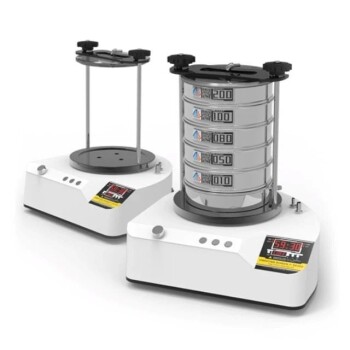
Laboratory Test Sieves and Vibratory Sieve Shaker Machine

Laboratory Test Sieves and Vibratory Sieve Shaker Machine

Efficiently process powders, granules, and small blocks with a high-frequency vibration sieve. Control vibration frequency, screen continuously or intermittently, and achieve accurate particle size determination, separation, and classification.

Three-dimensional electromagnetic sieving instrument

Three-dimensional electromagnetic sieving instrument

KT-VT150 is a desktop sample processing instrument for both sieving and grinding. Grinding and sieving can be used both dry and wet. The vibration amplitude is 5mm and the vibration frequency is 3000-3600 times/min.

Laboratory Vibratory Sieve Shaker Machine for Dry and Wet Three-Dimensional Sieving

Laboratory Vibratory Sieve Shaker Machine for Dry and Wet Three-Dimensional Sieving

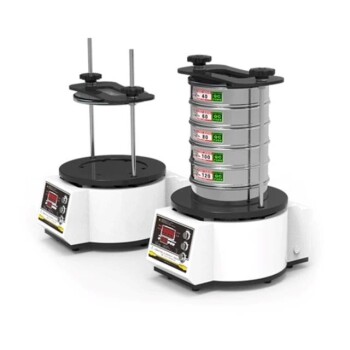
KT-VD200 can be used for sieving tasks of dry and wet samples in the laboratory. The screening quality is 20g-3kg. The product is designed with a unique mechanical structure and an electromagnetic vibrating body with a vibration frequency of 3000 times per minute.

Custom PTFE Teflon Parts Manufacturer for PTFE Mesh F4 Sieve

Custom PTFE Teflon Parts Manufacturer for PTFE Mesh F4 Sieve

PTFE mesh sieve is a specialized test sieve designed for particle analysis in various industries, featuring a non-metallic mesh woven from PTFE filament. This synthetic mesh is ideal for applications where metal contamination is a concern . PTFE sieves are crucial for maintaining the integrity of samples in sensitive environments, ensuring accurate and reliable results in particle size distribution analysis.

Laboratory Wet Three-Dimensional Vibratory Sieve Shaker Machine

Laboratory Wet Three-Dimensional Vibratory Sieve Shaker Machine

The wet three-dimensional vibrating sieving instrument focuses on solving the sieving tasks of dry and wet samples in the laboratory. It is suitable for sieving 20g - 3kg dry, wet or liquid samples.

Laboratory Vibratory Sieve Shaker Machine Slap Vibrating Sieve

Laboratory Vibratory Sieve Shaker Machine Slap Vibrating Sieve

KT-T200TAP is a slapping and oscillating sieving instrument for laboratory desktop use, with 300 rpm horizontal circular motion and 300 vertical slapping motions to simulate manual sieving to help sample particles pass through better.

Laboratory Vortex Mixer Orbital Shaker Multifunctional Rotation Oscillation Mixer

Laboratory Vortex Mixer Orbital Shaker Multifunctional Rotation Oscillation Mixer

The inching mixer is small in size, mixes quickly and thoroughly, and the liquid is in a vortex shape, which can mix all the test solutions attached to the tube wall.

Laboratory Single Horizontal Jar Mill

Laboratory Single Horizontal Jar Mill

KT-JM3000 is a mixing and grinding instrument for placing a ball milling tank with a volume of 3000ml or less. It adopts frequency conversion control to realize timing, constant speed, direction change, overload protection and other functions.

Lab Plastic PVC Calender Stretch Film Casting Machine for Film Testing

Lab Plastic PVC Calender Stretch Film Casting Machine for Film Testing

The cast film machine is designed for the molding of polymer cast film products and has multiple processing functions such as casting, extrusion, stretching, and compounding.

Lab Internal Rubber Mixer Rubber Kneader Machine for Mixing and Kneading

Lab Internal Rubber Mixer Rubber Kneader Machine for Mixing and Kneading

Lab internal rubber mixer is suitable for mixing, kneading and dispersing various chemical raw materials such as plastics, rubber, synthetic rubber, hot melt adhesive and various low-viscosity materials.

Automatic Heated Hydraulic Press Machine with Heated Plates for Laboratory Hot Press 25T 30T 50T

Automatic Heated Hydraulic Press Machine with Heated Plates for Laboratory Hot Press 25T 30T 50T

Efficiently prepare your samples with our Automatic Heated Lab Press. With a pressure range up to 50T and precise control, it's perfect for various industries.

Double Plate Heating Press Mold for Lab

Double Plate Heating Press Mold for Lab

Discover precision in heating with our Double Plate Heating Mold, featuring high-quality steel and uniform temperature control for efficient lab processes. Ideal for various thermal applications.

Rubber Vulcanizer Vulcanizing Machine Plate Vulcanizing Press for Lab

Rubber Vulcanizer Vulcanizing Machine Plate Vulcanizing Press for Lab

The Plate vulcanizing press is a kind of equipment used in the production of rubber products, mainly used for the vulcanization of rubber products. Vulcanization is a key step in rubber processing.

Mini Planetary Ball Mill Machine for Laboratory Milling

Mini Planetary Ball Mill Machine for Laboratory Milling

Discover the KT-P400 desktop planetary ball mill, ideal for grinding and mixing small samples in the lab. Enjoy stable performance, long service life, and practicality. Functions include timing and overload protection.

Metallographic Specimen Mounting Machine for Laboratory Materials and Analysis

Metallographic Specimen Mounting Machine for Laboratory Materials and Analysis

Precision metallographic mounting machines for labs—automated, versatile, and efficient. Ideal for sample prep in research and quality control. Contact KINTEK today!

Single Punch Electric Tablet Press Machine Laboratory Powder Tablet Punching TDP Tablet Press

Single Punch Electric Tablet Press Machine Laboratory Powder Tablet Punching TDP Tablet Press

The single-punch electric tablet press is a laboratory-scale tablet press suitable for corporate laboratories in pharmaceutical, chemical, food, metallurgical and other industries.

Single Punch Electric Tablet Press Machine TDP Tablet Punching Machine

Single Punch Electric Tablet Press Machine TDP Tablet Punching Machine

The electric tablet punching machine is a laboratory equipment designed for pressing various granular and powdery raw materials into discs and other geometric shapes. It is commonly used in pharmaceutical, healthcare products, food, and other industries for small batch production and processing. The machine is compact, lightweight, and easy to operate, making it suitable for use in clinics, schools, laboratories, and research units.

Small Injection Molding Machine for Lab Use

Small Injection Molding Machine for Lab Use

The small injection molding machinehas fast and stable movements; good controllability and repeatability, super energy saving; the product can be automatically dropped and formed; the machine body is low, convenient for feeding, easy to maintain, and no height restrictions on the installation site.

High Energy Planetary Ball Mill Machine for Laboratory Horizontal Tank Type

High Energy Planetary Ball Mill Machine for Laboratory Horizontal Tank Type

The KT-P2000H uses a unique Y-axis planetary trajectory, and utilizes the collision, friction and gravity between the sample and the grinding ball.

Touchscreen Automatic Vacuum Heat Press

Touchscreen Automatic Vacuum Heat Press

Precision vacuum heat press for labs: 800°C, 5-ton pressure, 0.1MPa vacuum. Ideal for composites, solar cells, aerospace.


Leave Your Message