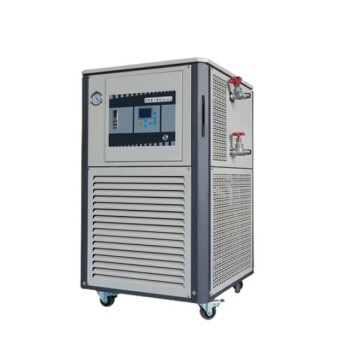
A hydrothermal synthesis reactor establishes a specialized high-pressure, constant-temperature liquid-phase environment. This sealed system forces magnesium ions to undergo precise coordination reactions with phosphonic acid ligands. The result is the formation of distinct crystalline materials characterized by specific 2D layered structures.
The reactor's strictly controlled environment is the defining factor in synthesizing Mg(GLY) MOFs. By maintaining stable high-pressure and temperature conditions, the process ensures the growth of specific crystal structures that determine the material's chemical stability and adhesion properties.
The Mechanics of the Synthesis Environment
High-Pressure Liquid Phase
The reactor creates a sealed environment that maintains the reaction mixture in a liquid phase under high pressure.
This pressure is essential for driving the interaction between components that might otherwise remain inert or evaporate.
It ensures that the magnesium ions are fully available to react with the organic ligands in the solution.
Precise Thermal Regulation
The process relies on a constant-temperature setting throughout the synthesis duration.
Thermal stability is critical for regulating the rate of reaction.
Fluctuations in temperature could disrupt the formation of the crystal lattice, leading to inconsistent material properties.
Coordination of Ligands
Under these specific thermal and pressure conditions, magnesium ions undergo coordination reactions with phosphonic acid ligands.
This chemical alignment is the fundamental step in building the Metal-Organic Framework (MOF).
The reactor environment facilitates the correct orientation of these molecules to form an ordered structure.
Impact on Material Structure and Performance
Formation of 2D Layered Structures
The primary physical outcome of this synthesis method is the growth of materials with specific 2D layered structures.
These structures are not random; they are a direct product of the controlled growth environment.
The layered geometry is a defining characteristic of the Mg(GLY) MOF produced via this route.
Defining Corrosion Inhibition Capabilities
The synthesis conditions directly dictate the hydrolysis degradation kinetics of the final product.
This determines how long the inhibitor will last when exposed to corrosive environments.
Additionally, the crystal structure developed in the reactor controls the material's metal surface affinity, ensuring it can effectively bond to and protect the target metal.
Understanding the Trade-offs
Sensitivity to Process Parameters
The reliance on a "controlled" environment implies a high sensitivity to process deviations.
If the reactor fails to maintain constant temperature or pressure, the coordination of ligands may fail.
This would likely result in amorphous materials rather than the desired crystalline 2D structures, compromising performance.
Complexity of Scale-up
Maintaining a uniform high-pressure liquid-phase environment becomes increasingly difficult as reactor size increases.
Inconsistencies in gradients within larger vessels can lead to heterogeneous crystal growth.
This makes the transition from laboratory synthesis to mass production a significant engineering challenge.
Making the Right Choice for Your Goal
To maximize the effectiveness of your Mg(GLY) MOF synthesis, consider the following based on your specific objectives:
- If your primary focus is Material Quality: Prioritize reactor equipment that offers the highest precision in temperature control to ensure perfect 2D layered crystal growth.
- If your primary focus is Application Performance: Verify that the synthesis parameters (pressure/temp) are optimized specifically to enhance metal surface affinity and degradation kinetics.
The success of your corrosion inhibitor depends entirely on the precision of the hydrothermal environment used to create it.
Summary Table:
| Condition | Function | Impact on Mg(GLY) MOF |
|---|---|---|
| High-Pressure Liquid Phase | Prevents evaporation of components | Ensures complete magnesium ion interaction with ligands |
| Constant-Temperature | Regulates reaction rate | Guarantees stable crystal lattice formation and consistency |
| Sealed Environment | Facilitates coordination reactions | Drives the growth of specific 2D layered structures |
| Controlled Growth | Influences degradation kinetics | Determines metal surface affinity and inhibitor durability |
Elevate Your Material Research with KINTEK Precision
Achieving the perfect 2D layered structure for Mg(GLY) MOF corrosion inhibitors requires uncompromising control over temperature and pressure. KINTEK specializes in advanced laboratory solutions, providing high-performance high-temperature high-pressure reactors and autoclaves designed specifically for hydrothermal synthesis.
Whether you are focusing on hydrolysis degradation kinetics or metal surface affinity, our equipment ensures the stability your research demands. Explore our comprehensive range of high-temperature furnaces, crushing systems, and specialized consumables like PTFE products and ceramics.
Ready to optimize your synthesis results? Contact our technical experts today to find the ideal reactor configuration for your lab!
References
- Nicoleta Pleşu, Dorin Jurcău. Polyester-Based Coatings with a Metal Organic Framework: An Experimental Study for Corrosion Protection. DOI: 10.3390/jcs7100422
This article is also based on technical information from Kintek Solution Knowledge Base .
Related Products
- High Pressure Laboratory Autoclave Reactor for Hydrothermal Synthesis
- Custom PTFE Teflon Parts Manufacturer for Hydrothermal Synthesis Reactor Polytetrafluoroethylene Carbon Paper and Carbon Cloth Nano-growth
- Customizable Laboratory High Temperature High Pressure Reactors for Diverse Scientific Applications
- Electric Rotary Kiln Small Rotary Furnace Biomass Pyrolysis Plant
- Customizable High Pressure Reactors for Advanced Scientific and Industrial Applications
People Also Ask
- What role does a high-pressure reactor (autoclave) play in the synthesis of NiCuFe-LDH? Master Hydrothermal Growth
- What Role Does a High-Pressure Reactor or Autoclave Play in HA Catalyst Synthesis? Achieve High Surface Area Materials
- What equipment is required for hydrothermal synthesis of Ga0.25Zn4.67S5.08? Optimize Your Semiconductor Production
- What is the function of a high-pressure reactor in the hydrothermal synthesis of boehmite? Expert Process Insights
- What role does an autoclave play in the synthesis of MnO2 nanofibers? Mastering Hydrothermal Growth