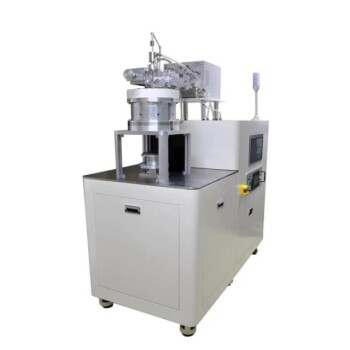
Chemical reactors and elution equipment act as the central control vessels for reversing the adsorption process. These systems house the nickel-saturated adsorbent and facilitate its interaction with acidic elution solutions, such as hydrochloric or nitric acid. By managing this chemical environment, the equipment allows for the systematic release of trapped nickel ions, effectively resetting the material for future use.
The primary function of this equipment is to create a controlled environment where high concentrations of hydrogen ions can physically displace bound nickel. This step is the bridge between simple waste removal and genuine resource circularity, allowing for both the reuse of the adsorbent and the recovery of concentrated nickel.
The Mechanics of Nickel Desorption
Facilitating Ion Exchange
The core role of the reactor is to manage a precise chemical reaction known as elution.
Inside the vessel, the equipment exposes the saturated adsorbent to a specific acidic solution. The goal is to flood the environment with hydrogen ions ($H^+$).
The Displacement Process
Because the elution environment is highly acidic, the hydrogen ions compete for the binding sites previously occupied by nickel ($Ni^{2+}$).
The equipment maintains the conditions necessary for the hydrogen ions to overpower and displace the nickel ions, forcing them off the adsorbent and back into the solution.
Concentrating the Extract
Once displaced, the nickel ions are suspended in the liquid solution in a much higher concentration than they were in the original wastewater.
This transforms a dispersed pollutant into a concentrated resource that can be extracted and processed further.
Economic and Environmental Impact
Enabling Resource Circularity
Without this regeneration step, saturated adsorbents would become solid waste that requires disposal.
By utilizing elution equipment to strip the nickel, the adsorbent material is effectively "cleaned" and returned to the start of the treatment cycle.
Reducing Treatment Costs
The ability to reuse adsorbents multiple times significantly lowers the operational costs associated with purchasing new filtration materials.
Furthermore, recovering nickel in a concentrated form adds potential value to the process, shifting the operation from a cost center to a potential recovery stream.
Understanding the Trade-offs
Equipment Durability
The regeneration process for Ni(II) relies heavily on strong acids like hydrochloric or nitric acid.
Consequently, the reactors and elution equipment must be constructed from highly corrosion-resistant materials. Standard tanks will degrade quickly under these harsh conditions.
Adsorbent Degradation
While the goal is to clean the adsorbent, the aggressive chemical environment inside the reactor can sometimes damage the adsorbent's structure over time.
Operators must balance the strength of the elution solution (to remove nickel) against the longevity of the adsorbent material. Too aggressive a treatment may reduce the number of cycles the material can withstand.
Making the Right Choice for Your Process
Optimizing your regeneration cycle depends on balancing recovery efficiency with material lifespan.
- If your primary focus is maximum nickel recovery: Ensure your equipment is rated to handle high concentrations of strong acids (HCl or HNO3) to maximize ion displacement.
- If your primary focus is adsorbent longevity: Calibrate the reactor's residence time to expose the material to acid only as long as necessary to prevent structural degradation.
Effective regeneration turns a disposal problem into a sustainable loop, preserving both your capital and your materials.
Summary Table:
| Feature | Role in Ni(II) Regeneration | Impact on Efficiency |
|---|---|---|
| Ion Exchange Control | Manages $H^+$ displacement of $Ni^{2+}$ | High recovery rates |
| Chemical Environment | Houses strong acids (HCl, $HNO_3$) | Efficient desorption |
| Concentration Management | Converts pollutants into concentrated resources | Enables nickel recovery |
| Material Durability | Requires corrosion-resistant vessels | Long-term equipment life |
| Process Optimization | Balances acid strength and contact time | Protects adsorbent longevity |
Maximize Your Resource Recovery with KINTEK
Transform waste into value with KINTEK’s specialized laboratory and industrial solutions. Our comprehensive range of corrosion-resistant chemical reactors, high-temperature high-pressure reactors, and autoclaves are designed to withstand the harsh acidic environments required for Ni(II) adsorbent regeneration.
Whether you are focusing on battery research, environmental remediation, or metal recovery, KINTEK provides the high-performance tools you need—from high-temperature furnaces and electrolytic cells to PTFE products and ceramics.
Ready to optimize your regeneration cycle and reduce operational costs? Contact our experts today to find the perfect equipment for your sustainable laboratory operations!
References
- Sylwia Charazińska, Paweł Lochyński. Recent trends in Ni(II) sorption from aqueous solutions using natural materials. DOI: 10.1007/s11157-021-09599-5
This article is also based on technical information from Kintek Solution Knowledge Base .
Related Products
- Microwave Plasma Chemical Vapor Deposition MPCVD Machine System Reactor for Lab and Diamond Growth
- Customer Made Versatile CVD Tube Furnace Chemical Vapor Deposition Chamber System Equipment
- Customizable Laboratory High Temperature High Pressure Reactors for Diverse Scientific Applications
- Custom PTFE Teflon Parts Manufacturer for Hydrothermal Synthesis Reactor Polytetrafluoroethylene Carbon Paper and Carbon Cloth Nano-growth
- Stainless High Pressure Autoclave Reactor Laboratory Pressure Reactor
People Also Ask
- How does a microwave plasma reactor facilitate the synthesis of diamond? Master MPCVD with Precision Technology
- What are the advantages of a Microwave Plasma CVD reactor for MCD/NCD coatings? Precision Multilayer Diamond Engineering
- How do vacuum pumps and valves collaborate in MPCVD? Achieve Precise Pressure Control for Superior CNT Synthesis
- How does MPCVD work? A Guide to Low-Temperature, High-Quality Film Deposition
- What is microwave plasma chemical vapor deposition? A Guide to High-Purity Diamond Film Growth