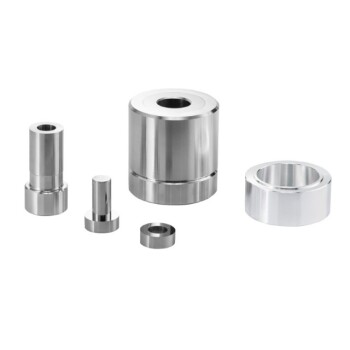
Graphite indenters and dies act as the essential mechanical interface between the hydraulic system and the metal powder during vacuum hot pressing. For Tungsten-Titanium alloys specifically, these components function as high-temperature consumables that must withstand up to 1550°C while facilitating the precise transfer of pressure required to densify the powder compact.
Core Takeaway While the graphite assembly physically contains the powder and defines its geometry, its most sophisticated role in Tungsten-Titanium sintering is enabling process measurement. Because graphite maintains thermal stability at extreme temperatures, its known thermal expansion coefficient allows engineers to calculate the actual densification of the alloy by isolating it from the thermal expansion of the tooling.
The Mechanics of Pressure Transfer
Transmitting Hydraulic Force
The primary function of the graphite indenter is to act as a piston within the hot pressing assembly. It serves as the direct conduit for transferring hydraulic pressure from the external system to the Tungsten-Titanium powder compact.
Structural Integrity at Extremes
Sintering Tungsten-Titanium alloys requires significantly higher temperatures than many standard metals, often reaching 1550°C. The graphite used must possess superior high-temperature strength to apply consistent pressure without deforming or cracking under this thermal load.
Defining Geometry
While the indenter applies the force, the graphite die (mold) acts as the containment vessel. It restricts lateral expansion, forcing the powder to consolidate into the specific geometric shape—typically a cylinder—defined by the mold's internal dimensions.
The Role in Process Monitoring and Data
Calculating True Densification
Precise control of the sintering process relies on tracking how much the powder has compressed. However, at 1550°C, the tooling itself expands, which can skew displacement data.
The Importance of Thermal Coefficients
To determine the actual density of the Tungsten-Titanium sample during the process, you must mathematically account for the graphite. By understanding the specific thermal expansion coefficient of the graphite indenter, you can subtract the tooling's expansion from the total displacement to isolate the true shrinkage of the alloy.
Thermal Regulation and Atmosphere
Uniform Heat Distribution
Graphite is an excellent thermal conductor. The die assembly absorbs heat from the furnace elements and distributes it uniformly around the powder compact, which is essential for ensuring the alloy block has a consistent microstructure throughout.
Environmental Interaction
The vacuum environment is the primary method for removing adsorbed gases and preventing oxidation of the titanium. However, the graphite components themselves remain chemically stable at these temperatures, ensuring they do not degrade or introduce contaminants into the W-Ti matrix during the cycle.
Operational Considerations and Trade-offs
Consumable Nature
Despite their strength, graphite indenters and dies are consumables. The combination of high mechanical pressure and extreme thermal cycling eventually degrades the material, requiring regular replacement to maintain dimensional tolerance.
Calculation Errors
Reliance on thermal expansion data introduces a potential point of failure. If the thermal expansion coefficient used in calculations does not perfectly match the specific grade of graphite currently in the furnace, the calculated density of the final product will be incorrect.
Chemical Reactivity Risks
While generally stable, graphite can react with certain reactive metals like titanium at very high temperatures if not properly managed. While the vacuum environment mitigates this, operators must monitor for any carbon pickup on the surface of the alloy.
Optimizing Your Sintering Setup
To ensure high-quality Tungsten-Titanium billets, tailor your approach based on your specific operational goals:
- If your primary focus is Dimensional Accuracy: Ensure your graphite grade has high compressive strength at 1550°C to prevent mold deformation under load.
- If your primary focus is Process Control: Calibrate your displacement sensors by strictly validating the thermal expansion coefficient of every new batch of graphite indenters.
Success in vacuum hot pressing lies not just in applying pressure, but in accurately distinguishing between the expansion of your tools and the densification of your product.
Summary Table:
| Function | Description | Key Benefit |
|---|---|---|
| Pressure Transfer | Acts as a piston/conduit for hydraulic force | Enables high-density powder consolidation |
| Process Measurement | Known thermal expansion coefficient | Allows calculation of true alloy densification |
| Structural Containment | Defines the geometry of the powder compact | Ensures precise dimensional accuracy and shape |
| Thermal Regulation | Distributes heat uniformly around the compact | Produces a consistent alloy microstructure |
| Chemical Stability | Maintains integrity in vacuum at 1550°C | Prevents contamination of the W-Ti matrix |
Precision in vacuum hot pressing starts with the right tooling. KINTEK provides specialized high-temperature graphite components and a comprehensive range of laboratory equipment, including vacuum hot presses, high-temperature furnaces (muffle, tube, rotary, and vacuum), and advanced crushing, milling, and hydraulic systems. Whether you are working on Tungsten-Titanium alloys or complex battery research, our premium consumables and equipment ensure your process data is accurate and your results are consistent. Contact KINTEK today to optimize your lab's sintering capabilities with our expert solutions!
Related Products
- 2200 ℃ Graphite Vacuum Heat Treat Furnace
- Ultra-High Temperature Graphite Vacuum Graphitization Furnace
- 600T Vacuum Induction Hot Press Furnace for Heat Treat and Sintering
- Vacuum Heat Treat and Pressure Sintering Furnace for High Temperature Applications
- Vertical High Temperature Graphite Vacuum Graphitization Furnace
People Also Ask
- How does heat transmit in a vacuum? Mastering Thermal Radiation for Purity & Precision
- Why do you heat treat in a vacuum? Achieve Perfect Surface Finish and Material Integrity
- What is the process of vacuum heat treating? Achieve Superior Hardening with a Clean, Bright Finish
- How does a vacuum heat treat furnace work? Achieve Pristine, Oxide-Free Metal Parts
- What is graphite heating? A Guide to Durable, High-Temp Industrial Furnace Solutions