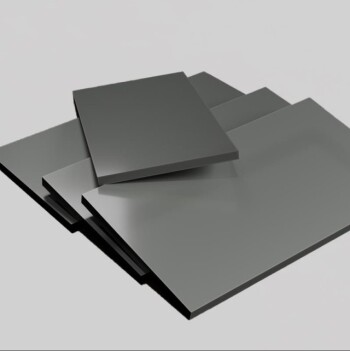
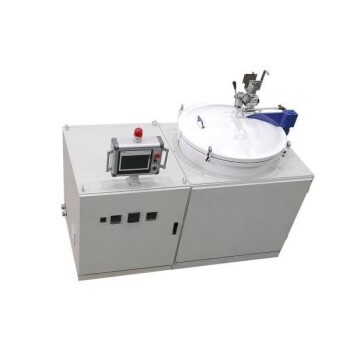
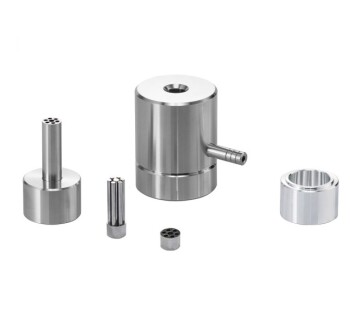
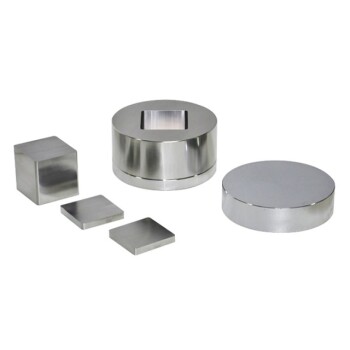
Graphite molds act as the primary structural and thermal interface during the vacuum hot pressing of NiCr-based composites. They serve a dual function: acting as a forming container to define the composite's geometry and functioning as the mechanical medium that transmits the pressure required to consolidate the powder into a solid block.
By maintaining structural stability at 1100°C while withstanding axial pressures of 25 MPa, graphite molds allow for the simultaneous application of heat and force. This ensures the NiCr-based powder is compressed into a dense, dimensionally precise component without the mold deforming under stress.
The Mechanics of Consolidation
To understand the role of graphite, one must look beyond simple containment. The mold is an active participant in the densification mechanics of the composite.
Facilitating Axial Pressure Transmission
The primary challenge in hot pressing is transferring force from the hydraulic ram to the loose powder.
Graphite molds serve as the direct transmission medium for this force. During the NiCr-based composite process, the mold effectively transmits 25 MPa of axial mechanical pressure.
This pressure forces the powder particles into close contact within the restricted space of the mold. This contact is the catalyst for the consolidation process, turning loose powder into a unified solid.
Defining Geometric Precision
While under immense pressure, the material must be constrained to a specific shape.
The graphite mold acts as a rigid forming container. It prevents the powder from splaying outward as vertical pressure is applied.
This ensures that the final sintered product achieves a dense block form with precise geometric shapes, matching the internal dimensions of the mold cavity.
Thermal Properties and Process Stability
The vacuum hot pressing process subjects the system to extreme environments where standard metals would soften or melt. Graphite is selected specifically for its behavior under these thermal loads.
Ensuring Uniform Heat Distribution
Temperature gradients (uneven heating) can lead to defects or inconsistent density in the final composite.
Graphite possesses superior thermal conductivity. This property allows the mold to act as an efficient heat transfer medium, moving heat from the furnace elements to the sample.
This ensures that the NiCr-based composite is heated uniformly, promoting consistent sintering across the entire volume of the material.
Maintaining Strength at 1100°C
The critical requirement for NiCr-based composites is processing at approximately 1100°C.
At this temperature, many materials lose their mechanical strength. However, the graphite molds utilized in this process maintain high structural stability.
They resist deformation even when subjected to the combined stress of high heat and the 25 MPa mechanical load, preserving the dimensional integrity of the composite.
Critical Operational Constraints
While graphite is the material of choice, its performance is contingent on specific material qualities. Understanding these constraints is vital for process success.
The Necessity of High-Strength Graphite
Not all graphite is suitable for this application. The process relies on the mold's ability to withstand significant axial pressure without cracking or buckling.
If the graphite lacks sufficient mechanical strength, it cannot support the 25 MPa load at 1100°C. Failure here leads to mold rupture or loss of pressure on the powder, resulting in a low-density product.
Chemical and Dimensional Stability
The mold must remain chemically stable to avoid contaminating the NiCr composite.
Furthermore, the mold must maintain its shape over the sintering cycle. Any creep or deformation in the graphite at peak temperature will result in a final part that fails to meet dimensional specifications.
Making the Right Choice for Your Goal
To maximize the quality of your NiCr-based composites, focus on the specific interaction between the mold and your processing parameters.
- If your primary focus is High Density: Ensure your graphite mold is rated for high-strength pressure transmission to effectively sustain the required 25 MPa without absorbing the force through deformation.
- If your primary focus is Dimensional Precision: Prioritize graphite grades with proven thermal stability at 1100°C to prevent mold distortion during the heating cycle.
Success in vacuum hot pressing relies on viewing the graphite mold not just as a container, but as a precision tool for thermal and mechanical control.
Summary Table:
| Feature | Function in Vacuum Hot Pressing | Impact on NiCr Composites |
|---|---|---|
| Pressure Transmission | Delivers 25 MPa axial mechanical force | Facilitates particle contact and densification |
| Structural Stability | Maintains integrity at 1100°C | Prevents mold deformation and ensures dimensional precision |
| Thermal Conductivity | Uniform heat distribution across the mold | Promotes consistent sintering and eliminates defects |
| Geometric Containment | Rigid forming container | Produces precise shapes without outward material splaying |
Elevate Your Material Research with KINTEK Precision Solutions
Achieve uncompromising precision in your vacuum hot pressing workflows. KINTEK specializes in advanced laboratory equipment and high-performance consumables designed for extreme environments. Whether you are consolidating NiCr-based composites or developing next-generation materials, our high-temperature furnaces and high-strength graphite molds provide the stability you need at 1100°C and beyond.
Our extensive portfolio supports every stage of your process:
- High-Temperature Furnaces: Muffle, tube, vacuum, and atmosphere furnaces for precise thermal control.
- Pressing Systems: Hydraulic presses (pellet, hot, isostatic) for optimal powder consolidation.
- Specialized Reactors: High-temperature high-pressure reactors and autoclaves for complex synthesis.
- Essential Consumables: Premium ceramics, crucibles, and high-purity graphite components.
Don't let equipment limitations hinder your innovation. Partner with KINTEK for reliable, high-performance tools tailored to your laboratory's needs. Contact us today to find the perfect solution for your research!
Related Products
- 2200 ℃ Graphite Vacuum Heat Treat Furnace
- Ultra-High Temperature Graphite Vacuum Graphitization Furnace
- Horizontal High Temperature Graphite Vacuum Graphitization Furnace
- Ball Press Mold for Lab
- Vertical High Temperature Graphite Vacuum Graphitization Furnace
People Also Ask
- How does heat transmit in a vacuum? Mastering Thermal Radiation for Purity & Precision
- What is the process of vacuum heat treating? Achieve Superior Hardening with a Clean, Bright Finish
- Why do you heat treat in a vacuum? Achieve Perfect Surface Finish and Material Integrity
- How does a vacuum heat treat furnace work? Achieve Pristine, Oxide-Free Metal Parts
- What is graphite heating? A Guide to Durable, High-Temp Industrial Furnace Solutions