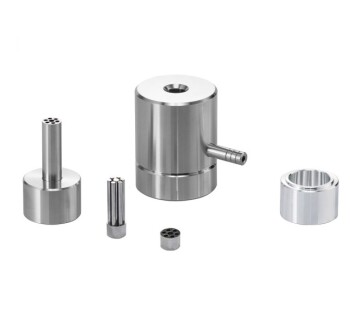
In the fabrication of NiCrAlY-Mo-Ag composites, high-purity graphite molds serve as the critical interface between the raw material and the extreme processing environment. Specifically, these molds function simultaneously as a precise containment vessel, a mechanical transmitter of 25 MPa of pressure, and a thermal conductor at temperatures reaching 1100°C. Their role is to ensure the loose powder is consolidated into a dense, dimensionally accurate solid.
Core Takeaway Graphite molds are not passive containers; they are active components in the sintering ecosystem responsible for translating force and heat into the material. Their ability to maintain high strength and thermal conductivity at 1100°C is the primary factor enabling the densification and geometric stability of NiCrAlY-Mo-Ag composites.
The Functional Roles of the Mold
Defining Geometric Integrity
The most immediate function of the graphite mold is to act as a shaping vessel.
It contains the loose NiCrAlY-Mo-Ag powders, confining them to a specific volume. This confinement defines the final geometry of the sample, ensuring that the loose particles coalesce into the intended shape during the transition from powder to solid.
Facilitating Mechanical Densification
During vacuum hot-pressing, the mold acts as the medium for pressure transmission.
For NiCrAlY-Mo-Ag composites, the mold must transmit a mechanical pressure of 25 MPa from the press rams to the powder. This pressure is vital for forcing particle-to-particle contact, expelling voids, and achieving high material density.
Ensuring Thermal Homogeneity
The mold plays a decisive role in thermal regulation within the vacuum chamber.
It transfers heat from the heating elements to the composite material, operating at sintering temperatures of 1100°C. The thermal conductivity of the graphite ensures that this heat is distributed uniformly, preventing hot spots that could lead to uneven sintering or microstructural defects.
Why Graphite is Critical for this Composite
Stability Under Thermal Load
The primary challenge in sintering NiCrAlY-Mo-Ag is maintaining structural integrity at elevated temperatures.
Graphite is selected because of its superior high-temperature strength. Unlike many metals that soften at 1100°C, high-purity graphite retains the rigidity required to maintain precise dimensions under the applied 25 MPa load without deforming.
Dimensional Precision
The combination of thermal stability and mechanical strength ensures dimensional stability.
Because the mold resists warping or expanding unpredictably under heat and pressure, the final composite sample retains high geometric accuracy. This minimizes the need for extensive post-process machining.
Understanding the Trade-offs
Material Compatibility and Reactivity
While graphite is generally chemically stable, it functions as a sacrificial or semi-permanent consumable.
In broader vacuum hot-pressing contexts, molds must be chemically inert relative to the powder to prevent unwanted diffusion (such as carbon contamination). High-purity graphite is used to mitigate reaction risks, but the mold surface degrades over time, limiting its reusability compared to metal dies used in lower-temperature processes.
Mechanical Limits of Graphite
Graphite is strong in compression but brittle in tension.
While it handles the 25 MPa uniaxial pressure effectively, it cannot withstand significant shear or tensile forces. Misalignment in the press or uneven powder loading can cause the graphite mold to fracture catastrophically during the sintering cycle.
Making the Right Choice for Your Goal
To maximize the quality of your NiCrAlY-Mo-Ag composite, align your tooling strategy with your specific objectives:
- If your primary focus is Dimensional Accuracy: Ensure the graphite grade selected has the highest possible thermal strength to resist deformation at the 1100°C peak temperature.
- If your primary focus is Material Density: Verify that the mold wall thickness is sufficient to withstand the 25 MPa pressure without deflection, ensuring full force transmission to the powder.
- If your primary focus is Microstructural Uniformity: Prioritize graphite with high thermal conductivity to ensure the core of the sample heats at the same rate as the edges.
The graphite mold is the guarantor of your composite's final density and shape; treat it as a precision instrument, not just a container.
Summary Table:
| Function | Parameter | Impact on Composite |
|---|---|---|
| Pressure Transmission | 25 MPa | Eliminates voids and ensures maximum material density |
| Thermal Regulation | 1100°C | Provides uniform heating to prevent microstructural defects |
| Geometric Shaping | Fixed Volume | Ensures dimensional accuracy and reduces post-processing |
| Structural Support | High-Purity Graphite | Maintains rigidity under load without thermal deformation |
Elevate Your Materials Research with KINTEK Precision Solutions
Achieving the perfect density and microstructure in NiCrAlY-Mo-Ag composites requires more than just high temperatures—it demands high-performance tooling. KINTEK specializes in advanced laboratory equipment designed for the most rigorous sintering environments.
Whether you need robust vacuum hot-pressing systems, high-precision graphite molds, or specialized high-temperature furnaces (vacuum, tube, or atmosphere), our solutions are engineered to deliver consistent, repeatable results. Beyond sintering, we offer a comprehensive range of crushing systems, hydraulic pellet presses, and electrolytic cells to support every stage of your material science workflow.
Ready to optimize your fabrication process? Contact our technical experts today to find the ideal equipment and consumables for your laboratory's success.
Related Products
- 2200 ℃ Graphite Vacuum Heat Treat Furnace
- Ultra-High Temperature Graphite Vacuum Graphitization Furnace
- Vacuum Heat Treat and Pressure Sintering Furnace for High Temperature Applications
- Horizontal High Temperature Graphite Vacuum Graphitization Furnace
- Vertical High Temperature Graphite Vacuum Graphitization Furnace
People Also Ask
- How does heat transmit in a vacuum? Mastering Thermal Radiation for Purity & Precision
- Why do you heat treat in a vacuum? Achieve Perfect Surface Finish and Material Integrity
- What is the process of vacuum heat treating? Achieve Superior Hardening with a Clean, Bright Finish
- How does a vacuum heat treat furnace work? Achieve Pristine, Oxide-Free Metal Parts
- What is graphite heating? A Guide to Durable, High-Temp Industrial Furnace Solutions