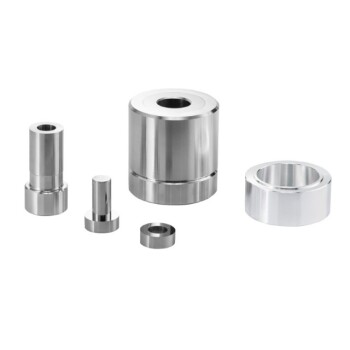
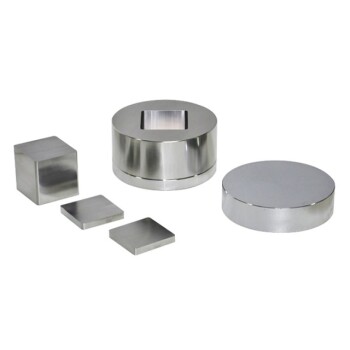
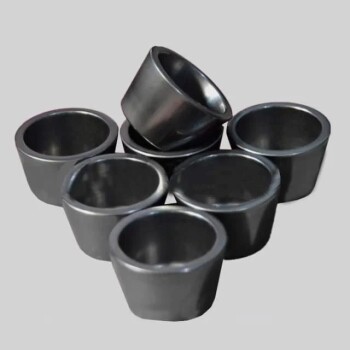
High-strength graphite molds serve as the critical interface between the processing equipment and the Fe-Cu (Iron-Copper) composite material during vacuum hot press sintering. They function not merely as passive containers for defining shape, but as active transmission media that simultaneously apply extreme axial pressure and regulate thermal energy to ensure material densification.
Core Takeaway The effectiveness of the sintering process relies entirely on the mold's capacity to withstand high-stress environments without deformation. It must bridge the gap between mechanical force and thermal dynamics, translating external pressure into internal material density while ensuring the uniform heat distribution required for a consistent microstructure.
The Mechanics of Containment and Densification
To understand the mold's role, one must look beyond its geometry to the physical forces it manages during the sintering cycle.
Defining Geometry Under Load
At the most fundamental level, the graphite mold acts as a vessel for the loose Fe-Cu powder mixture. It constrains the material, forcing it to adopt a specific shape as it transitions from a loose powder to a solid composite.
However, unlike a standard casting mold, this vessel must maintain precise dimensional stability while being subjected to active compression. It prevents the powder from displacing laterally, ensuring that the applied force results in densification rather than deformation of the container.
Transmitting Axial Pressure
The mold serves as the primary medium for transferring mechanical force from the hydraulic rams to the powder itself.
In the context of Fe-Cu composites, the mold must transmit significant uniaxial pressure—typically up to 40 MPa. It must do this without absorbing the energy through its own deformation, ensuring the force is directed entirely into compacting the powder to eliminate voids.
Thermal Regulation and Microstructure
The quality of the final Fe-Cu composite is heavily dictated by how heat moves through the mold.
Facilitating Uniform Heat Transfer
Graphite is selected specifically for its high thermal conductivity. The mold ensures that thermal energy is transferred evenly from the heating elements to the powder sample.
Ensuring Microstructural Consistency
If the mold acted as a thermal insulator or transferred heat unevenly, the composite would suffer from thermal gradients. By distributing heat uniformly, the graphite mold promotes a consistent sintered microstructure throughout the Fe-Cu sample, preventing localized defects or uneven grain growth.
Critical Material Requirements and Trade-offs
While graphite is the material of choice, not all graphite is suitable. The "high-strength" designation is a strict operational requirement, not a marketing term.
High-Temperature Structural Integrity
The sintering environment for Fe-Cu composites reaches temperatures around 1040°C. Standard graphite grades may degrade or lose mechanical stiffness at these temperatures.
The mold must maintain its structural integrity under the combined stress of 1040°C heat and 40 MPa pressure. A failure here results in the fracture of the mold and the immediate ruin of the sample.
Chemical Inertness and Stability
A vital, often overlooked function is the mold's chemical stability. It must remain chemically inert to the Iron and Copper components.
If the mold reacts with the composite, it can alter the material's composition or fuse with the billet, making demolding impossible. High-quality graphite ensures a clean separation and preserves the purity of the Fe-Cu composite.
Optimizing Process Reliability
When selecting or designing molds for Fe-Cu sintering, prioritize the specific environmental stresses of your cycle.
- If your primary focus is Maximum Density: Prioritize graphite grades with exceptional compressive strength to safely maximize the axial pressure (up to 40 MPa) without risk of mold fracture.
- If your primary focus is Microstructural Homogeneity: Ensure the mold design and wall thickness favor rapid, uniform thermal conductivity to eliminate temperature gradients across the sample.
The graphite mold is the guarantor of your process, translating raw energy into precise material properties.
Summary Table:
| Feature | Role in Fe-Cu Sintering | Impact on Final Composite |
|---|---|---|
| Structural Integrity | Withstands 1040°C & 40 MPa pressure | Prevents mold fracture and sample ruin |
| Pressure Transmission | Transfers axial force to powder | Eliminates voids for maximum densification |
| Thermal Conductivity | Distributes heat uniformly | Ensures consistent microstructure and grain growth |
| Chemical Inertness | Prevents reaction with Iron/Copper | Maintains material purity and facilitates demolding |
| Geometric Stability | Constrains powder under load | Guarantees precise dimensional accuracy |
Elevate Your Material Research with KINTEK Precision
Achieving perfect densification in Fe-Cu composites requires hardware that can withstand extreme thermal and mechanical stress. KINTEK specializes in high-performance laboratory equipment, offering industry-leading high-temperature furnaces, hydraulic presses, and specialized graphite consumables designed for the most demanding sintering applications.
Whether you are refining your hot press sintering process or scaling up battery research, our comprehensive portfolio—from vacuum furnaces and isostatic presses to PTFE and ceramic consumables—provides the reliability your lab needs.
Ready to optimize your sintering results? Contact KINTEK today to discuss your equipment needs and see how our expert solutions can enhance your lab's efficiency and output.
Related Products
- Anti-Cracking Press Mold for Lab Use
- Special Shape Press Mold for Lab
- Ball Press Mold for Lab
- Double Plate Heating Press Mold for Lab
- Ultra-High Temperature Graphite Vacuum Graphitization Furnace
People Also Ask
- What is the press mould method? A Guide to Consistent, Detailed Ceramic Forms
- How to use a press mold? Master the Art of Creating Consistent Ceramic Forms
- What is the function of press molds during the preparation of SiCf/Ti-43Al-9V composites? Achieve Structural Precision
- What is a press mold used for? Achieve Repeatable Precision and Efficiency
- What is the purpose of specialized pressure devices in sulfide solid-state batteries? Ensure Chemo-Mechanical Stability