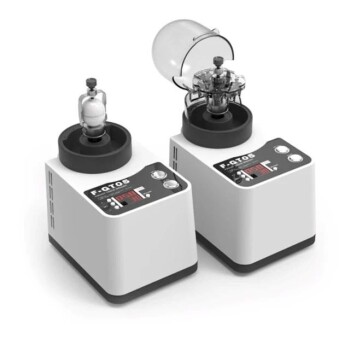
In the synthesis of Sc1/3Zr2(PO4)3 solid electrolytes, a ball mill functions as a mechanochemical reactor rather than a simple mixing device. Unlike traditional methods that rely solely on thermal energy to drive reactions, the ball mill utilizes powerful mechanical grinding to transform raw materials into a highly reactive, metastable amorphous state. This high-energy processing allows the material to crystallize at significantly lower temperatures while improving the final product's ionic conductivity.
The core distinction is that ball milling induces mechanochemical activation. It does not just mix particles; it fundamentally alters their internal energy state, enabling superior crystallization and conductivity that traditional solid-state mixing cannot achieve at similar processing temperatures.
The Mechanism: Mechanochemical Activation
Creating a Metastable Amorphous State
The primary function of the ball mill in this specific synthesis is to generate intense mechanochemical effects. Through powerful mechanical grinding, the device forces the raw material mixture out of its stable phase and into a metastable amorphous state.
Increasing Reaction Activity
This amorphous state is chemically "hungry" or highly reactive. By disrupting the crystalline order of the raw ingredients, the ball mill creates a high-energy powder. This stored mechanical energy lowers the activation energy barrier required for subsequent chemical reactions.
Microscopic Refinement
While the primary goal is activation, the process concurrently refines particle size. As seen in similar electrolyte syntheses, high-speed rotation generates shear forces that ensure thorough contact between components at the microscopic level, a prerequisite for uniform reaction kinetics.
Comparison with Traditional Mixing Methods
Lowering Thermal Requirements
Traditional solid-state methods rely heavily on high temperatures to diffuse atoms and drive reactions. Because the ball-milled powder is already in a high-energy metastable state, it can complete crystallization at lower temperatures. The mechanical energy input effectively substitutes for a portion of the thermal energy usually required.
Improving Crystallinity
The outcome of this lower-temperature crystallization is superior structural order. Traditional mixing often results in incomplete reactions or requires temperatures that can degrade the material. The mechanochemical approach ensures a more complete and uniform crystallization of the Sc1/3Zr2(PO4)3 phase.
Enhancing Ionic Conductivity
The ultimate differentiator is performance. The combination of high reaction activity and improved crystallinity leads to a marked increase in ionic conductivity. The ball mill produces a final electrolyte that facilitates ion movement more effectively than counterparts synthesized via traditional mixing.
Understanding the Process Trade-offs
Energy Input Source
The trade-off in this synthesis is the shift in energy source. You are exchanging the thermal energy burden of traditional sintering for the mechanical energy burden of the ball milling process. High-energy grinding is an intense process required to achieve the specific amorphous state necessary for these results.
Processing Complexity
Traditional mixing is a physical blending process, whereas this method is a chemical preparation step. The ball mill is not merely ensuring homogeneity; it is actively driving a phase transformation before heating begins. This adds a layer of complexity to the synthesis but is necessary to access the improved material properties.
Making the Right Choice for Your Goal
To determine if high-energy ball milling is the correct approach for your solid electrolyte project, consider these specific objectives:
- If your primary focus is Maximizing Ionic Conductivity: Adopt the ball milling process, as the improved crystallinity and metastable precursors directly correlate to higher performance in the final product.
- If your primary focus is Reducing Sintering Temperatures: Use the ball mill to introduce mechanochemical energy, which allows you to crystallize the material without reaching the extreme temperatures required by traditional methods.
Mechanochemical activation is the key to unlocking the full potential of Sc1/3Zr2(PO4)3, transforming it from a simple mixture into a high-performance conductor.
Summary Table:
| Feature | Traditional Mixing Methods | High-Energy Ball Milling |
|---|---|---|
| Primary Function | Physical Blending | Mechanochemical Activation |
| Material State | Stable Crystalline Mixture | Metastable Amorphous State |
| Energy Source | Thermal Energy (High Temperature) | Mechanical + Thermal Energy |
| Crystallization Temp | High | Significantly Lower |
| Ionic Conductivity | Standard / Lower | Superior / Enhanced |
| Structural Order | Potentially Incomplete | Uniform & Highly Crystalline |
Elevate Your Solid Electrolyte Synthesis with KINTEK
Precision in material science starts with the right equipment. KINTEK specializes in advanced laboratory solutions, including high-performance crushing and milling systems designed to achieve the precise mechanochemical activation required for Sc1/3Zr2(PO4)3 and other solid-state electrolytes.
Whether you are refining particle size or driving phase transformations, our portfolio—from ball mills and planetary grinders to high-temperature furnaces and hydraulic pellet presses—ensures your battery research meets the highest standards of conductivity and crystallinity.
Ready to optimize your synthesis process? Contact KINTEK experts today to find the perfect equipment for your lab and accelerate your material breakthroughs.
Related Products
- Stainless Steel Laboratory Ball Mill for Dry Powder and Liquid with Ceramic Polyurethane Lining
- High-Energy Omnidirectional Planetary Ball Mill Milling Machine for Laboratory
- Laboratory Ball Mill Jar Mill with Metal Alloy Grinding Jar and Balls
- High-Energy Omnidirectional Planetary Ball Mill Machine for Laboratory
- Hybrid High Energy Vibratory Ball Mill for Lab Use
People Also Ask
- How do laboratory ball mills facilitate the mechanochemical synthesis of ZIF-8? Solvent-Free Synthesis Explained
- What is the primary function of a laboratory ball mill in the modification of sulfide-based solid electrolytes with LiPO2F2?
- How does a laboratory ball mill ensure the mixing quality of Mn3Zn0.8Sn0.2N and Ti? Achieve Perfect Homogeneity
- What is the function of a laboratory ball mill in the preparation of AMMCs? Optimize Dispersion & Grain Refinement
- In what way does a laboratory ball mill affect material properties when modifying PHBV/pulp fiber composites?