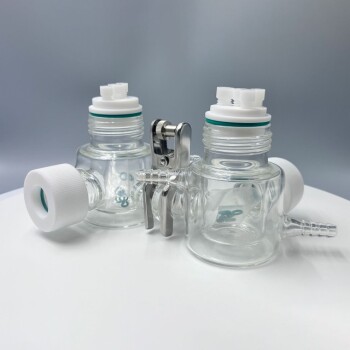
A double-jacketed reactor acts as the thermal anchor for the esterification process. It utilizes a circulating heating medium within an external shell to provide precise temperature compensation throughout the reaction. This design ensures the mixture maintains a constant 60°C, which is critical for efficiently reducing the free fatty acid (FFA) content in raw materials like waste cooking oil and Calophyllum inophyllum oil.
The reactor's primary function is to eliminate thermal fluctuations that can stall the chemical conversion, ensuring the raw oil is properly pretreated for the subsequent stages of biodiesel production.
The Mechanics of Thermal Stability
Precise Temperature Compensation
The core advantage of a double-jacketed reactor is its ability to isolate the reaction mixture from ambient temperature fluctuations.
By circulating a heating medium through the jacket (the space between the inner and outer vessel walls), the system actively compensates for any heat loss.
Maintaining the 60°C Threshold
For the specific mixture of waste cooking oil and Calophyllum inophyllum oil, the reactor is calibrated to maintain a strict temperature of 60°C.
This specific thermal environment is necessary to drive the chemical reaction forward at an optimal rate.
The Impact on Biodiesel Production
Efficient FFA Reduction
The primary goal of the esterification pretreatment phase is the reduction of Free Fatty Acids (FFA).
The double-jacketed reactor facilitates this by creating a stable environment where the reaction kinetics remain consistent.
Without this stability, the reduction of FFAs would be inefficient, leaving impurities that complicate later processing steps.
Foundation for Transesterification
Esterification is not the final step; it is the preparation for transesterification.
By ensuring the FFAs are effectively lowered via precise heating, the reactor ensures the feedstock is chemically ready for the final conversion into biodiesel.
Operational Considerations
The Cost of Thermal Instability
While a double-jacketed reactor adds mechanical complexity compared to a standard vessel, it addresses the risk of inconsistent heating.
If the temperature drops below the 60°C target due to a lack of compensation, the reaction rate slows significantly.
This results in incomplete pretreatment, yielding a feedstock that still contains high levels of free fatty acids, which can ruin the efficiency of the final biodiesel yield.
Optimizing Your Pretreatment Process
To ensure the success of your biodiesel production, consider how temperature control aligns with your raw material inputs.
- If your primary focus is processing High-FFA Oils: Prioritize a double-jacketed design to ensure the constant 60°C needed to drive down acidity levels efficiently.
- If your primary focus is Process Consistency: Rely on the circulating heating medium to eliminate environmental variables that could disrupt the reaction rate.
Precise thermal control during pretreatment is the single most effective way to secure high-quality feedstock for biodiesel conversion.
Summary Table:
| Feature | Function in Esterification | Impact on Biodiesel Production |
|---|---|---|
| Jacketed Design | Circulates heating medium for thermal compensation | Eliminates fluctuations and ensures reaction stability |
| 60°C Threshold | Maintains optimal temperature for oil mixtures | Drives chemical kinetics for efficient FFA reduction |
| Thermal Isolation | Separates mixture from ambient temperature drops | Prevents stalled reactions and incomplete pretreatment |
| FFA Reduction | Lowers acidity in raw waste cooking oils | Prepares feedstock for successful transesterification |
Elevate Your Biodiesel Yield with KINTEK Precision
Maximize the efficiency of your esterification process with KINTEK’s high-performance double-jacketed reactors. Specializing in advanced laboratory equipment, KINTEK provides the thermal stability and precision required to reduce FFAs and optimize feedstock quality. Beyond our jacketed reactors, we offer a comprehensive suite of solutions including high-temperature high-pressure reactors, centrifuges, and crushing systems tailored for bioenergy research.
Ready to eliminate thermal instability and streamline your production? Contact KINTEK today for a customized solution and see how our expertise in laboratory and industrial processing can drive your success.
References
- Jassinnee Milano, M. Mofijur. Experimental Study of the Corrosiveness of Ternary Blends of Biodiesel Fuel. DOI: 10.3389/fenrg.2021.778801
This article is also based on technical information from Kintek Solution Knowledge Base .
Related Products
- Double-Layer Water Bath Electrolytic Electrochemical Cell
- High Pressure Laboratory Autoclave Reactor for Hydrothermal Synthesis
- Stainless High Pressure Autoclave Reactor Laboratory Pressure Reactor
- Mini SS High Pressure Autoclave Reactor for Laboratory Use
- Customizable High Pressure Reactors for Advanced Scientific and Industrial Applications
People Also Ask
- What does the routine maintenance of a double-layer water-bath electrolytic cell involve? A Guide to Ensuring Precision and Longevity
- What is the typical experimental system used with a double-layer water-bath electrolytic cell? Achieve Precise Electrochemical Control
- What are the procedures for after using a double-layer water-bath electrolytic cell? Ensure Equipment Longevity and Data Accuracy
- When is professional repair required for a double-layer water-bath electrolytic cell? Protect Your Lab's Precision and Safety
- What are the key features of a double-layer water-bath electrolytic cell? Achieve Precise Temperature Control for Your Experiments