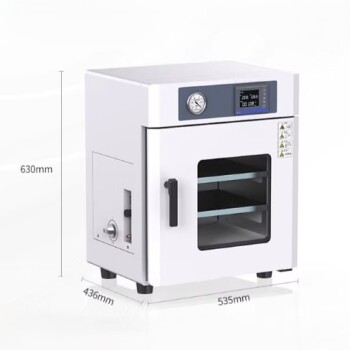
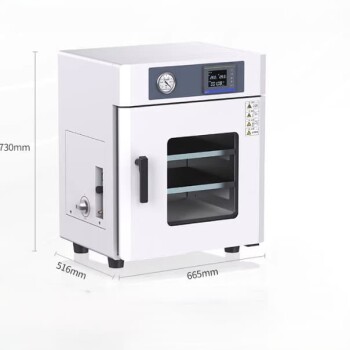
The drying oven serves as the critical solidification stage in the manufacturing of NCM523 composite cathodes. Its primary function is to subject the slurry-coated aluminum foil to controlled heat—typically at 80°C overnight—to drive off the N-Methyl-2-pyrrolidone (NMP) solvent. This process transforms the wet chemical mixture into a dry, tightly bonded, and uniform electrode structure, which is essential for the battery's mechanical integrity and electrochemical performance.
Core Takeaway The drying oven does more than simply remove liquid; it engineers the electrode's physical structure. By thoroughly evaporating the NMP solvent, the oven locks the active materials into a cohesive coating, preventing residual solvents from destabilizing the battery chemistry later on.
The Mechanics of Solvent Evaporation
The preparation of NCM523 cathodes involves a delicate transition from a liquid slurry to a solid state. The drying oven is the engine of this transition.
Removing the NMP Carrier
The cathode slurry relies on N-Methyl-2-pyrrolidone (NMP) as a solvent to mix the active materials and binders. Once the coating is applied to the foil, the NMP becomes a liability.
The oven provides consistent thermal energy, typically maintained at 80°C for an extended period (overnight). This specific temperature profile is sufficient to evaporate the NMP without damaging the active NCM523 components.
Creating Structural Integrity
Evaporation is not just about removal; it is about formation. As the solvent leaves the matrix, the remaining materials must settle into a permanent structure.
Proper drying ensures the electrode material forms a tightly bonded coating on the aluminum current collector. This solidification process creates a uniform layer that adheres well to the foil, which is vital for handling during battery assembly.
Preventing Chemical Degradation
Beyond structural formation, the drying oven acts as a safeguard against chemical contamination within the cell.
Eliminating Residual Solvents
If NMP is not completely removed, it remains trapped within the electrode structure.
Residual solvent interferes with the battery's internal chemistry. It can compromise the formation of the solid electrolyte interphase (SEI) or lead to parasitic reactions that degrade capacity over time.
Managing Moisture (Supplementary Context)
While the primary focus for NCM523 slurry drying is NMP removal, the drying process—especially when utilizing vacuum ovens—plays a secondary role in removing environmental moisture.
Moisture is a poison to battery systems. In advanced applications, residual water can react with electrolytes to form harmful gases (such as hydrogen sulfide in sulfide-based systems) or cause side reactions that ruin cycling stability. Thorough drying minimizes these risks.
Critical Trade-offs in the Drying Process
While heating is necessary, the application of that heat requires precision. Mismanagement of the drying parameters can lead to immediate failure.
Speed vs. Quality
There is often a temptation to increase temperatures to speed up manufacturing. However, drying the slurry too quickly can cause the solvent to evaporate violently.
This rapid evaporation can lead to cracking or delamination of the electrode surface. If the "skin" of the coating dries before the interior, solvent gets trapped, creating voids that destroy conductivity.
Temperature Sensitivity
While NCM523 is relatively thermally stable, the binders and conductive additives used in the composite are sensitive.
Operating strictly within the recommended range (e.g., 80°C for initial NMP removal) ensures the solvent is removed without thermally degrading the polymeric binders that hold the electrode together.
Optimizing the Drying Protocol
The effectiveness of your cathode preparation hinges on how strictly you adhere to the drying parameters.
- If your primary focus is Mechanical Integrity: Prioritize a lower, steady temperature (80°C) over a long duration to ensure the coating solidifies uniformly without cracking.
- If your primary focus is Electrochemical Stability: Ensure the drying time is sufficient to remove all traces of NMP, as even microscopic residues will sabotage long-term cycling performance.
- If your primary focus is Advanced/Solid-State Applications: Consider a secondary vacuum drying stage at higher temperatures to eliminate trace environmental moisture that convection drying might miss.
The drying oven is not a passive tool; it is the active gatekeeper that determines whether your slurry becomes a viable, high-performance electrode.
Summary Table:
| Parameter | Standard Drying Condition | Purpose/Benefit |
|---|---|---|
| Temperature | Typically 80°C | Evaporates NMP solvent without degrading binders |
| Duration | Overnight (Extended) | Ensures complete solvent removal and uniform solidification |
| Key Outcome | Solidified Coating | Creates a tightly bonded, crack-free electrode structure |
| Critical Risk | Rapid Heating | Prevents delamination, surface cracking, and voids |
| Chemical Safety | Solvent Elimination | Prevents parasitic reactions and capacity degradation |
Elevate Your Battery Research with KINTEK
Precision drying is the backbone of high-performance NCM523 cathode production. At KINTEK, we specialize in providing high-precision laboratory equipment designed to meet the rigorous demands of battery material synthesis. Whether you need advanced vacuum drying ovens to eliminate moisture or specialized muffle and tube furnaces for electrode calcination, we have the solution.
Our extensive portfolio for battery researchers includes:
- High-Temperature Ovens & Furnaces: Ensuring uniform thermal processing.
- Battery Research Tools: Including hydraulic pellet presses and homogenization systems.
- Advanced Lab Solutions: From vacuum reactors to specialized electrolytic cells.
Don't let residual solvents compromise your electrochemical performance. Contact us today to find the perfect drying solution for your lab!
Related Products
- 23L Laboratory Vacuum Drying Oven
- Laboratory Scientific Electric Heating Blast Drying Oven
- 56L Vertical Laboratory Vacuum Drying Oven
People Also Ask
- Why is a laboratory vacuum drying oven recommended for rice straw residues? Protect Your Biomass Integrity
- What role does a laboratory vacuum drying oven play in the preparation of modified multi-walled carbon nanotubes?
- What is the importance of using a laboratory vacuum drying oven? Preserving Slow-Release Microcapsule Integrity
- Why is a Laboratory Vacuum Drying Oven recommended for PBAT microspheres? Protect Sensitive Polymer Integrity
- What role does a laboratory vacuum drying oven play in processing nanoparticle powder samples? Protect Sample Integrity