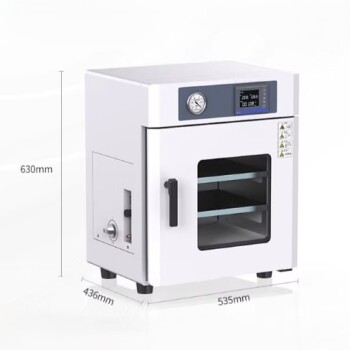
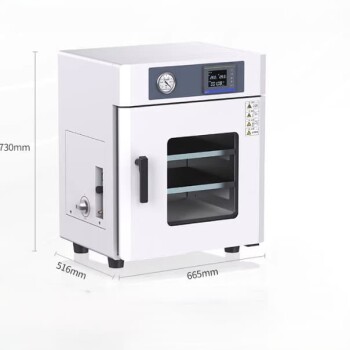
The primary role of a forced air or electric constant temperature drying oven is to gently remove volatile contaminants without altering the crystal structure. These devices utilize controlled air circulation at low temperatures, typically around 40°C, to evaporate residual washing agents like acetone and trace surface moisture from sodium molybdate particles. This process ensures the final product is dry and pure while preventing thermal degradation.
Precise temperature control is not merely a drying mechanism; it is a preservation strategy. The oven removes external moisture while strictly maintaining the essential lattice water required for the sodium molybdate dihydrate structure.
The Mechanics of Gentle Drying
Removal of Volatile Solvents
After crystallization and filtration, sodium molybdate crystals are often washed with agents such as acetone. The drying oven provides a controlled environment to fully evaporate these residual solvents. This step is essential for achieving high purity in the final reagent.
Eliminating Surface Moisture
Beyond chemical solvents, trace amounts of water often remain on the surface of the crystals. The forced air circulation ensures that this external moisture is removed efficiently. This prevents clumping and ensures a free-flowing crystalline powder.
Uniform Heat Distribution
Electric constant temperature ovens are designed to eliminate hot spots. By circulating air, they ensure that every part of the batch receives the same thermal treatment. This uniformity is critical for consistent product quality.
Preserving Crystal Integrity
Protecting Lattice Water
Sodium molybdate typically exists as a dihydrate, meaning two water molecules are chemically bound within its crystal lattice. The drying process must be delicate enough to leave these bound water molecules untouched. The oven’s ability to maintain a steady 40°C is the key factor in this preservation.
Preventing Structural Collapse
If the drying temperature is too high, the energy breaks the bonds holding the lattice water in place. This results in the loss of hydration, effectively changing the compound from a dihydrate to an anhydrous form. This alteration can compromise the material's suitability for specific chemical applications.
Understanding the Risks and Trade-offs
The Danger of Overheating
The most common pitfall in this process is aggressive drying to save time. Exceeding the 40°C threshold creates a high risk of efflorescence, where the crystal loses its water of crystallization and turns into a powder. Once lattice water is lost, the crystal structure is effectively destroyed and cannot be easily restored.
Airflow vs. Temperature
While airflow speeds up evaporation, it must be balanced with temperature control. Relying solely on high heat rather than air circulation will unevenly dry the batch. This can lead to a product that is degraded on the outside while still retaining solvent in the core.
Making the Right Choice for Your Goal
When configuring your drying equipment for sodium molybdate preparation, prioritize precision over speed.
- If your primary focus is Chemical Purity: Ensure the oven has sufficient airflow to completely evacuate evaporated acetone and prevent solvent re-deposition.
- If your primary focus is Structural Stability: Strictly limit the temperature to 40°C to guarantee the dihydrate form remains intact.
Mastering this drying phase is the difference between a high-grade reagent and a degraded, unstable compound.
Summary Table:
| Process Component | Role in Sodium Molybdate Preparation | Key Benefit |
|---|---|---|
| Temperature Control | Maintained strictly at ~40°C | Preserves lattice water and prevents structural collapse |
| Forced Airflow | Rapid evaporation of acetone and surface water | Ensures uniform drying and prevents solvent re-deposition |
| Heat Distribution | Elimination of hot spots within the chamber | Guarantees batch consistency and prevents localized degradation |
| Moisture Removal | Targets surface moisture specifically | Produces a free-flowing, high-purity crystalline powder |
Optimize Your Crystal Purity with KINTEK Precision Drying Solutions
Maintaining the delicate balance of a dihydrate structure requires more than just heat; it requires absolute thermal precision and superior airflow. KINTEK specializes in advanced laboratory equipment designed to protect your most sensitive chemical reagents. From our forced air and electric constant temperature drying ovens to our high-performance vacuum ovens and high-temperature furnaces, we provide the tools needed to ensure your sodium molybdate crystals remain stable, pure, and free-flowing.
Beyond drying, KINTEK offers a comprehensive range of laboratory essentials, including crushing and milling systems, pellet presses, PTFE consumables, and cooling solutions to support every stage of your research and production.
Ready to elevate your lab's efficiency and product quality? Contact our technical experts today to find the perfect drying solution for your specific application requirements.
References
- Jesús Casas, Josué Lagos. Drowning-out crystallization of sodium molybdate in aqueous-ethanol solutions. DOI: 10.2298/ciceq191029017c
This article is also based on technical information from Kintek Solution Knowledge Base .
Related Products
- 23L Laboratory Vacuum Drying Oven
- 56L Vertical Laboratory Vacuum Drying Oven
- Laboratory Scientific Electric Heating Blast Drying Oven
- High Temperature Muffle Oven Furnace for Laboratory Debinding and Pre Sintering
People Also Ask
- Why is a laboratory vacuum drying oven recommended for rice straw residues? Protect Your Biomass Integrity
- What role does a laboratory vacuum drying oven play in the preparation of modified multi-walled carbon nanotubes?
- What is the importance of using a laboratory vacuum drying oven? Preserving Slow-Release Microcapsule Integrity
- Why is a Laboratory Vacuum Drying Oven recommended for PBAT microspheres? Protect Sensitive Polymer Integrity
- What role does a laboratory vacuum drying oven play in processing nanoparticle powder samples? Protect Sample Integrity