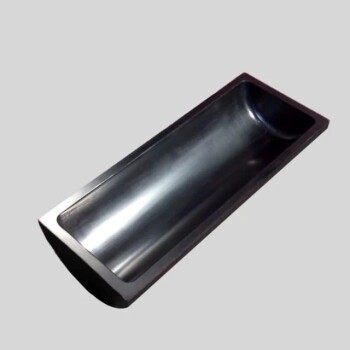
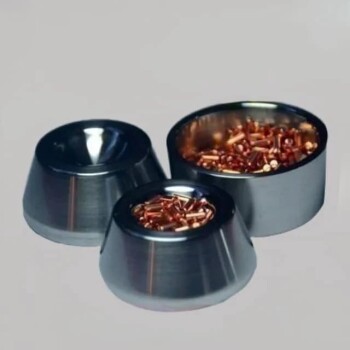
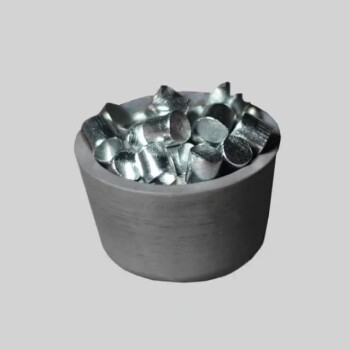
In the deep purification of crude lead via vacuum gasification, the graphite crucible functions as the essential high-temperature containment vessel that facilitates phase separation. It holds the molten raw material, allowing the lead and volatile impurities to vaporize and escape, while physically trapping non-volatile impurities in the remaining liquid residue.
The graphite crucible acts as a selective separator based on thermal dynamics. By withstanding the vacuum environment, it allows lead to gasify for purification while isolating impurities like copper, silver, and tin within the crucible based on their lower saturated vapor pressures.
The Mechanics of Separation
The graphite crucible is not merely a container; it is the environment that enables the thermodynamic separation of elements.
High-Temperature Stability
The primary role of the graphite crucible is to maintain structural integrity under extreme conditions.
It must hold the molten crude lead without reacting or degrading, even as temperatures rise to the levels necessary for gasification.
Facilitating Vaporization
Under high-temperature vacuum conditions, the crucible allows the primary metal (lead) to transition from a liquid to a gas.
This process also permits high-volatility impurities to gasify alongside the lead. These vapors escape the crucible, moving away from the melt to be collected and condensed elsewhere.
Retention of Residue
The crucible serves a critical role in isolation.
Elements with lower saturated vapor pressures do not gasify as readily as lead.
Consequently, impurities such as copper, silver, and tin are left behind. They remain within the liquid residue at the bottom of the crucible, effectively separating them from the purified lead vapor.
Understanding the Constraints
While the graphite crucible facilitates this process, it is important to understand the limitations of this separation method.
Vapor Pressure Dependency
The crucible itself does not filter the material; it relies entirely on thermodynamic properties.
If an impurity has a saturated vapor pressure very similar to lead, it may gasify and escape the crucible alongside the lead, reducing purification efficiency.
Residue Accumulation
The process results in a concentration of non-volatile metals within the vessel.
As copper, silver, and tin accumulate, the composition of the melt changes. This requires management of the liquid residue to prevent saturation or cross-contamination over time.
Optimizing the Purification Process
To maximize the effectiveness of the graphite crucible in this application, consider the specific goals of your refinement process.
- If your primary focus is high-purity lead: Ensure your thermal profile allows for the complete gasification of lead while strictly maintaining temperatures below the vaporization point of the non-volatile impurities.
- If your primary focus is recovering byproducts (Cu, Ag, Sn): Treat the residue remaining in the graphite crucible as a valuable concentrate, as this is where these precious and base metals will aggregate.
The graphite crucible effectively converts a mixed alloy into distinct physical phases, leveraging heat and vacuum to achieve deep purification.
Summary Table:
| Feature | Role in Vacuum Gasification |
|---|---|
| Material | High-purity graphite with thermal stability |
| Function | Primary containment & thermodynamic reaction vessel |
| Mechanism | Selective vaporization based on vapor pressure differences |
| Separated Elements | Lead & high-volatile impurities (gas phase) |
| Retained Elements | Copper (Cu), Silver (Ag), Tin (Sn) (liquid residue) |
Elevate Your Metallurgical Precision with KINTEK
Are you looking to optimize your vacuum gasification or high-temperature metal refinement processes? KINTEK specializes in providing the industry's most reliable laboratory equipment and consumables, including high-performance graphite crucibles, high-temperature furnaces, and vacuum systems designed for extreme thermal environments.
From induction melting to CVD and dental applications, our comprehensive portfolio—featuring everything from PTFE products and ceramics to crushing and milling systems—ensures your research and production meet the highest purity standards.
Ready to achieve superior purification results? Contact KINTEK today to discuss our custom solutions for your laboratory and industrial needs.
Related Products
- High Purity Pure Graphite Crucible for Evaporation
- High Purity Pure Graphite Crucible for Electron Beam Evaporation
- Carbon Graphite Boat -Laboratory Tube Furnace with Cover
- Arc-Shaped Alumina Ceramic Crucible High Temperature Resistant for Engineering Advanced Fine Ceramics
- Engineering Advanced Fine Ceramics Alumina Al2O3 Crucible With Lid Cylindrical Laboratory Crucible
People Also Ask
- Why are high-purity graphite crucibles preferred for sulfide solid electrolytes? Achieve Superior Material Purity
- Why is a high-purity graphite crucible required for Chromel-TaC composites? Ensure Peak Purity at 1400°C
- What role do high-purity graphite crucibles play in molten salt corrosion research? Ensure Reactor-Grade Precision
- Why are high-purity graphite crucibles used for magnesium distillation? Ensure 3N8 Purity & Thermal Stability
- Why is a high-purity graphite crucible ideal for nitrogen-doped graphene at 1500 °C? Maximize Purity and Stability