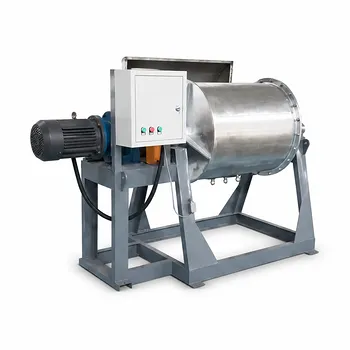
High-energy ball milling functions as a mechanochemical reactor, not merely a mixing tool, in the synthesis of halide solid electrolytes like Li3YCl6.
It provides the necessary kinetic energy through high-frequency impacts to drive solid-phase reactions between precursor powders (such as lithium chloride and yttrium chloride) at room temperature. This process effectively bypasses the need for high-temperature sintering, thereby preventing undesirable phase transformations while creating highly conductive, refined electrolyte powders.
Core Takeaway By replacing thermal energy with mechanical impact energy, high-energy ball milling enables the synthesis of halide electrolytes in non-equilibrium states. This critical distinction allows for the preservation of disordered structures that offer superior ionic conductivity compared to their thermally annealed counterparts.
The Mechanics of Synthesis
Driving Reactions via Mechanochemistry
The primary role of the ball mill is to supply mechanochemical energy.
Instead of applying external heat, the mill generates high-intensity impact and shear forces. These forces are sufficient to trigger chemical reactions between raw materials at the atomic level, effectively synthesizing complex compounds like Li3YCl6 directly from simple precursors.
Atomic-Level Mixing and Refinement
Beyond simple blending, the high-energy impacts fracture particles down to the micron or sub-micron scale.
This extreme particle refinement increases the surface area significantly. It facilitates atomic-level mixing, ensuring that the reaction is uniform and complete without requiring the diffusion distances necessary in traditional thermal methods.
Enhancing Ionic Conductivity
Engineering Cation Disorder
A unique advantage of this method is its ability to induce cation site disorder.
Halide electrolytes often perform better when their crystal structure is imperfect. The ball milling process naturally creates a disordered arrangement of ions (non-equilibrium conditions). This disorder lowers the energy barrier for lithium-ion movement, directly resulting in higher ionic conductivity (approximately 0.32 mS cm⁻¹ for Li3YCl6).
Introducing Structural Defects
The intense mechanical collisions introduce beneficial lattice distortions and structural defects.
These defects expand the lattice parameters and widen the diffusion channels within the material. By disrupting long-range order, the mill creates pathways that allow sodium or lithium ions to migrate more freely than they would in a perfectly crystalline structure.
Understanding the Trade-offs: Mechanical vs. Thermal
The Pitfalls of Thermal Sintering
The most significant "trade-off" discussed in this context is actually the avoidance of thermal processing pitfalls.
Traditional high-temperature sintering often leads to detrimental side reactions or phase transformations that degrade performance. By operating at room temperature, ball milling avoids these issues entirely, preserving the purity of the desired electrolyte phase.
Stability vs. Conductivity
It is important to note that ball milling produces metastable or non-equilibrium phases.
While these phases offer superior conductivity due to their disordered nature, they are chemically distinct from the thermodynamically stable phases produced by high-temperature annealing. The choice of ball milling implies a prioritization of electrochemical performance over perfect crystalline order.
Making the Right Choice for Your Goal
To maximize the effectiveness of your synthesis strategy, consider your specific performance targets:
- If your primary focus is maximizing ionic conductivity: Utilize high-energy ball milling to intentionally induce cation disorder and lattice defects, as these non-equilibrium features facilitate faster ion migration.
- If your primary focus is material purity and phase control: Rely on the room-temperature mechanochemical reaction of the ball mill to prevent the side reactions and phase segregation often caused by high-temperature sintering.
Ultimately, high-energy ball milling is the preferred synthesis route for halide electrolytes because it decouples material formation from thermal degradation.
Summary Table:
| Feature | High-Energy Ball Milling Role | Benefit to Halide Electrolytes |
|---|---|---|
| Reaction Mode | Mechanochemical activation | Synthesis without high-temperature sintering |
| Particle Size | Sub-micron refinement | Increases surface area and atomic-level mixing |
| Crystal Structure | Induction of cation disorder | Lowers energy barriers for ion migration |
| Phase Control | Non-equilibrium synthesis | Prevents phase degradation & side reactions |
| Performance | Lattice defect engineering | Achieves high ionic conductivity (~0.32 mS cm⁻¹) |
Elevate Your Solid-State Battery Research with KINTEK
Precise control over mechanochemical synthesis is the key to unlocking superior ionic conductivity in halide electrolytes. KINTEK specializes in advanced laboratory equipment, providing the high-performance crushing and milling systems necessary to achieve perfect cation disorder and atomic refinement.
Whether you are synthesizing Li3YCl6 or developing next-generation battery materials, our comprehensive range of high-energy ball mills, high-temperature vacuum furnaces, and hydraulic pellet presses ensures your research is backed by industrial-grade precision.
Ready to optimize your electrolyte synthesis? Contact KINTEK experts today to find the perfect equipment solution for your laboratory needs.
Related Products
- High Energy Planetary Ball Mill Milling Machine for Laboratory
- High Energy Planetary Ball Mill for Laboratory Horizontal Tank Type Milling Machine
- High-Energy Omnidirectional Planetary Ball Mill Milling Machine for Laboratory
- High Energy Planetary Ball Mill Milling Machine for Laboratory
- High Energy Planetary Ball Mill Machine for Laboratory Horizontal Tank Type
People Also Ask
- How does a planetary ball mill provide mechanical activation for scandium recovery? Maximize Your Leaching Efficiency
- What role do planetary ball mills and zirconia media play in LLZT preparation? Optimize Your Solid Electrolyte Research
- What is the function of a planetary ball mill in the preparation of high-entropy rare earth silicate multi-phase ceramics?
- What is the purpose of using a planetary ball mill for cathode material regeneration? Achieve Atomic-Level Mixing
- What is the primary function of a planetary ball mill? Mastering SiC/Al Composite Mixing for Homogeneity