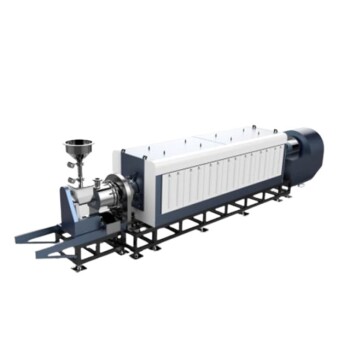
A high-pressure hydrothermal reactor serves as a critical process intensification tool for synthesizing advanced materials like mesoporous hydroxyapatite and biochar. It creates a sealed, high-temperature, and high-pressure environment that forces liquid-phase reactions to occur at rates and efficiencies impossible under atmospheric conditions. This environment drives the simultaneous formation of surface functional groups and intricate pore structures, transforming raw precursors (such as spent mushroom substrates) into high-performance adsorbents.
By maintaining a subcritical or near-supercritical state, the reactor significantly boosts the solubility and reactivity of precursors. This creates materials with vastly superior specific surface areas and adsorption capacities—such as increasing cadmium ion adsorption by over 200%—while ensuring consistent phase purity.
The Mechanism of Synthesis
Creating a Subcritical Environment
The reactor operates as a closed system, allowing temperatures to exceed the atmospheric boiling point of solvents without evaporation.
This creates a subcritical water state. In this state, the solubility and diffusivity of reactants increase significantly, enabling chemical transformations that are kinetically difficult in standard open-vessel reactions.
Facilitating Liquid-Phase Reactions
Within this pressurized environment, liquid-phase reactions are accelerated.
This is the primary driver for surface modification. The reactor environment facilitates the development of specific functional groups on the material's surface, which are essential for chemical interactions in subsequent applications, such as catalysis or heavy metal removal.
Guiding Self-Assembly
The high-pressure environment does not just speed up reactions; it organizes them.
The conditions guide the self-assembly of crystals. Whether synthesizing hydroxyapatite or biochar, the reactor promotes the formation of uniform mesoporous structures (pores between 2 and 50 nm), rather than random, non-porous aggregations.
Impact on Material Performance
Drastic Increase in Adsorption
The most tangible benefit of using a high-pressure hydrothermal reactor is the massive increase in specific surface area.
The combination of high porosity and abundant functional groups creates more "docking sites" for contaminants. For example, biochar derived from spent mushroom substrates in this reactor showed an increase in cadmium ion adsorption from 28 mg/L to 92 mg/L.
Precision Phase Control
The reactor allows for the isolation of specific material phases.
By regulating the temperature and pressure distribution, you can control the crystallinity and phase composition of the final powder. This ensures that synthesized hydroxyapatite achieves high phase purity without unwanted byproducts.
High Reproducibility
Because the system is closed and thermodynamically constant, experimental conditions can be replicated exactly.
This eliminates the variability often seen in open-air synthesis methods. It ensures that the morphology and particle size of the powder remain consistent from batch to batch.
Understanding the Trade-offs
The Necessity of Parameter Precision
While the reactor enables control, it also demands it.
The relationship between temperature, pressure, and residence time is non-linear. Slight deviations in the thermal environment can alter the crystal morphology or pore size distribution, potentially ruining the material's catalytic activity.
Precursor Solubility Dependencies
The efficiency of the reactor is heavily dependent on the solubility of the raw materials in the subcritical fluid.
While the reactor enhances solubility, the precursors must still be chemically compatible with the hydrothermal media to undergo the necessary dissolution and recrystallization processes.
Making the Right Choice for Your Goal
To maximize the utility of a high-pressure hydrothermal reactor in your synthesis process, consider your specific endpoints:
- If your primary focus is maximum adsorption (e.g., wastewater treatment): Prioritize reaction parameters that maximize the formation of surface functional groups and mesoporous volume to replicate the high ion-capture rates (e.g., 92 mg/L) seen in biochar studies.
- If your primary focus is catalyst manufacturing: Concentrate on the precise control of phase composition and crystallinity to ensure high purity and uniform particle morphology for consistent catalytic activity.
Ultimately, the high-pressure hydrothermal reactor converts low-value substrates into high-value engineered materials through precise thermodynamic control.
Summary Table:
| Feature | Hydrothermal Reactor Impact | Material Outcome |
|---|---|---|
| Environment | Subcritical / High-Pressure | Increased precursor solubility & reactivity |
| Pore Structure | Guided Self-Assembly | Uniform mesoporous architecture (2-50 nm) |
| Surface Chemistry | Intensified Liquid-Phase Reactions | Abundant functional groups for ion capture |
| Adsorption | Enhanced Surface Area | 3x increase in heavy metal (Cd) adsorption |
| Phase Control | Thermodynamic Stability | High crystallinity and phase purity |
Elevate Your Material Research with KINTEK Precision
Unlock the full potential of your synthesis workflows with KINTEK’s premium laboratory equipment. Whether you are developing high-performance biochar or advanced catalysts, our high-temperature high-pressure reactors and autoclaves provide the precise thermodynamic control required to achieve superior porosity and phase purity.
Beyond reactors, KINTEK offers a comprehensive range of tools to support your entire lifecycle, including:
- Material Processing: Crushing, milling systems, and hydraulic presses for pelletizing.
- Thermal Treatment: Muffle, tube, and vacuum furnaces for post-synthesis calcination.
- Lab Essentials: High-purity ceramics, crucibles, and specialized electrolytic cells.
Ready to transform low-value substrates into high-engineered materials? Contact our technical experts today to find the perfect solution for your laboratory's needs.
References
- Tamar Makharadze, Giorgi Makharadze. Measurement of complex formation process of lead (II) with fulvic acids isolated from natural waters at pH=9. DOI: 10.21175/rad.abstr.book.2023.13.3
This article is also based on technical information from Kintek Solution Knowledge Base .
Related Products
- Customizable Laboratory High Temperature High Pressure Reactors for Diverse Scientific Applications
- High Pressure Laboratory Autoclave Reactor for Hydrothermal Synthesis
- Customizable High Pressure Reactors for Advanced Scientific and Industrial Applications
- Stainless High Pressure Autoclave Reactor Laboratory Pressure Reactor
- Mini SS High Pressure Autoclave Reactor for Laboratory Use
People Also Ask
- How do high-pressure and high-temperature reactors ensure the effective treatment of lignocellulosic wastewater in WAO?
- What equipment is required for high-pressure high-temperature reactions? Master Extreme Chemistry Safely
- How do you control high pressure in a reactor? A Guide to Safe & Stable Operation
- Why is argon better than nitrogen for inert atmosphere? Ensure Absolute Reactivity & Stability
- How does initial oxygen pressure affect the wet oxidation of pharmaceutical sludge? Master Your Oxidation Depth