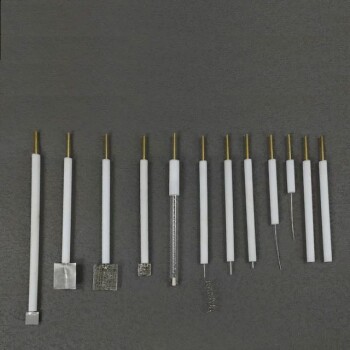
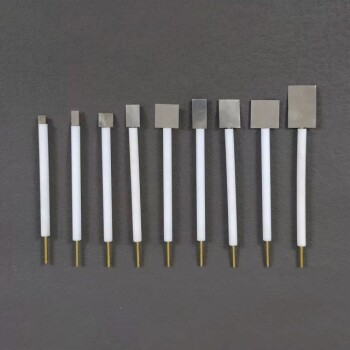
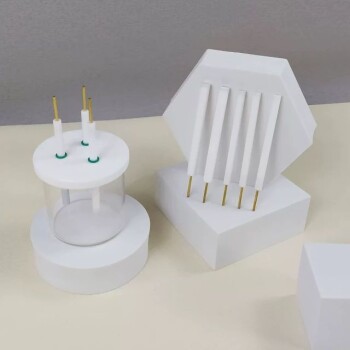
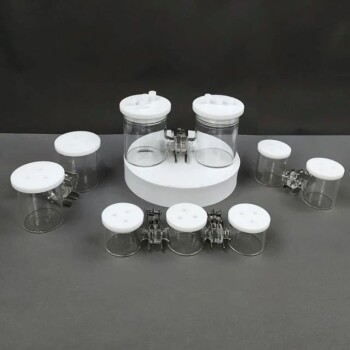
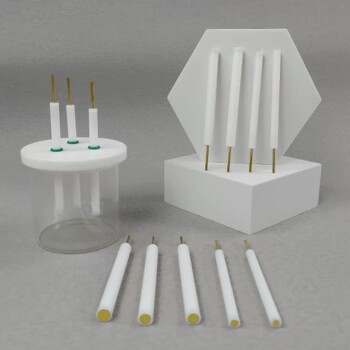
In the context of testing PdLa/ATO catalysts, a high-purity platinum counter electrode acts as the essential conduit for completing the current loop within a three-electrode system. Its primary function is to facilitate stable current transmission between itself and the working electrode while maintaining total chemical neutrality to preserve data integrity.
Core Takeaway: By providing a highly conductive and chemically inert path for current, the platinum counter electrode ensures that the recorded signals purely reflect the redox behavior of the catalyst, free from external interference or impurities.
The Functional Role in the Circuit
Completing the Current Loop
In a three-electrode setup, the current must flow between two specific points to enable electrochemical measurements.
The high-purity platinum electrode functions as the counter (or auxiliary) electrode. It pairs with the working electrode (containing the PdLa/ATO catalyst) to form a complete electrical circuit, allowing electrons to flow and reactions to occur.
Facilitating Redox-Balancing
Electrochemistry requires balance; for every reaction at the working electrode, a balancing reaction must occur elsewhere.
The platinum electrode provides the necessary surface for these redox-balancing reactions. This ensures the system remains electrically neutral without interfering with the specific potential being applied to the working electrode.
Why High-Purity Platinum is Essential
Unwavering Chemical Stability
The environment inside an electrolytic cell can be harsh and reactive.
Platinum is selected because it is chemically inert. It withstands the electrolyte solution and the electrical stress of Cyclic Voltammetry (CV) testing without corroding or dissolving, which is critical for consistent results.
Ensuring Stable Current Transmission
Accurate testing requires a smooth flow of electricity.
Due to platinum’s excellent electrical conductivity, it minimizes resistance within the cell. This ensures that the current transmission remains stable throughout the experiment, preventing voltage drops that could skew the data.
Ensuring Data Integrity
Eliminating Interference Signals
The greatest risk in catalyst testing is measuring a reaction that isn't actually happening on your catalyst.
A high-purity platinum electrode does not introduce impurities or interference signals. If a lower-quality metal were used, it might oxidize or release ions, creating "ghost" peaks in the data that obscure the true performance of the PdLa/ATO.
Reflecting True Redox Characteristics
The ultimate goal is to understand the PdLa/ATO catalyst.
By serving as a silent, stable partner in the circuit, the platinum electrode allows the system to accurately reflect the redox characteristics specifically on the catalyst surface. It ensures that every peak and valley in your voltammogram can be attributed to your catalyst, not your equipment.
Understanding the Trade-offs
The Cost of Precision
While platinum is chemically ideal, it represents a significant material cost compared to other conductive materials like carbon or gold.
However, the "trade-off" here is strictly financial rather than technical. Attempting to use cheaper, lower-purity counter electrodes introduces a high risk of electrolyte contamination and baseline drift, which can render sensitive CV data unusable.
Maintenance Requirements
Despite its stability, platinum is not magic.
To maintain its "high purity" status and performance, the electrode requires regular cleaning (such as flame annealing or acid washing). Neglecting this maintenance allows contaminants to build up on the platinum surface, which will eventually impede current transmission and reintroduce the interference you are trying to avoid.
Making the Right Choice for Your Experiment
To ensure your assessment of the PdLa/ATO catalyst is valid, consider the following regarding your counter electrode:
- If your primary focus is Signal Clarity: Prioritize high-purity platinum (99.9%+) to eliminate background noise and ensure all observed current is relevant to the catalyst.
- If your primary focus is Long-Term Reproducibility: Ensure the platinum wire has sufficient surface area and is cleaned regularly to maintain stable current transmission across multiple testing cycles.
The high-purity platinum counter electrode is the invisible foundation of your experiment, ensuring that the activity you measure belongs solely to your catalyst.
Summary Table:
| Feature | Role & Benefit in Catalyst Testing |
|---|---|
| Material | High-Purity Platinum (99.9%+) for chemical inertness |
| Function | Completes the current loop and facilitates redox balancing |
| Conductivity | Minimizes resistance for stable current transmission |
| Data Integrity | Eliminates interference signals and "ghost" peaks |
| Maintenance | Requires regular cleaning (acid wash/flame) for reproducibility |
Elevate Your Electrochemical Research with KINTEK
Precise catalyst characterization requires hardware you can trust. KINTEK specializes in high-performance laboratory equipment, providing the high-purity electrolytic cells and electrodes essential for accurate PdLa/ATO catalyst testing.
Our extensive portfolio supports your entire workflow—from crushing and milling systems for sample preparation to high-temperature furnaces (muffle, vacuum, CVD) and high-pressure reactors for advanced material synthesis. Whether you need reliable platinum counter electrodes, PTFE consumables, or cooling solutions like ULT freezers, KINTEK delivers the quality required for reproducible data.
Ready to eliminate interference and optimize your lab's efficiency? Contact our technical experts today to find the perfect solution for your research needs.
References
- Paulo V. R. Gomes, Almir Oliveira Neto. Synergistic Pd-La Catalysts on ATO for Clean Conversion of Methane into Methanol and Electricity. DOI: 10.3390/reactions6010002
This article is also based on technical information from Kintek Solution Knowledge Base .
Related Products
- Platinum Auxiliary Electrode for Laboratory Use
- High Purity Gold Platinum Copper Iron Metal Sheets
- Platinum Sheet Electrode for Battery Lab Applications
- Platinum Sheet Electrode for Laboratory and Industrial Applications
- Rotating Platinum Disk Electrode for Electrochemical Applications
People Also Ask
- What is the function of a platinum electrode as an auxiliary electrode? Ensure Precise Nickel Coating Corrosion Testing
- Why is platinum typically selected as the auxiliary electrode for electrochemical testing of oxazoline inhibitors?
- What does the auxiliary electrode do? Ensuring Accurate Electrochemical Measurements
- What are the roles of Pt counter and reference electrodes in nitrided steel testing? Optimize Your Electrochemical Data
- What are the advantages of using a platinum counter electrode? Ensure Purity in Photocatalytic Coating Deposition