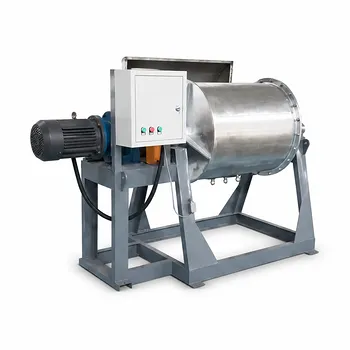
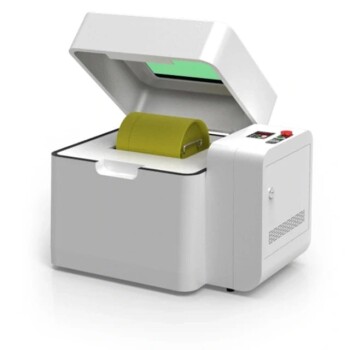
The horizontal ball mill serves as the primary homogenization engine during the initial mixing of Yttrium Aluminum Garnet (YAG) ceramic raw materials. Its function is to subject raw powders, specifically alumina and yttria, to extended mechanical grinding alongside dispersants like anhydrous ethanol, creating a perfectly uniform mixture before chemical synthesis begins.
The core purpose of this process is to eliminate raw material agglomeration and ensure the distribution of components is uniform at a microscopic level. This physical uniformity provides the essential foundation required for complete solid-phase reactions in later manufacturing steps.
The Mechanism of Horizontal Milling
Mixing Raw Components
The process begins by combining the core solid ingredients—alumina and yttria powders—into the mill.
To facilitate mixing and prevent dry clumping, a liquid medium is introduced. Anhydrous ethanol is commonly used as a dispersant during this stage to create a slurry.
Extended Mechanical Grinding
Unlike high-speed impact mills, the horizontal ball mill relies on extended mechanical grinding.
The mill rotates, causing the grinding media to cascade and tumble over the slurry for a prolonged period. This continuous motion gently but thoroughly forces the particles to interact.
Critical Objectives of the Process
Eliminating Agglomeration
Raw ceramic powders naturally tend to stick together, forming clusters or "agglomerates."
The shearing force of the ball mill breaks these clusters apart. This ensures that individual particles are separated and coated with the dispersant, rather than remaining stuck in dry pockets.
Establishing Microscopic Uniformity
For high-quality ceramics, macroscopic mixing is not enough; the materials must be uniform at the microscopic scale.
The horizontal mill ensures that every particle of alumina is in close proximity to a particle of yttria. This intimate mixing is the physical prerequisite for the chemistry that follows.
Enabling Solid-Phase Reactions
The ultimate goal of this mechanical step is to prepare the material for the solid-state reaction.
By ensuring a uniform distribution now, manufacturers ensure that complete solid-phase reactions can occur during subsequent heating. If the mixing is poor, the final ceramic structure will be flawed.
Understanding the Trade-offs
Process Duration vs. Efficiency
The primary reference highlights the need for "extended" grinding.
While effective at homogenization, horizontal milling is a time-intensive process compared to high-energy alternatives. Rushing this stage often results in residual agglomeration and inconsistent ceramic properties.
Energy Input vs. Contamination Risk
Extended grinding times increase the contact time between the milling media and the lining.
While this ensures thorough mixing, it requires careful monitoring to prevent contamination from the milling jar or balls (wear debris), which would degrade the optical or thermal properties of the final YAG ceramic.
Making the Right Choice for Your Goal
When optimizing your initial mixing stage, consider your specific priorities:
- If your primary focus is Chemical Homogeneity: Prioritize the duration of the milling process to guarantee that microscopic agglomeration is fully resolved before sintering.
- If your primary focus is Process Efficiency: Evaluate the ratio of dispersants (ethanol) to solids to maximize the fluidity and impact efficiency of the slurry during the extended grinding cycle.
The quality of the final YAG ceramic is inextricably linked to the uniformity achieved in this initial mechanical step.
Summary Table:
| Feature | Role in YAG Raw Material Mixing |
|---|---|
| Primary Mechanism | Extended mechanical grinding and cascading motion |
| Key Components | Alumina, Yttria, and Anhydrous Ethanol (dispersant) |
| Process Goal | Eliminate agglomeration and ensure microscopic uniformity |
| Impact on Quality | Enables complete solid-phase reactions for flaw-free ceramics |
| Processing Media | Slurry-based milling to prevent dry clumping |
Elevate Your Ceramic Research with KINTEK Precision
High-performance YAG ceramics demand uncompromising homogenization. KINTEK specializes in advanced crushing and milling systems, including high-efficiency horizontal ball mills designed to eliminate agglomeration and ensure microscopic uniformity.
Our comprehensive laboratory portfolio supports every stage of your workflow, featuring:
- High-Temperature Furnaces: Muffle, vacuum, and atmosphere furnaces for precise sintering.
- Milling & Grinding: Ball mills, crushing systems, and high-purity ceramics/crucibles to prevent contamination.
- Material Processing: Hydraulic pellet presses and isostatic presses for superior green body density.
Whether you are refining solid-phase reactions or optimizing battery research, KINTEK provides the reliable tools and consumables your lab needs to succeed. Contact us today to find the perfect equipment for your application!
Related Products
- Laboratory Horizontal Planetary Ball Mill Milling Machine
- High Energy Planetary Ball Mill for Laboratory Horizontal Tank Type Milling Machine
- High Energy Planetary Ball Mill Machine for Laboratory Horizontal Tank Type
- Stainless Steel Laboratory Ball Mill for Dry Powder and Liquid with Ceramic Polyurethane Lining
- Laboratory Four-Body Horizontal Jar Mill
People Also Ask
- What is the primary purpose of using a planetary ball mill for iridium powder? Achieve Microscopic Mixing Uniformity
- What is the primary function of a planetary ball mill for Al2O3-TiC/CaF2 powders? Achieving Microstructural Homogeneity
- What is the role of a planetary ball mill in sulfide-based solid-state batteries? Engineer High-Performance Cathodes
- What is the function of a planetary ball mill in MAX phase powder preparation? Unlock High-Purity Atomic Homogeneity
- Why are planetary ball mills used for intermetallic precursors? Achieve Precise Atomic-Level Mechanical Alloying