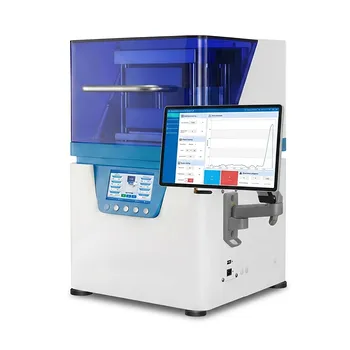
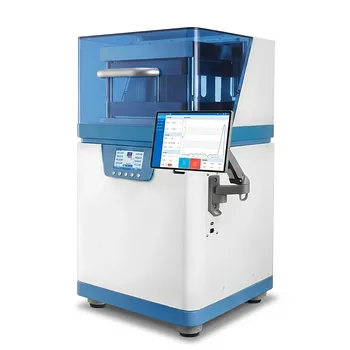
A laboratory hydraulic press is the critical instrument used to transform gadolinium-doped carbon nanotube powder into a transparent, solid pellet suitable for FTIR analysis. By applying uniform high-tonnage pressure to a mixture of the sample and potassium bromide (KBr)—typically at a ratio of 1:300—the press eliminates air gaps and scattering voids. This process renders the sample optically transparent, allowing an infrared beam to penetrate the material and produce a high-resolution absorption spectrum.
The hydraulic press serves as the bridge between raw powder and a measurable optical medium, ensuring that light scattering is minimized so that the chemical signatures of the carbon nanotubes can be accurately detected.
The Physics of Pelletizing for Infrared Analysis
Eliminating Scattering Voids
In its raw state, gadolinium-doped carbon nanotube powder consists of discrete particles that scatter infrared radiation in all directions. The hydraulic press applies uniform high pressure to force these particles into a dense, continuous matrix. This physical rearrangement removes the microscopic air pockets (voids) that would otherwise cause "noise" and prevent the infrared beam from reaching the detector.
Achieving Optical Transparency
Transparency is the primary requirement for FTIR operating in transmission mode. The press flattens the sample-KBr mixture into a thin disk, often around 0.3mm thick. This thinness, combined with the elimination of internal gaps, ensures the infrared light can pass through the sample with high transmittance, resulting in a high signal-to-noise ratio.
Creating the Ideal Sample Environment
The Role of the Potassium Bromide (KBr) Matrix
Because carbon nanotubes are highly concentrated and can be opaque, they must be diluted in a medium that is "invisible" to infrared light. Spectroscopic-grade KBr is used because it becomes plastic under high pressure and does not have absorption peaks in the primary IR range. The hydraulic press fuses the nanotubes into this KBr lattice, creating a stable, standardized environment for analysis.
Ensuring Uniform Thickness and Density
Precision molds, or pellet dies, are used in conjunction with the press to ensure the pellet has a consistent density. Variations in thickness or density can lead to shifted baselines or distorted absorption peaks. A high-quality hydraulic press maintains constant pressure to produce a pellet with a stable baseline, which is essential for identifying the functional groups and chemical interactions of the gadolinium dopants.
Common Pitfalls and Trade-offs
The Risk of Atmospheric Moisture
Potassium bromide is hygroscopic, meaning it rapidly absorbs moisture from the air. If the pressing process is too slow or conducted in high humidity, water vapor can become trapped in the pellet, creating "ghost peaks" in the FTIR spectrum that mask the sample’s true characteristics.
Pressure-Induced Sample Alteration
While high pressure is necessary for transparency, excessive tonnage can occasionally alter the crystalline structure of certain samples or cause the pellet to become brittle and crack. Conversely, insufficient pressure results in an opaque or "cloudy" pellet that produces a weak signal and significant light scattering.
Optimizing Your Sample Preparation
How to Apply This to Your Project
To achieve the most accurate FTIR results for gadolinium-doped carbon nanotubes, consider your specific analytical requirements:
- If your primary focus is Maximum Signal Clarity: Use a higher dilution ratio (such as 1:300) and ensure the press is held at peak pressure for at least 1-2 minutes to allow the KBr to flow completely around the nanotubes.
- If your primary focus is Quantitative Analysis: Ensure that every pellet is pressed at the exact same tonnage and for the same duration to maintain consistent path length and density across all samples.
- If your primary focus is Structural Integrity: Use a vacuum-capable pellet die during the pressing process to remove all traces of air, which prevents the pellet from blooming or becoming cloudy over time.
Mastering the hydraulic press process ensures that your FTIR data reflects the true molecular nature of your nanotubes rather than the artifacts of poor sample preparation.
Summary Table:
| Parameter | Requirement | Benefit for FTIR Analysis |
|---|---|---|
| Sample-to-KBr Ratio | Typically 1:300 | Prevents opacity; ensures optimal IR beam penetration. |
| Applied Pressure | Uniform High Tonnage | Eliminates air voids and prevents light scattering. |
| Pellet Thickness | Approx. 0.3 mm | Achieves high transmittance and a strong signal-to-noise ratio. |
| Matrix Material | Spectroscopic-grade KBr | Provides an IR-transparent medium for a stable baseline. |
| Equipment Type | Vacuum-capable Pellet Die | Removes atmospheric moisture to prevent "ghost peaks." |
Achieve Flawless Analytical Results with KINTEK
Precision in sample preparation is the foundation of breakthrough research. KINTEK specializes in high-performance laboratory equipment designed to meet the rigorous demands of advanced materials science. Whether you are preparing gadolinium-doped nanotubes or complex ceramics, our laboratory hydraulic presses (pellet, hot, isostatic) and precision dies ensure the uniform density and optical transparency required for high-resolution FTIR spectroscopy.
Beyond sample preparation, KINTEK provides a comprehensive ecosystem for your lab, including:
- High-Temperature Furnaces: Muffle, tube, vacuum, and CVD systems.
- Processing Equipment: Crushing, milling, and sieving systems.
- Specialized Reactors: High-temperature high-pressure reactors and autoclaves.
- Essential Consumables: High-purity KBr, PTFE products, and crucibles.
Ready to elevate your lab's efficiency and data accuracy? Contact KINTEK today to find the perfect equipment solution for your specific application.
References
- R.G. Abaszade, Ruslan Zapukhlyak. Influence of gadolinium doping on structural properties of carbon nanotubes. DOI: 10.15330/pcss.24.1.153-158
This article is also based on technical information from Kintek Solution Knowledge Base .
Related Products
- Laboratory Hydraulic Press Lab Pellet Press Machine for Glove Box
- Laboratory Hydraulic Press Split Electric Lab Pellet Press
- Fully Automatic Heated Hydraulic Lab Press for Materials Sintering and Sample Preparation
- Automatic Laboratory Hydraulic Press for XRF & KBR Pellet Press
- Laboratory Hydraulic Press Lab Pellet Press for Button Battery
People Also Ask
- How do laboratory hydraulic presses contribute to zero-gap electrolyzers? Optimize Performance & Safety
- Why is a laboratory hydraulic press necessary for ZrO2/Cr2O3 interface analysis? Optimize Sample Density and Accuracy
- How do a precision laboratory hydraulic press and specialized molds contribute to the fabrication of spherical ceramic samples? Achieving High-Density Material Precision
- What is the role of a laboratory hydraulic press in the preparation of rare earth denitrification catalysts?
- How does pressure control of a laboratory hydraulic press affect W-Ti alloys? Optimize Grain Structure & Density