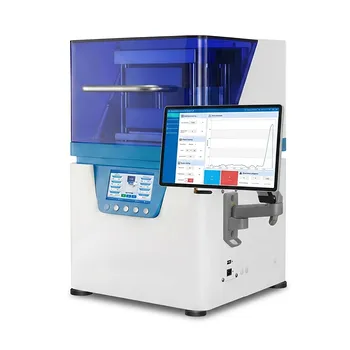
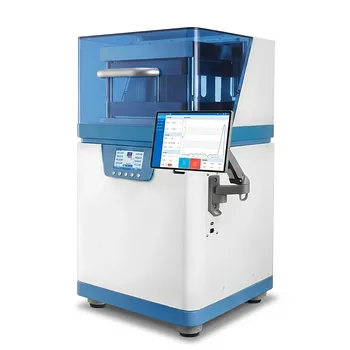
A laboratory hydraulic press is the critical bridge between raw material and precise measurement. It converts loose powders or composite mixtures into standardized, high-density specimens with uniform dimensions. By applying controlled, repeatable pressure, the press ensures the physical integrity required for accurate electromagnetic analysis using tools such as Vector Network Analyzers (VNA).
The primary role of a laboratory hydraulic press is to eliminate physical variables—such as air gaps and density fluctuations—that would otherwise distort electromagnetic data. It ensures that the resulting measurements reflect the intrinsic properties of the material rather than artifacts or defects in sample preparation.
Ensuring Geometric and Density Uniformity
Precision in Standardized Specimen Dimensions
To measure electromagnetic properties, materials must often be shaped into standardized coaxial rings with specific dimensions, such as an inner diameter of 3.04 mm and an outer diameter of 7.0 mm. A hydraulic press, used in conjunction with precision stainless steel molds, ensures these dimensions are met with high repeatability. This geometric accuracy is essential for the specimen to fit perfectly within test fixtures, preventing leakage or measurement errors.
The Importance of Uniform Density
The hydraulic press applies consistent pressure to ensure that the composite powder and matrix (such as paraffin) have a uniform density and thickness. Variations in density across a sample can lead to inconsistent readings of the dielectric constant and magnetic permeability. By achieving a homogenous state, the press allows the Vector Network Analyzer to produce data that is technically sound and coherent.
Optimizing Internal Material Structure
Elimination of Air Pores and Voids
The high-pressure forming process is essential for eliminating air pores that could interfere with electromagnetic testing. Air pockets act as dielectric discontinuities, which can cause scattering or incorrect readings of a material's complex permittivity. Controlled compression ensures that internal particles are tightly arranged, providing a true representation of the material's bulk properties.
Enhancing Electrical Contact and Reducing Resistance
In conductive composites, the hydraulic press is used to enhance electrical contact between conductive fillers and the polymer matrix. By applying significant pressure, the press reduces interfacial resistance and optimizes the material's conductivity and shielding effectiveness. This is particularly vital when preparing specimens for EMI shielding or high-frequency applications.
High-Temperature Molding and Matrix Remelting
Specialized high-temperature hydraulic presses can remelt polymer matrices at specific temperatures (e.g., 220°C) while applying pressure. This process expels residual micro-air bubbles and ensures that the active materials are securely bonded to the current collector or substrate. This structural stability is critical for maintaining consistent performance during rigorous electromagnetic testing cycles.
Understanding the Trade-offs and Pitfalls
Pressure-Induced Material Alteration
While high pressure is necessary for density, excessive force can lead to the crushing of sensitive particles or unwanted phase changes in the material. Over-compression may also cause pressure-induced anisotropy, where particles align in a way that does not represent the material's natural state. Finding the specific "saturation point" for pressure is key to maintaining material integrity.
The Risk of Specimen Deformation
If pressure is released too quickly or if the mold is not properly lubricated, the specimen may develop micro-cracks or "spring-back" effects. These physical defects can lead to significant data errors in a VNA, as the electromagnetic waves will interact with the cracks rather than the bulk material. Consistency in the speed and direction of the press is as important as the total pressure applied.
Optimizing Your Specimen Preparation Workflow
Effective electromagnetic characterization requires a balanced approach to sample preparation, focusing on the specific needs of your material.
- If your primary focus is VNA Measurement Accuracy: Use a precision mold to create standardized ring specimens, ensuring consistent thickness to prevent data drift.
- If your primary focus is High-Conductivity Shielding: Prioritize higher pressures to maximize electrical contact between fillers and minimize interfacial resistance.
- If your primary focus is Powder Analysis (XRD/XRF): Utilize the press to create dense, flat pellets that provide a smooth surface for accurate wave reflection and diffraction.
Mastering the application of pressure transforms a raw composite into a high-fidelity data source.
Summary Table:
| Key Function | Impact on Characterization | Specific Application |
|---|---|---|
| Geometric Standardization | Prevents leakage & ensures perfect fixture fit | Coaxial ring production for VNA |
| Density Uniformity | Consistent dielectric & permeability readings | Composite material testing |
| Air Void Elimination | Removes dielectric discontinuities & scattering | High-frequency material analysis |
| Structural Optimization | Enhances filler contact & conductivity | EMI shielding & conductive composites |
Elevate Your Material Characterization with KINTEK
Precision in electromagnetic analysis starts with flawless specimen preparation. KINTEK specializes in high-performance laboratory equipment designed to eliminate variables and ensure data integrity. Whether you are conducting VNA measurements or EMI shielding research, our comprehensive range of hydraulic presses (pellet, hot, and isostatic), precision molds, and crushing systems provide the uniformity your research demands.
From high-temperature high-pressure reactors to specialized ceramics and crucibles, KINTEK is your partner in advanced material science. Contact us today to find the perfect pressing solution for your lab!
References
- Ziqing Wang, Bolin Wang. Polyimide aerogel-derived amorphous porous carbon/crystalline carbon composites for high-performance microwave absorption. DOI: 10.1039/d3ra00155e
This article is also based on technical information from Kintek Solution Knowledge Base .
Related Products
- Laboratory Hydraulic Press Lab Pellet Press Machine for Glove Box
- Laboratory Hydraulic Press Split Electric Lab Pellet Press
- Fully Automatic Heated Hydraulic Lab Press for Materials Sintering and Sample Preparation
- Laboratory Hydraulic Press Lab Pellet Press for Button Battery
- Automatic Laboratory Hydraulic Press for XRF & KBR Pellet Press
People Also Ask
- What is the function of a laboratory hydraulic press in W-Cu composites? Control Porosity and Material Ratio
- What is the role of a laboratory hydraulic press in the initial stages of Li6PS5Cl preparation? Key to Green Pellets
- What role does a laboratory hydraulic press play in triboelectric testing? Achieve Precision Alloy Sample Prep
- How can a laboratory hydraulic press be applied to chitosan for wastewater treatment? Optimize Pores & Strength
- How do a precision laboratory hydraulic press and specialized molds contribute to the fabrication of spherical ceramic samples? Achieving High-Density Material Precision