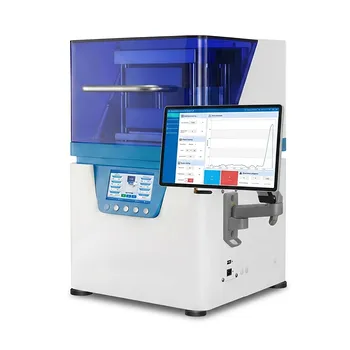
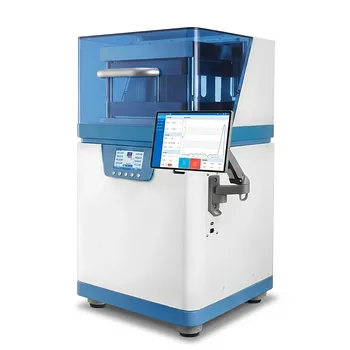
A laboratory hydraulic press is the critical instrument used to transform loose, mechanochemically synthesized $LaSrAl_{1-x}Mg_xO_{4-\delta}$ powders into solid "green bodies" through the application of precise uniaxial pressure. By applying a controlled force—typically around 50 kg/cm²—the press forces powder particles into a tightly packed geometric shape, a necessary precursor for the subsequent high-temperature sintering phase.
The laboratory hydraulic press serves as the foundation for ceramic electrolyte fabrication by eliminating large internal pores and maximizing particle contact. This initial densification is what allows the material to achieve the high final density and structural integrity required for effective ionic conductivity.
The Critical Function of the Hydraulic Press
Transitioning from Powder to Green Body
The fabrication process begins with powders synthesized through mechanochemical means. The hydraulic press applies uniaxial pressure to these powders within a die, compacting them into a "green body"—a term for an unsintered ceramic object with a specific shape.
Precision Pressure Control
For $LaSrAl_{1-x}Mg_xO_{4-\delta}$, maintaining a consistent pressure of approximately 50 kg/cm² is vital. Precise control ensures that the density is uniform across the entire specimen, preventing structural weak points that could fail during thermal processing.
Simulating Industrial Conditions
In a research environment, the hydraulic press allows scientists to simulate the unit pressure used in industrial-scale manufacturing. This ensures that laboratory results regarding material density and shrinkage are scalable and relevant to real-world production.
Impact on Microstructure and Densification
Minimizing Internal Porosity
The primary mechanical goal of pressing is the removal of air gaps between particles. By minimizing large internal pores at the green stage, the press ensures that the remaining microscopic voids can be effectively closed during the sintering process.
Establishing Particle Connectivity
Tight packing of powder particles is essential for solid-state diffusion. The press creates the initial particle-to-particle contact necessary for atoms to migrate across grain boundaries when the ceramic is heated to high temperatures.
Determining Final Electrolyte Performance
The density achieved during the pressing stage directly dictates the ionic conductivity and mechanical strength of the final electrolyte. A well-pressed green body leads to a dense, low-defect ceramic that can efficiently transport ions in electrochemical applications.
Understanding the Trade-offs
The Risk of Under-Pressing
If the applied pressure is too low, the green body will retain excessive porosity and lack the mechanical strength to be handled. This often results in a "friable" ceramic that fails to densify properly during sintering, leading to poor electrochemical performance.
The Consequences of Over-Pressing
Applying pressure far beyond the recommended 50 kg/cm² can lead to internal stresses and "capping" or lamination defects. These are micro-cracks that form when the pressure is released, which can expand during sintering and cause the ceramic electrolyte to fracture.
Precision vs. Speed
While manual presses are common, they often lack the repeatability of automated hydraulic systems. Variations in the rate of pressure application can lead to inconsistent green densities, making it difficult to isolate the effects of chemical dopants like Magnesium (Mg) on the electrolyte's properties.
How to Optimize Your Pressing Process
Applying This to Your Project
To achieve the best results when fabricating $LaSrAl_{1-x}Mg_xO_{4-\delta}$ or similar ceramic electrolytes, tailor your pressing strategy to your specific research or production goals:
- If your primary focus is maximizing ionic conductivity: Ensure the hydraulic press is calibrated to minimize initial porosity, as a denser green body is the only path to a fully dense, high-conductivity final ceramic.
- If your primary focus is structural integrity and scaling: Use the press to establish a standardized "unit pressure" that can be replicated across multiple batches to ensure consistent drying shrinkage and mechanical toughness.
- If your primary focus is material characterization: Utilize precise uniaxial pressing to create standardized geometric shapes, such as 80x120 mm specimens, to accurately measure the impact of additives on sintering performance.
By mastering the precise application of uniaxial pressure, you establish the physical foundation necessary for high-performance ceramic electrolytes.
Summary Table:
Key Roles of Hydraulic Presses in Ceramic Fabrication
| Function | Impact on Electrolyte Fabrication | Research Importance |
|---|---|---|
| Compaction | Transforms loose powders into solid "green bodies" | Essential precursor for high-temperature sintering |
| Pressure Control | Applies precise uniaxial force (e.g., 50 kg/cm²) | Ensures uniform density and prevents structural failure |
| Densification | Minimizes internal porosity and air gaps | Directly increases final ionic conductivity |
| Connectivity | Establishes critical particle-to-particle contact | Enables effective solid-state diffusion during heating |
| Standardization | Simulates industrial unit pressure | Ensures laboratory results are scalable to production |
Elevate Your Ceramic Research with KINTEK Precision
Achieving the perfect green body for $LaSrAl_{1-x}Mg_xO_{4-\delta}$ electrolytes requires more than just force—it requires the absolute precision of KINTEK laboratory solutions.
We specialize in high-performance hydraulic presses (pellet, hot, and isostatic) designed to provide the repeatable uniaxial pressure necessary for high-density ceramic fabrication. To complete your workflow, our portfolio features high-temperature muffle and tube furnaces for sintering, crushing and milling systems for powder preparation, and essential crucibles and ceramics.
Why partner with KINTEK?
- Unmatched Accuracy: Precise control to eliminate porosity without the risk of over-pressing defects.
- End-to-End Solutions: From battery research tools to cooling solutions and high-pressure reactors.
- Proven Reliability: Equipment engineered to withstand the rigorous demands of advanced material science.
Don't let inconsistent compaction compromise your ionic conductivity results. Contact KINTEK today to discuss the ideal pressing and sintering setup for your laboratory!
References
- C. Mariño, L. Troncoso. Structural and Electrical Characterization of LaSrAl1−xMgxO4−δ Layered Perovskites Obtained by Mechanical Synthesis. DOI: 10.3390/ma16247564
This article is also based on technical information from Kintek Solution Knowledge Base .
Related Products
- Laboratory Hydraulic Press Lab Pellet Press Machine for Glove Box
- Laboratory Hydraulic Press Split Electric Lab Pellet Press
- Fully Automatic Heated Hydraulic Lab Press for Materials Sintering and Sample Preparation
- Laboratory Hydraulic Press Lab Pellet Press for Button Battery
- Automatic Laboratory Hydraulic Press for XRF & KBR Pellet Press
People Also Ask
- What is the function of a laboratory hydraulic press in W-Cu composites? Control Porosity and Material Ratio
- What is the role of a laboratory hydraulic press in the initial stages of Li6PS5Cl preparation? Key to Green Pellets
- What role does a laboratory hydraulic press play in triboelectric testing? Achieve Precision Alloy Sample Prep
- How can a laboratory hydraulic press be applied to chitosan for wastewater treatment? Optimize Pores & Strength
- How do a precision laboratory hydraulic press and specialized molds contribute to the fabrication of spherical ceramic samples? Achieving High-Density Material Precision