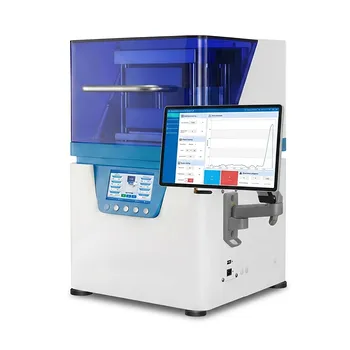
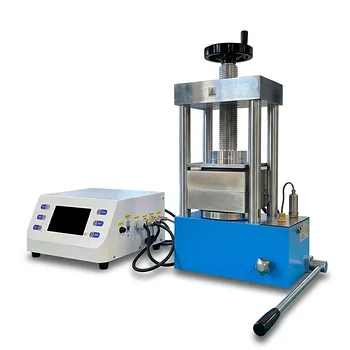
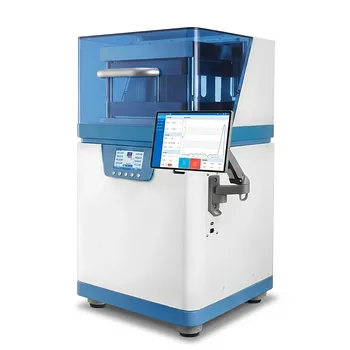
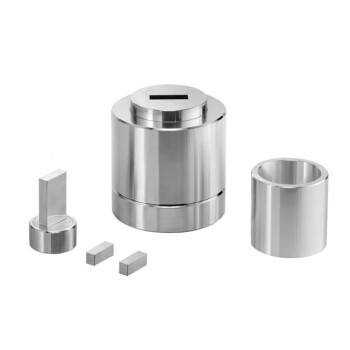
In the fabrication of porous carbon nanosheet electrodes, a laboratory hydraulic press acts as the critical densification tool. It applies precise, constant pressure—typically around 10 MPa—to compress loose active materials and slurries onto a conductive current collector. This process transforms a fragile coating into a robust, high-performance electrode by ensuring intimate contact between the carbon nanosheets and the metal framework.
The laboratory hydraulic press bridges the gap between raw material and functional electrode by optimizing electrical conductivity and mechanical adhesion. By eliminating internal voids and securing the active material to the substrate, it directly enables high-rate performance and long-term cycling stability.
Enhancing Electrical and Structural Integrity
Reducing Internal Contact Resistance
Porous carbon materials, such as graphene-functionalized nanotubes, often begin as loose, "cotton-like" structures with high resistance. The hydraulic press applies vertical force to compact these networks, significantly increasing the mutual contact between individual particles and sheets. This compaction shortens electron transmission paths and lowers the overall internal resistance of the electrode.
Strengthening Adhesion to the Current Collector
A primary role of the press is to bond the active material mixture—containing carbon nanosheets, conductive agents, and binders—onto a current collector like nickel foam or copper foil. This high-pressure bonding prevents the active material from peeling or delaminating during repeated charge-discharge cycles. Without this step, the electrode would lose structural integrity when exposed to electrolyte flushing or mechanical stress.
Optimizing Electrochemical Performance
Maximizing Volumetric Specific Capacity
By eliminating internal voids within the electrode layer, the hydraulic press increases the density of the active material. This is essential for achieving high volumetric specific capacity, as it allows more energy-storing material to fit into a smaller volume. The resulting dense layer ensures that the electrode remains thin while maintaining high electrochemical activity.
Facilitating High-Rate Performance
Precise compaction is vital for applications requiring high current densities, such as supercapacitors operating at 100 A g⁻¹. The press ensures that the interface resistance between the active substance and the nickel mesh is minimized. This efficient interface allows for rapid electron transport, which is the foundation of excellent rate performance.
Understanding the Trade-offs
Balancing Conductivity and Ion Diffusion
While higher pressure improves electronic conduction, excessive compression can be counterproductive. Over-compacting the electrode may collapse the essential micropores and macropores needed for electrolyte penetration. This creates a trade-off: higher density improves electron flow but can potentially hinder ionic diffusion efficiency.
Risks of Non-Uniform Pressure
Applying uneven pressure during the pressing stage can lead to "hot spots" of high resistance or mechanical weak points. Manual presses require careful operation to ensure the 10 MPa (or specified) pressure is held constantly. If the pressure is inconsistent, the electrode may suffer from localized delamination, leading to premature failure during long-term cyclic testing.
How to Apply This to Your Fabrication Process
Achieving the ideal electrode requires balancing the mechanical force of the hydraulic press with the specific morphology of your carbon nanosheets.
- If your primary focus is high energy density: Prioritize higher compaction pressures to maximize the mass loading and volumetric capacity of the electrode.
- If your primary focus is high-rate power delivery: Use moderate, precise pressure to maintain a balance between low contact resistance and open pore structures for fast ionic transport.
- If your primary focus is long-term cycling stability: Ensure the bonding pressure is sufficient to prevent the "peeling" effect, particularly when using flexible current collectors or high-volume-change materials.
A properly calibrated hydraulic press is the definitive tool for turning synthesized carbon powders into high-performance, durable energy storage components.
Summary Table:
| Key Role | Impact on Electrode Performance | Critical Considerations |
|---|---|---|
| Densification | Increases volumetric specific capacity and mass loading. | Avoid over-compaction to maintain ion diffusion. |
| Resistance Reduction | Lowers internal contact resistance by shortening electron paths. | Requires uniform pressure to prevent 'hot spots'. |
| Adhesion Bonding | Secures active material to current collector (e.g., Ni foam). | Prevents delamination during long-term cycling. |
| Pressure Control | Ensures repeatable results with precise force (e.g., 10 MPa). | Consistent application is vital for structural integrity. |
Precision Tools for Advanced Energy Research
Elevate your material science breakthroughs with KINTEK’s industry-leading laboratory equipment. Our high-precision hydraulic presses (pellet, hot, and isostatic) are engineered specifically to help researchers achieve the perfect balance of conductivity and structural integrity in electrode fabrication.
Beyond pressing solutions, KINTEK offers a comprehensive ecosystem for your lab, including:
- High-Temperature Furnaces: Muffle, tube, and vacuum systems for carbonization and synthesis.
- Battery Research Tools: Specialized electrolytic cells, electrodes, and high-quality consumables.
- Material Processing: Advanced crushing, milling, and sieving systems for uniform powder preparation.
Maximize your research potential with KINTEK’s reliable technology. Contact us today to find the perfect equipment for your application!
References
- Zhiwei Tian, Shaohua Jiang. Hierarchically Porous Carbon Nanosheets from One-Step Carbonization of Zinc Gluconate for High-Performance Supercapacitors. DOI: 10.3390/ijms241814156
This article is also based on technical information from Kintek Solution Knowledge Base .
Related Products
- Laboratory Hydraulic Press Split Electric Lab Pellet Press
- Fully Automatic Heated Hydraulic Lab Press for Materials Sintering and Sample Preparation
- Automatic Laboratory Hydraulic Press for XRF & KBR Pellet Press
- Automatic Laboratory Hydraulic Pellet Press Machine for Lab Use
- Laboratory Hydraulic Pellet Press for XRF KBR FTIR Lab Applications
People Also Ask
- What role does a laboratory hydraulic press play in platinum recovery research? Enhancing Sample Precision
- What are the specific applications of a lab hydraulic press in biochar evaluation? Optimize density and data accuracy.
- What are the roles of a laboratory hydraulic press and stainless steel molds in the preparation of graphite samples?
- What is the role of a laboratory hydraulic press in electrode prep? Maximize Energy Density & Sealing Precision
- Why must a laboratory hydraulic press equipped with cylindrical molds be used when preparing BZY green bodies? High Density