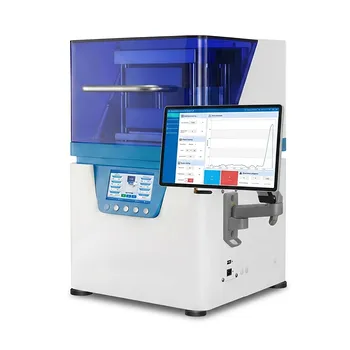
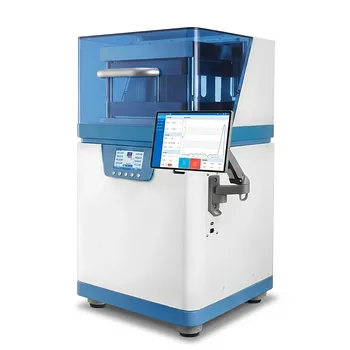
A laboratory hydraulic press is the critical instrument for transforming loose powders into dense, uniform pellets required for analytical accuracy. It applies high-tonnage pressure to eliminate internal voids and density gradients, creating a standardized medium for testing. This process is essential for ensuring that light or electrical signals can pass through the material without interference from air gaps or physical inconsistencies.
The primary role of a hydraulic press is to ensure sample homogeneity and density, effectively bridging the gap between raw powder and measurable data. By removing air and minimizing light scattering, it enables the high-resolution signal capture necessary for both optical spectroscopy and electrical characterization.
Standardizing Samples for Infrared Spectroscopy (FTIR)
Creating Transparent KBr Pellets
For infrared spectroscopy, the press is used to blend a small amount of sample with Potassium Bromide (KBr) powder. Under high pressure, this mixture flows and fuses into a semi-transparent disk that allows infrared radiation to pass through.
Maximizing Signal-to-Noise Ratio
By applying several tons of pressure, the press eliminates the air trapped between powder particles. This reduction in internal voids significantly minimizes light scattering, ensuring the spectrometer captures clear, high-resolution characteristic absorption peaks.
Quantifying Chemical Changes
The uniformity achieved by the press allows for precise measurements, such as the Carbonyl Index in plastics or imine double bond vibrations. This level of standardization is necessary to analyze whether physical encapsulation or chemical interactions have occurred within a matrix.
Optimizing Samples for Conductivity and Electrochemical Testing
Establishing Electrical Contact
In conductivity testing, the press compresses active materials into dense pellets, often as small as 4 mm in diameter. This physical molding process eliminates voids between particles, establishing the continuous electrical contact required for valid measurements.
Improving Impedance Accuracy
Dense pelletization is vital for Electrochemical Impedance Spectroscopy (EIS). A well-pressed sample ensures that the test accurately reflects the material’s true charge transfer resistance (Rct) rather than artifacts caused by poor particle-to-particle contact.
Ensuring Uniform Current Distribution
Uniform pressure eliminates density gradients across the sample surface. This homogeneity ensures that electrical current flows evenly through the pellet, preventing localized "hot spots" or resistance fluctuations that could skew data.
Understanding the Trade-offs and Pitfalls
Pressure-Induced Phase Changes
While high pressure is necessary for density, excessive force can inadvertently alter the crystalline structure of certain sensitive materials. It is critical to determine the minimum pressure required to achieve transparency or contact without compromising the sample's integrity.
Sample Contamination Risks
The stainless steel molds and die sets must be meticulously cleaned between uses. Any cross-contamination or moisture trapped during the pressing process can introduce "ghost peaks" in spectroscopy or alter the chemical resistance in conductivity tests.
Thickness Consistency
Varying the amount of powder or the pressure applied can lead to inconsistent pellet thickness. Because signal intensity is proportional to path length, inconsistent thickness makes it difficult to compare results across multiple samples quantitatively.
How to Apply This to Your Project
When utilizing a laboratory hydraulic press, your preparation strategy should align with your specific analytical goals to ensure the highest data quality.
- If your primary focus is Infrared Spectroscopy (FTIR): Prioritize the ratio of sample to KBr and apply sufficient pressure to achieve a glass-like transparency for maximum light transmittance.
- If your primary focus is Conductivity Testing (EIS): Focus on achieving maximum material density and flat parallel surfaces to ensure consistent electrical contact and accurate resistance readings.
- If your primary focus is X-ray Fluorescence (XRF): Utilize the press to create solid, flat-surfaced pellets that provide a consistent geometry for non-destructive elemental analysis.
Mastering the mechanics of sample pelletization ensures that your analytical results are a true reflection of the material properties rather than a byproduct of poor preparation.
Summary Table:
| Application | Role of Hydraulic Press | Key Analytical Benefit |
|---|---|---|
| FTIR Spectroscopy | Creates transparent KBr pellets | Minimizes light scattering; improves signal-to-noise ratio |
| Conductivity (EIS) | Compresses active materials | Eliminates voids; ensures consistent electrical contact |
| XRF Analysis | Produces flat-surfaced pellets | Provides consistent geometry for elemental analysis |
| General Lab Use | Removes internal air gaps | Ensures sample homogeneity and data reproducibility |
Elevate Your Analytical Precision with KINTEK
Don't let poor sample preparation compromise your research. KINTEK specializes in high-performance laboratory hydraulic presses (pellet, hot, and isostatic) designed to produce the flawless, high-density pellets required for accurate FTIR, EIS, and XRF analysis.
Beyond pelletization, we offer a comprehensive suite of laboratory solutions, including:
- Thermal Processing: Muffle, tube, vacuum, and CVD/PECVD furnaces.
- Sample Preparation: Crushing, milling, and sieving systems.
- Electrochemistry: Electrolytic cells, electrodes, and advanced battery research tools.
- Lab Essentials: High-pressure reactors, ULT freezers, and precision ceramics.
Ready to achieve superior consistency in your testing? Contact our experts today to find the perfect hydraulic press and consumables for your specific material needs.
References
- Qiulan Huang, Wei Chen. Sheet‐Isolated MoS<sub>2</sub> Used for Dispersing Pt Nanoparticles and its Application in Methanol Fuel Cells. DOI: 10.1002/chem.202302934
This article is also based on technical information from Kintek Solution Knowledge Base .
Related Products
- Laboratory Hydraulic Press Lab Pellet Press Machine for Glove Box
- Laboratory Hydraulic Press Split Electric Lab Pellet Press
- Fully Automatic Heated Hydraulic Lab Press for Materials Sintering and Sample Preparation
- Laboratory Hydraulic Press Lab Pellet Press for Button Battery
- Automatic Laboratory Hydraulic Press for XRF & KBR Pellet Press
People Also Ask
- What is the function of a laboratory hydraulic press in W-Cu composites? Control Porosity and Material Ratio
- What is the role of a laboratory hydraulic press in the initial stages of Li6PS5Cl preparation? Key to Green Pellets
- What role does a laboratory hydraulic press play in triboelectric testing? Achieve Precision Alloy Sample Prep
- How can a laboratory hydraulic press be applied to chitosan for wastewater treatment? Optimize Pores & Strength
- How do a precision laboratory hydraulic press and specialized molds contribute to the fabrication of spherical ceramic samples? Achieving High-Density Material Precision